Enhancing Community Based Economic Value through Local Material Utilization within the Value Chain of Hed Cone Noi (Coprinopsis cinerea) Mushroom Cultivation in Chiang Mai Province
DOI:
https://doi.org/10.34044/tferj.2026.10.1.6607Keywords:
Community-based value chain, grassroot economy, Hed-cone noiAbstract
Background and Objectives: Hed-cone noi (Coprinopsis cinerea) is a saprophytic, edible mushroom widely distributed in Thailand’s tropical forest, particularly in the dry evergreen forests, mixed deciduous forest, and deciduous dipterocarp forest where leaf litter accumulates on the soil surface and termite mounds are present. The species also proliferates on moist piles of organic residues such as rice straw, legume residues, and sugarcane bagasse in high humidity, particularly after Thailand’s rainy season. Hed-cone-noi is well established in cultivation, with strong prominence in Chiang Mai Province. As a biological resource Hed-cone-noi links natural ecosystem functions with local based production systems. Its capacity to utilize locally available organic materials enables integration into smallholder farming and valorization of agricultural waste. By prioritizing locally sourced substrates, the research aims to minimize external inputs across the value chain, thereby enhancing household incomes and promoting sustainable resource management in local Thai communities. The objectives aimed to investigate the utilization of local raw materials in the cultivation process of Hed-cone noi and to strengthen the community-based enterprise development. Then, knowledge can promote grassroot economic development and enhance income generation throughout the value chain in the target areas of Chiang Mai Province. All data collection was done during March 2024 to February 2025.
Methodology: This study employed a mixed-methods research design, integrating both qualitative and quantitative approaches, across three target areas in Chiang Mai Province, Thailand: the northern zone of Mae Taeng District, the eastern zone of Doi Saket District, and the southern zone of Saraphi District. The population samples involved two groups. The first group consisted of three local enterprise leaders (Local enterprises: LEs), each selected based on specific criteria: (i) leadership of a community enterprise, (ii) logistics suitable for Hed-cone-noi collection and distribution of, and (iii) possessing at least three years of experience in mushroom cultivation or related agribusiness experience. The second group included members of the three community enterprises (total n = 38). Using purposive sampling for sample population selecting, 12 members (four per site) participated in qualitative data collection in total, 15 participants (3 LEs and 12 members). Qualitative data were obtained through focus group discussions and analyzed through direct content analysis based on SWOT analysis. Then, the strengthens (S), weaknesses (W), opportunities (O), and threats (T) of community-based cultivation enterprises were received. Quantitative data were gathered over 12 months using structured recording forms to capture the value of raw materials used in fresh mushroom production. Data analysis employed descriptive statistics, including summation and ratio analysis, to compare the proportion of locally sourced materials with external input sourcing. A model learning and mentoring hub of the sustainable agriculture community enterprise in Ban Sop Faek, Mae Faek Mai Subdistrict, San Sai District facilitated knowledge transfer, appropriate technologies, and integrated production processes from inoculation and spawn production of substrate preparation and distribution to participating smallholders. The intervention aimed to transfer production techniques and technologies to emerging community-based entrepreneurs, thereby increasing local monetary circulation, reducing external inputs, and self-reliant agricultural development in Thailand.
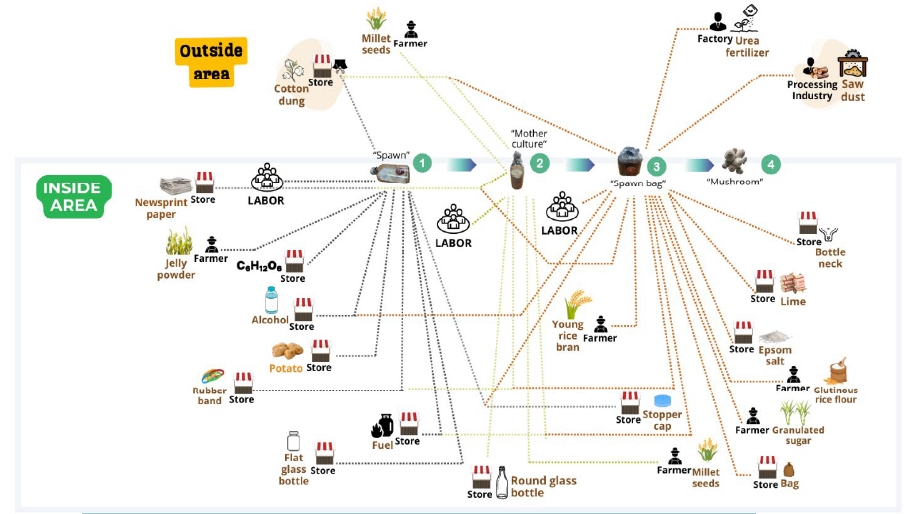
Main Results: The findings indicate that the establishment of three new community-based mushroom enterprises in Mae Ho Phra Subdistrict (Mae Taeng District), Samran Rat Subdistrict (Doi Saket District), and Nong Faek Subdistrict (Saraphi District), Chiang Mai Province, strengthened the Hed-cone-noi value chain by aligning supply with rising local demand and linking smallholder farmers to consumer markets and distribution networks. This enhanced value addition and monetary circulation at the grassroots level. Production capacity per enterprise was standardized: 38 inoculum bottles, 945 bottles of spawn, and 17,000 substrate blocks, which were subsequently distributed to a total of 750 cultivating households. The development of these enterprises resulted in a substantial increase in the utilization of locally sourced production inputs, with an annual value of 2,147,499.30 Thai Baht, compared to 1,042,091.95 Thai Baht for externally sourced inputs. This corresponds to a local to external input ratio of 67:33, highlighting the significant role of local resources in supporting fresh mushroom production systems. Spatial variation in local economies affected input sourcing regions with predominantly agricultural livelihoods relied more on local materials, while areas transitioning toward tourism-oriented economies depended more on external inputs. These patterns highlight the influence of socio-economic context on resource use strategies and the potential of localized production systems to bolster community resilience.
Conclusion: Strengthening newly established community-based enterprises that serve as critical nodes within agricultural value chains by primarily utilizing locally sourced materials from the community for the production process of Hed Cone Noi mushrooms can stimulate grassroots economic development. While both local and external inputs are mobilized, increasing the share of locally sourced resources materially enhances local monetary circulation and economic resilience. Contextual factors, especially land-use patterns and shifts in economic structure, meaningfully influence material availability and production costs. In regions shifting toward tourism or non-agricultural sectors, greater reliance on external inputs may diminish local value retention. Fostering localized enterprise networks and robust local input supply systems to boost material retention and economic multipliers. Expanding technology transfer in production and post-harvest management, improving market access, and strengthening inventory management and logistics. Scaling the community-based enterprises model to the regions by adapting to local resource endowments and socio-economic contexts, with ongoing monitoring of input sourcing, yield, and household income impacts.
Downloads
References
Assarroudi, A., F. H. Nabavi, M. R. Armat, A. Ebadi & M. Vaismoradi. 2018. Directed qualitative content analysis: the description and elaboration of its underpinning methods and data analysis process. Journal of Research in Nursing 23(1): 56–57. https://doi.org/10.1177/1744987117741667 DOI: https://doi.org/10.1177/1744987117741667
Innawong, B. 2023. A Management and Platform Development Plan to Enhance the Entrepreneurial Capacity of Local Enerprises, in Collaboration with Area-Based Researchers, Aiming to Create a Collaborative Local Enterprises Network and Achieve the Sustainable Economic Results. Research Report, the Thailand Science Research and Innovation Fund (TSRI) and Program Management Unit on Area Based Development (PMUA), Bangkok. (in Thai)
Brooks, K. S. & S. A. McDonald. 2018. Geographical factors and their impact on agricultural inputs: A case study of land use and resource allocation. Journal of Agricultural Economics 72(3): 457–468. https://doi.org/10.1016/j.agriec.2018.01.007
Bush, D. A. 1974. Autolysis of Coprinus comatus sporophores. Experientia 30(9): 984–985. https://doi.org/10.1007/BF01938959 DOI: https://doi.org/10.1007/BF01938959
Chantrasri, P. 2004. Cultivation of Inky Cap Mushrooms. Chiang Mai, Thailand: Institute for Science and Technology Research and Development, Chiang Mai University. (in Thai)
Chuatrakul, W. 2025. Creating a Center of Jobs Creation and Income Distribution to the local economy through the business of growing inky mushrooms. Research Report, the Thailand Science Research and Innovation Fund (TSRI) and Program Management Unit on Area Based Development (PMUA), Bangkok. (in Thai)
Danmake, K. 2013. Innovation Production of Coprinus Mushroom (Coprinus spp.) from Corn Crop Residues by Local Wisdom of Phayao Agriculturist. Phayao, Thailand: Department of Biotechnology, School of Agriculture and Natural Resources. University of Phayao. (in Thai)
Howell, A. 2015. ‘Indigenous’ innovation with heterogeneous risk and new firm survival in a transitioning Chinese economy. Research Policy 44(10): 1866–1876. DOI: https://doi.org/10.1016/j.respol.2015.06.012
Johansson, M., O. Sterner, H. Labischinski & T. Anke. 2001. Coprinol, a new antibiotic cuparane from a Coprinus species. Zeitschrift für Naturforschung C 56(1–2): 31–34. https://doi.org/10.1515/znc-2001-1-205 DOI: https://doi.org/10.1515/znc-2001-1-205
Kappchai, J. 2013. The role performance of village agricultural volunteers in Chiang Mai Province. M.Sc.thesis, School of Agricultural and Cooperatives. Sukhothai Thammathirat University, Bangkok, Thailand. (in Thai)
Kotha, R., Y. Zheng & G. George. 2011. Entry into new niches: The effects of firm age and the expansion of technological capabilities on innovative output and impact. Strategic Management Journal 32(9): 1011–1024. https://doi.org/10.1002/smj.915 DOI: https://doi.org/10.1002/smj.915
Lee, H. J. & S. Y. Kim. 2018. Agricultural resource allocation and input costs in different geographical regions. Regional Environmental Change 18(1): 123–134. https://doi.org/10.1007/s10113-018-1359-6
Limpichotipong, N. 2000. Effects of Temperature and Light on Growth and Deliquescent of Coprinus cinereus comatus var. ovatus (Schff. Ex Fr.). M.Sc. thesis, Faculty of Science. Chiang Mai University, Chiang Mai, Thailand (in Thai)
Liu, J. & F. Li. 2015. Environmental and climatic factors influencing agricultural resource use in different regions. Environmental Science & Policy 59: 1–8. https://doi.org/10.1016/j.envsci.2015.02.004 DOI: https://doi.org/10.1016/j.envsci.2015.02.004
Micheels, E. T. & J. F. Nolan. 2016. Examining the effects of absorptive capacity and social capital on the adoption of agricultural innovations: A Canadian Prairie case study. Agricultural Systems 145: 127– 138. https://doi.org/10.1016/j.agsy.2016.03.010 DOI: https://doi.org/10.1016/j.agsy.2016.03.010
Office of the Council of State. 2005. Community Enterprise Promotion Act, B.E. 2548 (2005). Thai government gazette series vol. 112/part 6a./page 1/18 January 2005. (in Thai)
Osathaphant, P. 2005. Coprinus mushroom cultivation in Thailand. Mushroom Growers’ Handbook 2 Part II Mushroom for better life: 199–207. (in Thai)
Redhead, S. A., R. Vilgalys, J. M. Moncalvo, J. Johnson & J. S. Hopple. 2001. Coprinus Pers. and the disposition of Coprinus species sensu lato. Taxon 50(1): 203–241. https://doi.org/10.2307/1224525 DOI: https://doi.org/10.2307/1224525
Smith, J. D. & R. Matthews. 2016. The role of geographical diversity in agricultural input costs. Agricultural Systems 143: 62–71. https://doi.org/10.1016/j.agsy.2016.02.002 DOI: https://doi.org/10.1016/j.agsy.2016.02.002
Soithong, K. 1994. Mushrooms and Large Fungi in Thailand. Bangkok, Thailand: Department of Pest Management Technology, School of Agricultural Technology. King Mongkut’s Institute of Technology Ladkrabang. (in Thai)
Tapingkae, T. 1996. Kan Phao Het Thua [Cultivation of Ink Cap Mushroom]. Het Thai 2539. Bangkok. (in Thai)
Trade Policy and Strategy Office, Ministry of Commerce. 2024. The Development of Community Enterprises’ to Uplift the Grassroots Economy. Available source: https://km.fti.or.th (in Thai)
Wang, R., Y. Wei, Y. Zhu, B. Huang & X. Lei. 2025. Bibliometric Insights into Riboflavin's Impact on Sperm Quality and Fertility Research. Journal of Reproductive Health. Endocrinol Metab Syndr 14: 442. https://doi.org/10.35248/2161-1017.25.14.442
Rattanapornwong, W. 2006. Community Enterprise for Enhancing Poverty Solving Process. Bangkok. (in Thai)
Vanhaverbeke, W., H. Chesbrough & J. West. 2014. Surfing the new wave of open innovation research. New frontiers in open innovation 281: 287–288. DOI: https://doi.org/10.1093/acprof:oso/9780199682461.003.0015
Yli-Renko, H., E. Autio & H. J. Sapienza. 2001. Social capital, knowledge acquisition, and knowledge exploitation in young technology-based firms. Strategic Management Journal 22(6–7): 587–613. DOI: https://doi.org/10.1002/smj.183
Yan, M., Y. Chen, M. Li, J. Wu, Z. Fang, J. Wang & J. Liu. 2022. Coprinopsis cinerea Galectin CGL1 Induces Apoptosis and Inhibits Tumor Growth in Colorectal Cancer Cells. International journal of molecular sciences 24(1): 235. https://doi.org/10.3390/ijms24010235 DOI: https://doi.org/10.3390/ijms24010235
Zhang, Y. & X. Liu. 2017. Land use change and its economic impact on agricultural production: A case study in eastern China. Environmental and Resource Economics 68(4): 801–821. https://doi.org/10.1007/s10640-017-0136-6
Downloads
Published
Issue
Section





.png)