
Relationship between Measured Buttressed Stem Girth and Girth Derived from Actual Basal Area in Lagerstroemia floribunda Jack in Eastern Thailand
DOI:
https://doi.org/10.34044/tferj.2026.10.1.6608Keywords:
Buttress correction, forest mensuration, girth–area relationshipAbstract
Background and Objectives: Accurate measurement of stem size is a fundamental component of forest mensuration, as it directly underpins the estimation of basal area, timber volume, aboveground biomass, and carbon stocks in forest ecosystems. In tropical forests, however, standard protocols for measuring stem girth or diameter at breast height (DBH) are frequently complicated by the presence of buttresses. These structural adaptations alter stem geometry, causing girth measurements taken at the conventional height of 1.30 m above ground to deviate from the idealized cylindrical form. Consequently, measurements that include buttresses tend to overestimate stem girth and propagate systematic bias into subsequent calculations of forest structure and ecosystem services. To avoid this issue, conventional practice recommends measuring stem size above the buttress. Nevertheless, this alternative approach introduces a different form of bias, as stem diameter typically decreases with height due to tapering. In many tropical species, such as Lagerstroemia floribunda, buttresses may extend continuously along much of the lower stem, making it difficult or impractical to define a consistent measurement position. These challenges are particularly critical in permanent plots, where monitored must be conducted at the same position. Despite the widespread recognition of this issue, practical and standardized methods for correcting buttressed stem measurements remain limited. Therefore, this study aimed to (1) develop a regression model relating measured buttressed girth to girth derived from the actual basal area of L. floribunda, (2) evaluate the accuracy of the developed model, and (3) assess its applicability to other tree species with similar buttress morphology.
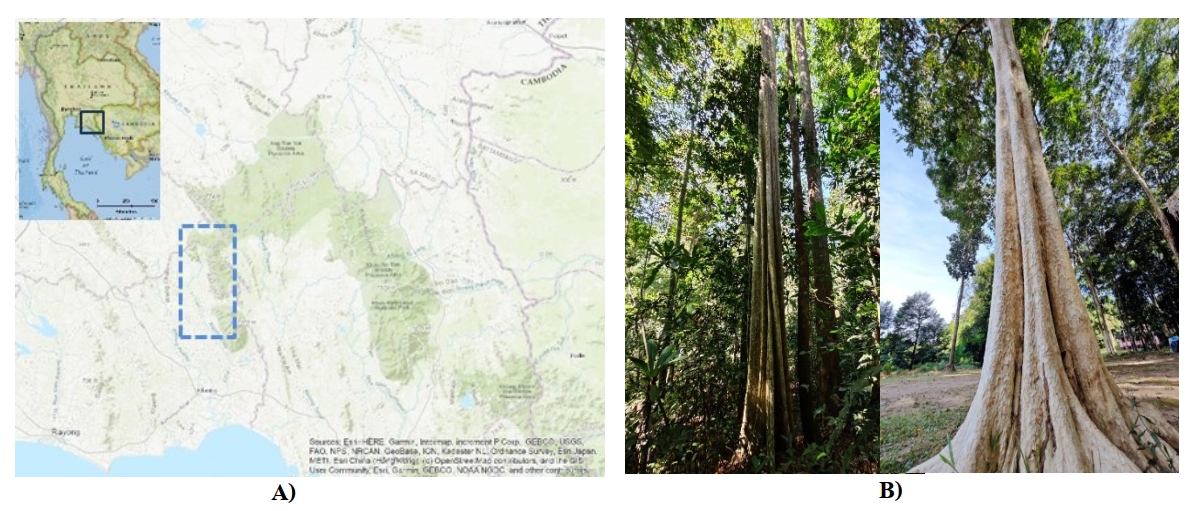
Methodology: The study was conducted in lowland tropical forest areas in eastern Thailand, where buttressed tree species are common. L. floribunda was selected as the focal species due to its well-developed ridge-type buttresses that often extend along the lower stem. A total of 50 trees were sampled using a size-class stratified sampling design to ensure representation across a wide range of girth classes. For each tree, stem girth including buttresses was measured at 1.30 m above ground. At the same height, the actual cross-sectional shape of the stem was captured by tracing the outer bark surface, including buttress contours, using a flexible aluminum strip to conform to irregular surfaces. The traced shapes were transferred onto reference sheets, scanned, and digitized in a geographic information system (GIS). The true cross-sectional area was then calculated from the digitized polygons. Based on the calculated area, an equivalent circular girth was derived mathematically to represent the girth corresponding to the actual basal area. The relationship between measured buttressed girth (denoted as GBH_mb, cm) and girth derived from actual basal area (denoted as GBH_pred, cm) was analyzed using simple linear regression based on the least squares method. Model performance was evaluated using the coefficient of determination (R²) and the statistical significance of regression parameters. To assess the robustness and applicability of the model, it was further validated using independent datasets of L. floribunda and additional buttressed species, including Markhamia stipulata var. stipulata and Irvingia malayana. Residual analysis was performed to evaluate systematic bias across girth classes and to examine model behavior at the lower and upper extremes of observed data.
Main Results: A strong linear relationship was observed between measured buttressed girth and girth derived from the actual basal area for L. floribunda, with the regression model explaining a high proportion of variance (R² = 0.989, p < .001). The fitted equation was: GBH_pred = 3.266 + 0.874 × GBH_mb. The regression slope of less than unity indicates that measurements buttress systematically overestimate true girth, reflecting the lateral expansion of buttress structures rather than proportional increases in cross-sectional area. Validation using independent datasets showed no significant difference between predicted and observed values, with residuals symmetrically distributed around zero, indicating the absence of systematic bias within the calibrated range. When applied to other species with similar buttress morphology, the model maintained low mean prediction errors and showed consistent performance. However, when applied to species with distinctly different buttress morphologies, prediction errors increased substantially, highlighting the influence of stem architecture on model applicability. Residual analysis across girth classes revealed no consistent trend of bias, supporting the use of a single correction model across the observed size range. Nevertheless, for smaller trees with measured buttressed girth values below approximately 26 cm, the model tended to slightly overpredict girth derived from actual basal area. This pattern reflects the influence of positive intercept of the regression equation and the limited development in smaller trees.
Conclusion: This study demonstrates that stem girth measured including buttresses at breast height can be effectively corrected to approximate true cross-sectional girth using an empirical regression approach. The proposed model provides a practical and field-applicable alternative to conventional measurement above buttresses, enabling consistent and repeatable measurements at a fixed height. This is particularly advantageous for long-term monitoring in permanent sample plots, where measurement consistency is essential. The model performs reliably within the calibrated girth range and for species with similar buttress morphology. However, caution is required when applying the model to small trees (GBH < 26 cm) or to species with different buttress forms. Overall, the approach reduces systematic measurement bias and enhances the accuracy and consistency of basal area, biomass, and carbon stock estimation in tropical forest inventories. Further research incorporating additional species and environmental conditions would help improve the general applicability of the model. This approach provides a standardized and practical solution for improving the accuracy of forest inventory and carbon stock estimation in tropical forests affected by buttressed tree forms.
Downloads
References
Brown, S. 1997. Estimating biomass and biomass change of tropical forests: A primer (FAO Forestry Paper No. 134). Food and Agriculture Organization. https://www.fao.org/3/w4095e/w4095e00.htm
Chave, J., Andalo, C., Brown, S., Cairns, M. A., Chambers, J. Q., Eamus, D., Fölster, H., Fromard, F., Higuchi, N., Kira, T., Lescure, J.-P., Nelson, B. W., Ogawa, H., Puig, H., Riéra, B., & Yamakura, T. 2005. Tree allometry and improved estimation of carbon stocks and balance in tropical forests. Oecologia 145: 87–99. https://doi.org/10.1007/s00442-005-0100-x DOI: https://doi.org/10.1007/s00442-005-0100-x
Cushman, K. C., Muller-Landau, H. C., Condit, R. S., & Hubbell, S. P. 2014. Improving estimates of biomass change in buttressed trees using tree taper models. Methods in Ecology and Evolution 5(6), 573–582. https://doi.org/10.1111/2041-210X.12184 DOI: https://doi.org/10.1111/2041-210X.12187
Henry, M., Picard, N., Trotta, C., Manlay, R. J., Valentini, R., Bernoux, M., & Saint-André, L. 2011. Estimating tree biomass of sub-Saharan African forests: a review of available allometric equations. Silva Fennica 45(3B): 477–569. https://doi.org/10.14214/sf.38 DOI: https://doi.org/10.14214/sf.38
Kershaw, J. A., Ducey, M. J., Beers, T. W., & Husch, B. 2017. Forest Mensuration (5th ed.). John Wiley & Sons. DOI: https://doi.org/10.1002/9781118902028
Ngomanda, A., Mavouroulou, Q. M., Obiang, N. L. E., Lebamba, J., Mbatchi, B., Gomat, H., Mankou, G. S., Loumeto, J., Midoko Iponga, D., Kossi, D., & Picard, N. 2012. Derivation of diameter measurements for buttressed trees: An example from Gabon. Journal of Tropical Ecology 28(3): 299–302. https://doi.org/10.1017/S0266467412000144 DOI: https://doi.org/10.1017/S0266467412000144
Nölke, N., Fehrmann, L., Vasile, C. R., Groeneveld, J., Kleinn, C., & Leuschner, C. 2015. On the geometry and allometry of big-buttressed trees: A challenge for forest monitoring. iForest – Biogeosciences and Forestry 8: 574–581. https://doi.org/10.3832/ifor1449-007 DOI: https://doi.org/10.3832/ifor1449-007
Peters, C. M. 1996. The ecology and management of non-timber forest resources. World Bank. DOI: https://doi.org/10.1596/0-8213-3619-3
Picard, N., Saint-André, L., & Henry, M. 2012. Manual for building tree volume and biomass allometric equations: from field measurement to prediction. Food and Agriculture Organization and CIRAD.
Richards, P. W. 1996. The tropical rainforest: An ecological study (2nd ed.). Cambridge University Press.
Royal Institute. 2011. Dictionary of the Royal Institute B.E. 2554. Retrieved from https://dictionary.orst.go.th (in Thai)
Warner, A., Jamroenprucksa, M., & Puangchit, L. 2017. Buttressing impact on diameter estimation in plantation teak (Tectona grandis L.f.) sample trees in northern Thailand. Agriculture and Natural Resources 51(6): 520–525. https://doi.org/10.1016/j.anres.2017.12.003 DOI: https://doi.org/10.1016/j.anres.2018.01.001
Watcharakitti, S. 1982. Forest resource inventory. Faculty of Forestry, Kasetsart University, Thailand. (in Thai)
Whitmore, T. C. 1998. An introduction to tropical rain forests (2nd ed.). Oxford University Press. DOI: https://doi.org/10.1093/oso/9780198501480.001.0001
Hu, Z., Tang, Y., Deng, X., & Chen, M. 2013. Buttress trees in a 20-hectare tropical dipterocarp rainforest in Xishuangbanna, SW China. Journal of Plant Ecology 6: 187–192. https://doi.org/10.1093/jpe/rts018 DOI: https://doi.org/10.1093/jpe/rts031
Downloads
Published
Issue
Section






.png)