
Population Density and Habitat Suitability of Gaur (Bos gaurus H. Smith) in the Phu Fa Non-Hunting Area, Nan Province
DOI:
https://doi.org/10.34044/tferj.2026.10.1.6614Keywords:
Habitat suitability, camera trap, population density, Random Encounter Model (REM)Abstract
Background and Objectives: Spatial ecology of wildlife provides a fundamental basis for conservation planning and sustainable natural resource management. This is particularly important for gaur (Bos gaurus H. Smith), the largest extant wild bovine, which requires extensive home ranges, exhibits low reproductive rates, and is highly sensitive to environmental changes. Currently, gaur populations are facing increasing pressure from habitat loss and fragmentation driven by human activities, as well as limitations in forest connectivity. These factors contribute to population decline and elevate the risk of habitat isolation in the long term. Although protected areas in Thailand have been progressively expanded, information on population density and spatial use patterns of gaur remains limited, particularly in mountainous forest ecosystems in northern Thailand, where terrain complexity and inaccessibility constrain field studies. Phu Fa Non-Hunting Area represents an ecologically significant forest landscape for wildlife, especially gaur, comprising relatively intact montane evergreen and dry evergreen forests. The area also has high potential as an ecological corridor facilitating movement of large mammals between Thailand and the Lao People’s Democratic Republic. However, current knowledge regarding population status and environmental determinants of habitat suitability in this area remains insufficient to support effective spatial management. Therefore, this study aims to estimate the population density of gaur and to analyze environmental factors influencing habitat selection. The findings are expected to provide baseline information for conservation planning, habitat restoration, and long-term population monitoring.
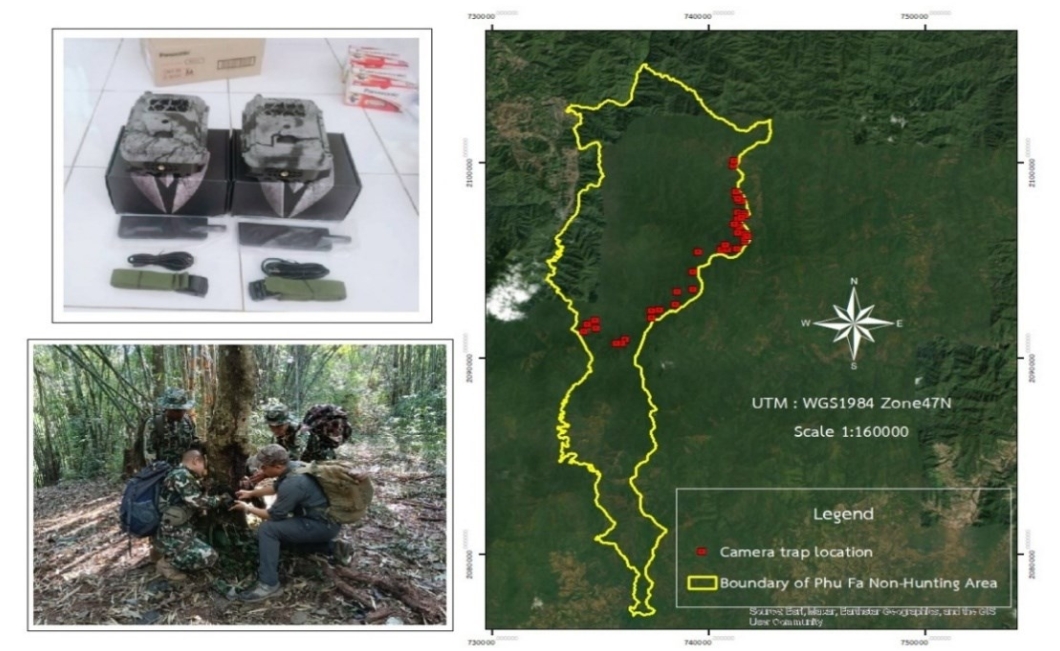
Material and method: Field data collection was conducted from November 2024 to October 2025. A total of 10 camera trap stations were systematically deployed across the study area to record the occurrence of gaur. Camera locations were selected based on areas with a high likelihood of gaur presence, including wildlife trails, water sources, and natural salt licks. In addition, signs of wildlife were recorded during patrol surveys, including direct sightings, vocalizations, footprints, dung, and feeding evidence, along with their geographic coordinates. All collected data were processed for statistical and spatial analyses. Population abundance was assessed using the Relative Abundance Index (RAI), calculated as the detection rate per number of trap nights. Population density was estimated using the Random Encounter Model (REM), which does not require individual identification and is particularly suitable for large ungulates lacking distinctive individual markings. Habitat suitability was evaluated using the Maximum Entropy (MaxEnt) model, which has been widely recognized for its high performance in predicting species distribution from presence-only data. A total of seven environmental variables were included in the analysis, comprising both physical and biological factors: elevation above mean sea level, slope, land use, distance to water sources, distance to roads, distance to villages, and distance to ranger stations. Model performance was assessed using the Area Under the Receiver Operating Characteristic Curve (AUC) to evaluate the model’s ability to discriminate between suitable and unsuitable habitats.
Results and discussion: A total sampling effort of 3,650 trap nights resulted in 27 independent detections of gaur, yielding a Relative Abundance Index (RAI) of 0.74%, indicating a relatively low detection rate. However, population density estimated using the REM was 19.6 individuals/km², suggesting that the study area still has the capacity to support a viable gaur population. The spatial distribution of gaur was uneven, with individuals tending to utilize specific areas associated with key resources, such as water sources, foraging grounds, and refuge sites. Habitat suitability analysis using the MaxEnt model demonstrated excellent model performance (AUC = 0.987). Approximately 35 km², representing 29.41% of the total study area (~119 km²), was classified as suitable habitat for gaur. Highly suitable areas were predominantly distributed within montane evergreen and dry evergreen forests, which provide favorable conditions for gaur survival. Permutation importance analysis indicated that distance to water sources, distance to ranger stations, and distance to villages were the most influential variables determining gaur occurrence. In contrast, percent contribution values highlighted the importance of both physical and biological factors, particularly elevation, land use (dry evergreen and montane evergreen forests), and distance to water sources, in shaping habitat suitability. Highly suitable habitats were primarily concentrated in high-elevation mountainous areas (1,200–1,600 m above mean sea level), characterized by a mosaic of ridge-top grasslands interspersed within montane and dry evergreen forests. These habitat features likely enhance resource availability, provide suitable shelter, and facilitate avoidance of potential threats. Although anthropogenic disturbance factors, such as roads and human settlements, had relatively lower contributions, they still played a role in constraining the spatial distribution of gaur within the study area.
Conclusion: The results indicate that although the population density of gaur in the study area is relatively low, the presence of suitable habitat covering approximately one-third of the total area reflects the potential of the forest landscape to support population persistence and future expansion. These findings provide important implications for management interventions, including the improvement of water sources, enhancement of forage availability, and maintenance of habitat connectivity to reduce the risk of population isolation. Furthermore, the establishment of baseline data on population density and habitat suitability serves as a critical tool for long-term monitoring of population dynamics and for evaluating the effectiveness of conservation measures. With appropriate management, the study area has the potential to function as a core habitat and a source population, contributing to regional population stability. This, in turn, would strengthen forest ecosystem integrity and support the sustainable conservation of wildlife in northern Thailand over the long term.
Downloads
References
Ahrestani, F. S. & H. H. T. Prins. 2011. Age and sex determination of gaur Bos gaurus (Bovidae). Mammalia 75: 151–155. https://www.degruyterbrill.com/document/doi/10.1515/mamm.2010.078 DOI: https://doi.org/10.1515/mamm.2010.078
Department of National Parks, Wildlife and Plant Conservation. 2017. Thailand wildlife conservation master plan (2017–2036). Bangkok, Thailand: DNP. (in Thai)
Department of National Parks, Wildlife and Plant Conservation. 2019. Wildlife Preservation and Protection Act B.E. 2019. Bangkok, Thailand.
Department of National Parks, Wildlife and Plant Conservation. 2023. Conservation and protection plan for Phu Fa Non-Hunting Area B.E. (2023-2032). Wildlife Conservation Division, Protected Areas Regional Office 13 (Phrae). (in Thai)
Duangchantrasiri, S. 2008. Abundance of Tiger (Panthera tigris (Linnaeus)) and its principal prey in Huai Kha Khaeng Wildlife Sanctuary, Uthai Thani Province. M.Sc. thesis, Faculty of Forestry, Kasetsart University. Bangkok, Thailand. (in Thai)
Duckworth, J. W., K. Sankar, A. C. Williams, N. S. Kumar & R. J. Timmins. 2016. Bos gaurus. The IUCN Red List of Threatened Species 2016, e.T2891A46363646. https://doi.org/10.2305/IUCN.UK.2016-2.RLTS.T2891A46363646.en DOI: https://doi.org/10.2305/IUCN.UK.2016-2.RLTS.T2891A46363646.en
Elith, J., C. H. Graham, R. P. Anderson, M. Dudík, S. Ferrier, A. Guisan, R. J. Hijmans, F. Huettmann, J. R. Leathwick, A. Lehmann, J. Li, L. G. Lohmann, B. A. Loiselle, G. Manion, C. Moritz, M. Nakamura, Y. Nakazawa, J. M. Overton, A. T. Peterson, S. J. Phillips, K. Richardson, R. Scachetti-Pereira, R. E. Schapire, J. Soberón, S. Williams, M. S. Wisz & N. E. Zimmermann. 2006. Novel methods improve prediction of species’ distributions from occurrence data. Ecography 29(2): 129–151. https://doi.org/10.1111/j.2006.0906-7590.04596.x DOI: https://doi.org/10.1111/j.2006.0906-7590.04596.x
Fawcett, T. 2006. An introduction to ROC analysis. Pattern Recognition Letters 27(8): 861–874. https://doi.org/10.1016/j.patrec.2005.10.010 DOI: https://doi.org/10.1016/j.patrec.2005.10.010
Haddad, N. M., L. A. Brudvig, J. Clobert, K. F. Davies, A. Gonzalez, R. D. Holt, T. E. Lovejoy, J. O. Sexton, M. P. Austin, C. D. Collins, W. M. Cook, E. I. Damschen, R. M. Ewers, B. L. Foster, C. N. Jenkins, A. J. King, W. F. Laurance, D. J. Levey, C. R. Margules, B. A. Melbourne, A. O. Nicholls, J. L. Orrock, D.-X. Song & J. R. Townshend. 2015. Habitat fragmentation and its lasting impact on Earth’s ecosystems. Science Advances 1(2): e1500052. https://doi.org/10.1126/sciadv.1500052 DOI: https://doi.org/10.1126/sciadv.1500052
Hice, C. L. & P. M. Velazco. 2013. Relative effectiveness of several bait and trap types for assessing small mammal communities in Neotropical rainforest. Occasional Papers, Museum of Texas Tech University 316: 1–15.
Hosmer, D. W., Jr., S. Lemeshow & R. X. Sturdivant. 2013. Applied logistic regression. 3rd ed. Wiley. DOI: https://doi.org/10.1002/9781118548387
Laichanthuek, P., R. Sukmasuang & P. Duengkae. 2017. Population and habitat use of gaur (Bos gaurus) in Khao Phaeng Ma Non-Hunting Area, Nakhon Ratchasima Province. Thai Journal of Wildlife 24: 83–95. (in Thai)
Nguyen, A., J. Hardcastle & B. M. Rawson. 2018. Modeling the distribution of the Endangered Saola (Pseudoryx nghetinhensis) to prioritize conservation efforts in the Annamite Mountains. Biological Conservation 221: 148-159. https://doi.org/10.1016/j.biocon.2018.03.003 DOI: https://doi.org/10.1016/j.biocon.2018.03.003
O’Brien, T. G., M. F. Kinnaird & H. T. Wibisono. 2003. Crouching tigers, hidden prey: Sumatran tiger and prey populations in a tropical forest landscape. Animal Conservation 6(2): 131–139. https://doi.org/10.1017/S1367943003003172 DOI: https://doi.org/10.1017/S1367943003003172
Phillips, S. J., R. P. Anderson & R. E. Schapire. 2006. Maximum entropy modeling of species geographic distributions. Ecological Modelling 190(3): 231-259. https://doi.org/10.1016/j.ecolmodel.2005.03.026 DOI: https://doi.org/10.1016/j.ecolmodel.2005.03.026
Phumanee, W., R. Steinmetz & W. Chutipong. 2020. Estimating the density of a low-visibility ungulate, the Mainland Serow (Capricornis sumatraensis), using camera traps and Random Encounter Models. Mammal Study 45(4): 285-297. https://doi.org/10.3106/ms2019-0091
Prasopsin, S., N. Bhumpakphan & R. Chairat. 2013. Diversity of food plants and feeding selection of gaur (Bos gaurus laosiensis) in the area of Khlong Pla Kang, Khao Yai National Park, Nakhon Ratchasima Province. Thai Journal of Forestry 32(2): 1–13. (in Thai)
Prayoon, U., W. Suksavate, A. Chaiyes, P. Paansri, B. Siriaroonrat, Y. Utara, W. Tipkantha, S. Baicharoen, W. Jairak, E. Kaewkhunjob, C. Chaisonkhram, U. Maikaew, G. Ieamsaard, S. Sripiboon, S. Winitpornsawan, S. Thunhikorn, N. Wanna, S. Sriracha, T. Sornsa, R. Chokcharoen, A. Buanual, S. Pattanakiat, K. Srikulnath & P. Duengkae. 2024. Home range and habitat utilization of gaur (Bos gaurus) in transition zone between protected forest and human-dominated landscape, eastern Thailand. Global Ecology and Conservation 50: e02811. https://doi.org/10.1016/j.gecco.2024.e02811 DOI: https://doi.org/10.1016/j.gecco.2024.e02811
Prayoon, U., W. Suksavate, A. Chaiyes, S. Winitpornsawan, S. Tunhikorn, K. Faengbubpha, C. Angkaew, S. Pattanakiat & P. Duengkae. 2021. Past, present and future habitat suitable for gaur (Bos gaurus) in Thailand. Agriculture and Natural Resources 55(5): 743–756. https://doi.org/10.34044/j.anres.2021.55.5.05 DOI: https://doi.org/10.34044/j.anres.2021.55.5.05
Royal Forest Department (RFD). (2019). Forest cover of Thailand year 2019. Bangkok, Thailand.
Rowcliffe, J. M., J. Field, S. T. Turvey & C. Carbone. 2008. Estimating animal density using camera traps without the need for individual recognition. Journal of Applied Ecology 45(4): 1228–1236. https://doi.org/10.1111/j.1365-2664.2008.01473.x DOI: https://doi.org/10.1111/j.1365-2664.2008.01473.x
Schaller, G. B. 1967. The deer and the tiger: A study of wildlife in India. University of Chicago Press.
Supattra, P. 2012. Ecology and distribution of gaur (Bos gaurus) in Khlong Plakang area, Khao Yai National Park. Master thesis. Kasetsart University, Thailand.
Swets, J. A. 1988. Measuring the accuracy of diagnostic systems. Science 240(4857): 1285–1293. https://doi.org/10.1126/science.3287615 DOI: https://doi.org/10.1126/science.3287615
Trisurat, Y., B. Kanchanasaka & H. Kreft. 2014. Assessing potential effects of land use and climate change on mammal distributions in northern Thailand. Wildlife Research 41(6): 522–536. https://doi.org/10.1071/WR14171 DOI: https://doi.org/10.1071/WR14171
Trisurat, Y. & A. G. Toxopeus. 2011. Modeling species distribution. pp. 171-197. In: Trisurat, Y., R. P. Shrestha & R. Alkemade (eds.). Modeling Species Distribution. IGI Global, Hershey. DOI: https://doi.org/10.4018/978-1-60960-619-0.ch009
Downloads
Published
Issue
Section






.png)