Spatial Modeling and Environmental Factors Influencing Seasonal Habitat Use of Wild Elephants (Elephas maximus) in Thung Salaeng Luang National Park, Phitsanulok Province
DOI:
https://doi.org/10.34044/tferj.2026.10.1.6618Keywords:
Habitat suitability, Maximum Entropy model, Thung Salaeng Luang National ParkAbstract
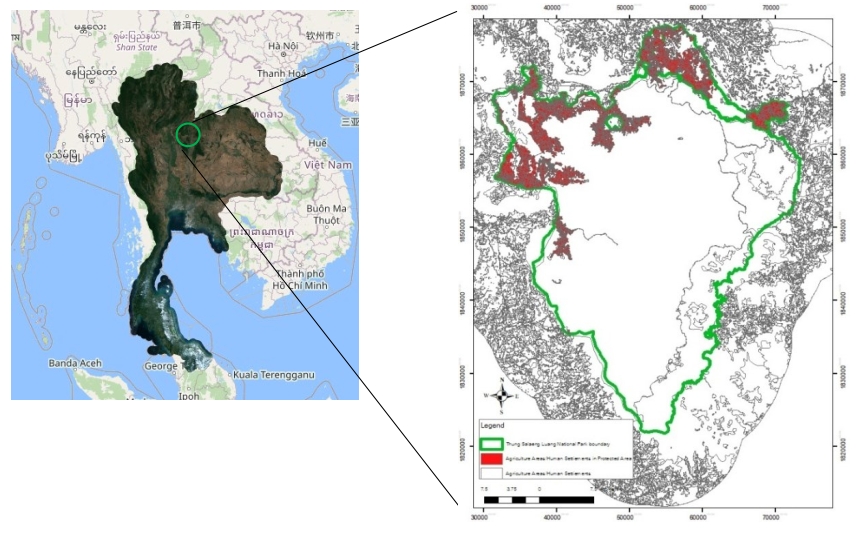
Background and Objectives: The Asian elephant (Elephas maximus) is classified as an umbrella species that plays a critical role in forest ecosystem conservation. Thung Salaeng Luang National Park (1,262.40 km²), located within the Phu Miang–Phu Thong Forest Complex, represents a key habitat for wild elephants. However, habitat fragmentation resulting from the expansion of human settlements and agricultural areas has compelled elephants to increasingly utilize agricultural lands as pseudo-habitats, elevating the risk of human-elephant conflict. This study aimed to analyze environmental factors influencing seasonal habitat selection and estimate home range size of wild elephants in Thung Salaeng Luang National Park, with the goal of informing wildlife management and conflict mitigation strategies.
Methodology: A total of 650 wild elephant occurrence records – comprising direct sightings, dung deposits, footprints, and rubbing marks – were collected from qualitative SMART patrol data between 2018 and 2024. Records were partitioned into dry season (November–April) and wet season (May–October) datasets. Maximum Entropy (MaxEnt) modeling was applied using 11 environmental variables across three categories: physical, biological, and threat factors, on a 100×100 m grid. Data were randomly split into 75% training and 25% testing sets, with five replications, and model performance was evaluated using the Area Under the Curve (AUC).
Results: Both seasonal models demonstrated good predictive performance (dry season AUC = 0.764; wet season AUC = 0.858). During the dry season, the most influential factors were distance to evergreen forest (46.10%) and distance to grassland (12.70%), with elephants exhibiting a broad distribution across the park and a home range of 456.92 km². During the wet season, distance to dry evergreen forest (21.70%) and distance to salt licks (21.00%) were the primary determinants, with elephants showing a more clustered distribution in the central and southern areas and a reduced home range of 173.03 km². The difference of 283.89 km² between seasons reflects marked behavioral plasticity in response to seasonal resource availability. Elephants showed stronger avoidance of human settlements, agricultural areas, roads, and other threat indicators during the dry season. However, during the late wet season when crops reached maturity, some elephant groups moved toward agricultural lands in the northern and western zones where communities reside and cultivate within the park, increasing the likelihood of human-elephant encounters.
Conclusion: Seasonal variation in wild elephant habitat selection was clearly evident, with biological factors as primary determinants and anthropogenic factors influencing avoidance or approach behavior depending on the season. These findings provide a scientific basis for targeted management interventions, including the establishment of buffer zones, systematic monitoring of high-risk conflict areas, and seasonal management of food and water resources within the park, to effectively mitigate human-elephant conflict and promote balanced conservation of wild elephants and their habitats.
Downloads
References
Anoop, N. R., J. Krishnaswamy, N. Kelkar, M. Bunyan & T. Ganesh. 2023. Factors determining the seasonal habitat use of Asian elephants in the Western Ghats of India. The Journal of Wildlife Management 87(8): e22477. https://doi.org/10.1002/jwmg.22477 DOI: https://doi.org/10.1002/jwmg.22477
Amorntiyangkul, P., A. Pattanavibool, W. Ochakul, W. Chinnawong, S. Klanprasert, C. Aungkeaw, P. Duengkae & W. Suksavate. 2022. Dynamic occupancy of wild Asian elephant: a case study based on the SMART database from the Western Forest Complex in Thailand. Environmental and Natural Resources Journal 20(3): 310-322. https://doi.org/10.32526/ennrj/20/202200005 DOI: https://doi.org/10.32526/ennrj/20/202200005
Baskaran, N., G. Kannan, U. Anbarasan, A. Thapa & R. Sukumar. 2013. A landscape-level assessment of Asian elephant habitat, its population and elephant–human conflict in the Anamalai hill ranges of southern Western Ghats, India. Mammalian Biology 78: 470–481. https://doi.org/10.1016/j.mambio.2013.04.007 DOI: https://doi.org/10.1016/j.mambio.2013.04.007
Baskaran, N., R. Kanakasabai & A.A. Desai. 2018. Ranging and spacing behaviour of Asian elephant (Elephas maximus Linnaeus) in the tropical forests of southern India. In C. Sivaperuman & K. Venkataraman (Eds.), Indian Hotspots: Vertebrate Faunal Diversity, Conservation and Management 1: 295–315. Springer. https://doi.org/10.1007/978-981-10-6605-4_15 DOI: https://doi.org/10.1007/978-981-10-6605-4_15
Berger, J. 1997. Population constraints associated with the use of black rhinos as an umbrella species for desert herbivores. Conservation Biology 11: 69–78. https://doi.org/10.1046/j.1523-1739.1997.95481.x DOI: https://doi.org/10.1046/j.1523-1739.1997.95481.x
Campos-Arceiz, A., A.R. Larrinaga, U.R. Weerasinghe, S. Takatsuki, J. Pastorini, P. Leimgruber, P. Fernando & L. Santamaría. 2008. Behavior rather than diet mediates seasonal differences in seed dispersal by Asian elephants. Ecology 89(10): 2684–2691. https://doi.org/10.1890/07-1573.1 DOI: https://doi.org/10.1890/07-1573.1
Chan, A. N., G. Wittemyer, J. McEvoy, A. C. Williams, N. Cox, P. Soe, M. Grindley, N. M. Shwe, A. M. Chit, Z. M. Oo & P. Leimgruber. 2022. Landscape characteristics influence ranging behavior of Asian elephants at the human-wildlands interface in Myanmar. Movement Ecology 10: 6. https://doi.org/10.1186/s40462-022-00304-x DOI: https://doi.org/10.1186/s40462-022-00304-x
Coverdale, T. C., T. R. Kartzinel, K. L. Grabowski, R. K. Shriver, A. A. Hassan, J. R. Goheen, T. M. Palmer & R. M. Pringle. 2016. Elephants in the understory: opposing direct and indirect effects of consumption and ecosystem engineering. Ecology 97: 3219-3230. https://doi.org/10.1002/ecy.1557 DOI: https://doi.org/10.1002/ecy.1557
Chaiyarat, R., S. Kanthachompoo, N. Thongthip & M. Yuttitham. 2021. Characteristics of general soils, natural saltlicks and artificial saltlicks for wild Asian elephants (Elephas maximus) conservation in the western forests of Thailand. Research Square (Preprint). https://doi.org/10.21203/rs.3.rs-389573/v1 DOI: https://doi.org/10.21203/rs.3.rs-389573/v1
Chaiyarat, R., M. Wettasin, N. Youngpoy & N. Cheachean. 2023. Use of human dominated landscape as connectivity corridors among fragmented habitats for wild Asian elephants (Elephas maximus) in the eastern part of Thailand. Diversity 15(1): 1006. https://doi.org/10.3390/d15010006 DOI: https://doi.org/10.3390/d15010006
Chaiyarat, R., S. Kanthachompoo, N. Thongtip & M. Yuttitham. 2024. Assessment of nutrients in natural saltlicks, artificial saltlicks, and general soils used by wild Asian elephants (Elephas maximus) in the western forests of Thailand. Resources 13(1): 6. https://doi.org/10.3390/resources13010006 DOI: https://doi.org/10.3390/resources13010006
Delany, M. J. & D. C. C. Happold. 1979. Ecology of African Mammals. Longman Group Limited.
De Vries, M. F. 1995. Large herbivores and the design of large-scale nature reserves in Western Europe. Conservation Biology 9: 25–33. https://doi.org/10.1046/j.1523-1739.1995.09010025.x DOI: https://doi.org/10.1046/j.1523-1739.1995.09010025.x
De la Torre, J.A., E.P. Wong, A.M. Lechner, N. Zulaikha, A. Zawawi, P. Abdul-Patah, S. Saaban, B. Goossens & A. Campos-Arceiz. 2021. There will be conflict – agricultural landscapes are prime, rather than marginal, habitats for Asian elephants. Animal Conservation 24(5): 720-732. https://doi.org/10.1111/acv.12668 DOI: https://doi.org/10.1111/acv.12668
Department of Wildlife National Parks and Plant Conservation (DNP). 2023. Current Wild Elephant Situation in Thailand. Wildlife Conservation Office, Bangkok, Thailand.
Duangkhae, P., Chaiyaset, I. & Pongpattananurak, N. 2014. Habitat suitability model of banteng under current conditions and climate change projections in Thailand. Wildlife in Thailand Journal 21(1): 150-165. (in Thai)
Htet, N. N. P., R. Chaiyarat, N. Thongthip, P. Anuracpreeda, N. Youngpoy & P. Chompoopong. 2021. Population and distribution of wild Asian elephants (Elephas maximus) in Phu Khieo Wildlife Sanctuary, Thailand. PeerJ 9: e11896. https://doi.org/10.7717/peerj.11896 DOI: https://doi.org/10.7717/peerj.11896
Holdgate, M. R. (2015). Applying GPS and accelerometers to the study of African savanna (Loxodonta africana) and Asian elephant (Elephas maximus) welfare in zoos (Doctoral dissertation, Portland State University). PDXScholar.https://doi.org/10.15760/etd.2232 DOI: https://doi.org/10.15760/etd.2232
IUCN. 2020. Elephas maximus. The IUCN Red List of Threatened Species 2020. Available source: https://www.iucnredlist.org. (Accessed: November 11, 2025)
Jirachai, A. & W. Puangsai. 2015. Study on feeding behavior of elephant herds and bull elephants in Phu Luang Wildlife Sanctuary, Loei Province. In Research and Progress Report 2013-2015 (pp. 404-447). Department of National Parks, Wildlife and Plant Conservation. (in Thai)
Kanchanasaka, B., S. Tunhikorn, S. Winitpornsawan, U. Prayoon & K. Faengbubpha. 2010. Status of large mammals in Thailand. Wildlife Research Division, Department of National Parks, Wildlife and Plant Conservation. (in Thai)
Khan, M. K. M. 1967. Movements of a herd of elephants in the upper Perak area. Malayan Nature Journal 20(1-2): 18–23.
Krishnan, V., M. A. Kumar, G. Raghunathan & S. Vijayakrishnan. 2019. Distribution and habitat use by Asian elephants (Elephas maximus) in a coffee-dominated landscape of Southern India. Tropical Conservation Science 12: 1-12. https://doi.org/10.1177/1940082918822599 DOI: https://doi.org/10.1177/1940082918822599
Land Development Department. 2025. Land Use Data. Available source: https://tswc.ldd.go.th/DownloadGIS/Index_L.html (Accessed: October 4, 2025) (in Thai)
Li, B. V. & B. Jiang. 2021. Responses of forest structure, functions, and biodiversity to livestock disturbances: A global meta-analysis. Global Change Biology 27(19): 4745-4757. https://doi.org/10.1111/gcb.15781 DOI: https://doi.org/10.1111/gcb.15781
Liu, C., P. M. Berry, T. P. Dawson & R. G. Pearson. 2005. Selecting thresholds of occurrence in the prediction of species distributions. Ecography 28(3): 385-393. https://doi.org/10.1111/j.0906-7590.2005.03957.x DOI: https://doi.org/10.1111/j.0906-7590.2005.03957.x
Matthana, S. & R. Sukmsuang. 1995. Feeding habits of wild elephants in Huai Kha Khaeng Wildlife Sanctuary. In Proceedings of Forestry Academic Conference 1995 (pp. 112-122). Royal Forest Department. (in Thai)
Mananya, P. 2018. Population and habitat use of wild elephants in Khao Yai National Park. M.Sc. thesis (Forest Biological Sciences), Kasetsart University. (in Thai)
Marasinghe, M.S.L.R.P., N.D.K. Dayawansa & R.P. De Silva. 2015. Seasonal changes in home range and habitat use of elephants in Southern and North-central Provinces of Sri Lanka. Tropical Agricultural Research 26(2): 248–260. https://doi.org/10.4038/tar.v26i2.8089 DOI: https://doi.org/10.4038/tar.v26i2.8089
Menon, V. & S. KR. Tiwari. 2019. Population status of Asian elephants Elephas maximus and key threats. International Zoo Yearbook 53(1): 17-30. https://doi.org/10.1111/izy.12247 DOI: https://doi.org/10.1111/izy.12247
Nanla, Y., D. Marod, P. Duengkae, P. Paansri, J. Noowong, C. Manitoem & R. Sukmsuang. 2024. Factors influencing appearance and suitable habitat for wild elephants in the Khao Yai National Park, Thailand. Biodiversitas 25(7): 3061-3072. https://doi.org/10.13057/biodiv/d250728 DOI: https://doi.org/10.13057/biodiv/d250728
Narit, P. 2000. Wildlife Management (2nd ed.). Department of Forest Biology, Faculty of Forestry, Kasetsart University. (in Thai)
NASA Shuttle Radar Topography Mission (SRTM). 2013. Shuttle Radar Topography Mission (SRTM) global. Open Topography. https://doi.org/10.5069/G9445JDF
National Park Act B.E. 2562 (2019). 2019, May 29. Royal Thai Government Gazette. Volume 136, Part 71A, pp. 145-165. (in Thai)
National Park Office. 2023. Thung Salaeng Luang National Park Management Plan. National Park Office, Department of National Parks, Wildlife and Plant Conservation. (in Thai)
Niranrat, P. 2015. Distribution and conservation status of Crinum thaianum J. Schulze in Thailand. M.Sc. thesis, Kasetsart University. (in Thai)
Penjor, U., Z. M. Kaszta, D. W. Macdonald & S. A. Cushman. 2024. Identifying umbrella and indicator species to support multispecies population connectivity in a Himalayan biodiversity hotspot. Frontiers in Conservation Science 5: 1306051. https://doi.org/10.3389/fcosc.2024.1306051 DOI: https://doi.org/10.3389/fcosc.2024.1306051
Phillips, S. J., R. P. Anderson & R. E. Schapire. 2006. Maximum entropy modeling of species geographic distributions. Ecological Modelling 190(3): 231-259. https://doi.org/10.1016/j.ecolmodel.2005.03.026 DOI: https://doi.org/10.1016/j.ecolmodel.2005.03.026
Phillips, S. J. & M. Dudík. 2008. Modeling of species distributions with Maxent: New extensions and a comprehensive evaluation. Ecography 31(2): 161-175. https://doi.org/10.1111/j.0906-7590.2008.5203.x DOI: https://doi.org/10.1111/j.0906-7590.2008.5203.x
R Core Team. 2020. R: A language and environment for statistical computing. R Foundation for Statistical Computing. Available source: https://www.R-project.org. (Accessed: November 7, 2025)
Roberge, J.-M. & P. E. R. Angelstam. 2004. Usefulness of the umbrella species concept as a conservation tool. Conservation Biology 18: 76–85. https://doi.org/10.1111/j.1523-1739.2004.00450.x DOI: https://doi.org/10.1111/j.1523-1739.2004.00450.x
Sukumar, R. 1989a. Asian Elephant: Ecology and Management. Cambridge University Press.
Sukumar, R. 1989b. Ecology of the Asian elephant in southern India. I. Movement and habitat utilization patterns. Journal of Tropical Ecology 5: 1–18. https://doi.org/10.1017/S0266467400003175 DOI: https://doi.org/10.1017/S0266467400003175
Suksavate, W., P. Duengkae & A. Chaiyes. 2019. Quantifying landscape connectivity for wild Asian elephant populations among fragmented habitats in Thailand. Global Ecology and Conservation 19: e00685.https://doi.org/10.1016/j.gecco.2019.e00685 DOI: https://doi.org/10.1016/j.gecco.2019.e00685
Tan, W. H., A. Hii, A. Solana-Mena, E. P. Wong, V. P. W. Loke, A. S. L. Tan, A. Kromann-Clausen, N. Hii, P. bin Pura, M. T. bin Tunil, S. A. L. Din, C. F. Chin & A. Campos-Arceiz. 2021. Long-term monitoring of seed dispersal by Asian elephants in a Sundaland rainforest. Biotropica 53(2): 453-465. https://doi.org/10.1111/btp.12889 DOI: https://doi.org/10.1111/btp.12889
Traba, J., E. Iranzo, C. P. Carmona & J. Malo. 2017. Realised niche changes in a native herbivore assemblage associated with the presence of livestock. Oikos 126(10): 1400-1409. https://doi.org/10.1111/oik.04066 DOI: https://doi.org/10.1111/oik.04066
Trisurat, Y., R. Alkemade & P. H. Verburg. 2010. Projecting land-use change and its consequences for biodiversity in Northern Thailand. Environmental Management 45(3): 626-639. https://doi.org/10.1007/s00267-010-9438-x DOI: https://doi.org/10.1007/s00267-010-9438-x
Trisurat, Y. & N. Bhumpakphan. 2018. Effects of land use and climate change on Siamese Eld's Deer (Rucervus eldii siamensis) distribution in the transboundary conservation area in Thailand, Cambodia, and Lao PDR. Frontiers in Environmental Science 6: 1-15. https://doi.org/10.3389/fenvs.2018.00035 DOI: https://doi.org/10.3389/fenvs.2018.00035
Trisurat, Y., B. Kanchanasaka & H. Kreft. 2014. Assessing potential effects of land use and climate change on mammal distributions in northern Thailand. Wildlife Research 41(6): 522-536. https://doi.org/10.1071/WR14171 DOI: https://doi.org/10.1071/WR14171
Trisurat, Y. & A. G. Toxopeus. 2011. Modeling Species Distribution. In Y. Trisurat, R. P. Shrestha & R. Alkemade (Eds.), Book Modeling Species Distribution (pp. 171-197). Hershey. DOI: https://doi.org/10.4018/978-1-60960-619-0.ch009
Wang, Z., H. Du, E. Yang, Z. Chang, Y. Xue, M. Zhang, F. Chen, C. Xiong & C. Gao. 2025. Analysis of spatial drivers in human-elephant conflict within human-dominated landscapes of Xishuangbanna, Yunnan Province. Journal of Environmental Management 389: 126156. https://doi.org/10.1016/j.jenvman.2025.126156 DOI: https://doi.org/10.1016/j.jenvman.2025.126156
Wadey, J., H.L. Beyer, S. Saaban, N. Othman, P. Leimgruber & A. Campos-Arceiz. 2018. Why did the elephant cross the road? The complex response of wild elephants to a major road in Peninsular Malaysia. Biological Conservation 218:91-98. https://doi.org/10.1016/j.biocon.2017.11.036 DOI: https://doi.org/10.1016/j.biocon.2017.11.036
WCS Thailand. 2023. SMART Patrol Technique for Protected Area Management. Available source: www.thailand.wcs.org/en-us/Initiatives/SMART-Patrol-System/. (Accessed: November 7, 2025)
Wettasin, M., R. Chaiyarat, N. Youngpoy, N. Jieychien, R. Sukmasuang & P. Tanhan. 2023. Environmental factors induced crop raiding by wild Asian elephant (Elephas maximus) in the Eastern Economic Corridor, Thailand. Scientific Reports 13: 13388. https://doi.org/10.1038/s41598-023-40070-3 DOI: https://doi.org/10.1038/s41598-023-40070-3
Wildlife Reservation and Protection Act B.E. 2535 (1992). 1992, February 19. Royal Thai Government Gazette. Volume 109, Part 15, pp. 1-20. (in Thai)
Yu, Q., Z. Hu, C. Huang, T. Xu, K.O. Onditi, X. Li & X. Jiang. 2024. Suitable habitats shifting toward human-dominated landscapes of Asian elephants in China. Biodiversity and Conservation 33: 685-704. https://doi.org/10.1007/s10531-023-02756-2 DOI: https://doi.org/10.1007/s10531-023-02766-w
Downloads
Published
Issue
Section





.png)