Vegetation Structure and Environmental Influences on Carbon Stocks in Lower Montane Evergreen Forest in Community Forests, Mae Hong Son Province
DOI:
https://doi.org/10.34044/tferj.2026.10.1.6634Keywords:
Community forest management, carbon sequestration, climate changeAbstract
Background and Objectives: Lower montane forest (LMF) is indispensable in mountain ecosystems; it was important for carbon sequestration in forest ecosystems and mostly found that in northern Thailand. The areas where this forest type is located in the national forest reserve, are often found that inhabited by hill tribe communities, making the lower montane forest vulnerable to encroachment and destruction. Therefore, to prevent this problem, the community forests have been established to enable local communities to help protect these forest types. Despite several studies on the vegetation structure and carbon sequestration in lower montane forest but mostly focused on the conservation area. This leads to a lack of data in national forest reserves, especially community forests. As well as the study of the limitation’s factors of carbon storage in such a plant community is also limited. Therefore, this study aims to investigate the vegetation structure characteristics, carbon sequestration, and environmental factors that affect carbon sequestration in lower montane forest areas that are managed as community forests.
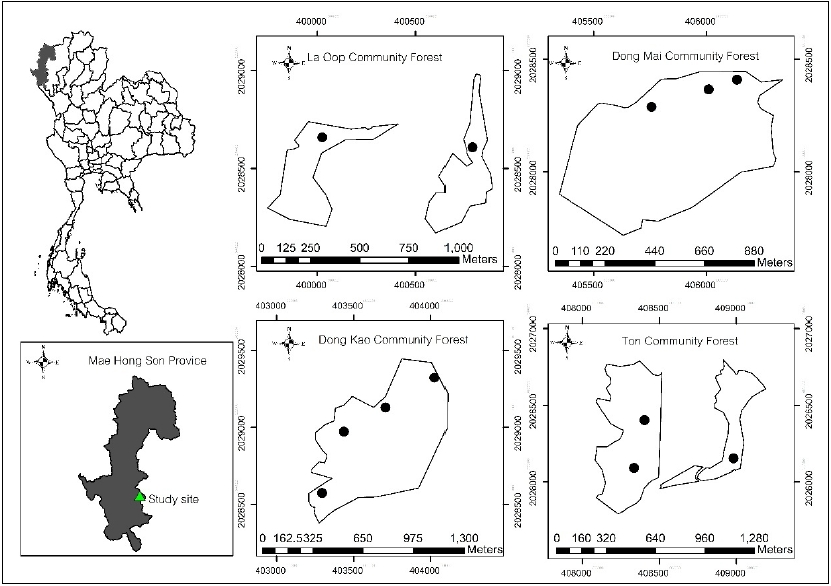
Methodology: This study was conducted in the lower montane forest located in community forests of Ban La-Oob, Ban Dong Kao, Ban Dong Mai, and Ban Tun, at Huai Hom Subdistrict, Mae Lan Noi District, Mae Hong Son Province. Twelve - 0.16 ha (40 x 40 meters) of purposive sampling plots were established to cover the community forest area of four villages. The diameter at breast height (DBH) and total height of all trees within the DBH ≥ 4.5 cm in the sample plots were measured. Cluster analysis was performed to classified sub-communities. Plant community characteristics were analyzed for each sub-community, including diversity index (H′), density (D), basal area (BA), and importance value index (IVI). We also analyzed biomass, carbon sequestration, and carbon dioxide sequestration of each sub-community. Furthermore, the relationship between carbon sequestration of lower montane forest with the factors of topographical as elevation above mean sea level, aspect, and slope, moreover the plant community characteristics as BA, D, H′ and number of species were analyzed using a Generalized Linear Mixed Model (GLMM) with the “lme4 package” and “MuMin package”, respectively, in R version 4.2.2.
Main Results: We found that a total of 138 tree species, 99 genera, and 54 families were founded including 2,548 trees. The tree density and basal area were 1,327 trees ha-1 and 29.93 m2 ha-1, respectively. The Shannon-Wiener index (H′) was high (H′=4.18). Plant communities can be divided into four sub-communities, three of which are secondary forest which dominated by Alstonia glaucescens (LMF-ALGL), Eurya nitida (LMF-EUNI) and Ostodes paniculate (LMF-OSPA), and one sub-community of primary forest of lower montane forest dominated by Castanopsis diversifolia (LMF-CADI). The forest structure and carbon sequestration varied among sub-community types. First, the sub-community of lower montane forest dominated by Alstonia glaucescens (LMF-ALGL) showed that 76 species 65 genera and 40 families were found. The Shannon-Wiener index (H′) was 3.64 with tree density and basal area were 2,014.58 trees ha-1 and 45 m2 ha-1, respectively. The biomass, carbon sequestration, and carbon dioxide sequestration values were 238.48±34.45. t ha-1, 112.08±16.19 tC eq ha-1 and 410.98±59.36 tCo2eq ha-1, respectively. Second, the sub-community of lower montane forest with Eurya nitida (LMF-EUNI) showed that 65 species 54 genera and 33 families were found. The Shannon-Wiener index (H′) was 3.46 with tree density and basal area were 1,472.91 trees ha-1 and 25.91 m2 ha-1, respectively. The biomass, carbon sequestration, and carbon dioxide sequestration values were 175.57±41.30 t ha-1, 82.52±19.41 tC eq ha-1 and 302.57±71.18 tCo2eq ha-1, respectively. Third, the sub-community of lower montane forest with Ostodes paniculata (LMF-OSPA) showed that 73 species 62 genera and 37 families were found. The Shannon-Wiener index (H′) was 3.81 with tree density and basal area were 887.50 trees ha-1 and 28.41 m2 ha-1, respectively. The biomass, carbon sequestration, and carbon dioxide sequestration values were 266.99±28.50 t ha-1, 125.48±13.39 tC eq ha-1 and 460.12±49.11 tCo2eq ha-1, respectively. Fourth, the sub-community of lower montane forest with Castanopsis diversifolia (LMF-CADI) showed that 59 species 46 genera and 30 families were found. The Shannon-Wiener index (H′) was 3.36 with tree density and basal area showed that 1,229.16 trees ha-1 and 29.85 m2 ha-1, respectively. The biomass, carbon sequestration, and carbon dioxide sequestration are shown 245.63±16.02 t ha-1, 115.44±7.53 tC eq ha-1 and 423.30±27.61 tCo2eq ha-1, respectively. Furthermore, the carbon sequestration of the lower montane forest in the study areas had negatively significantly with the elevation above mean sea level (p < 0.001), but positively significantly with the slope (p<0.05) and basal area (p<0.001). Indicating the carbon sequestration of LMF is positively associated with high elevations, steep slopes, and large basal areas.
Conclusion: This study indicates that community forests of Huai Hom subdistrict, Mae Hong Son Province, consist of secondary lower montane forest. These forests maintain high biodiversity and possess significant carbon sequestration capacity. However, alongside tree growth, topographic factors such as elevation and slope remained crucial determinants of carbon sequestration. Therefore, topography must be taken into consideration when managing lower montane community forests to enhance their carbon sequestration efficiency.
Downloads
References
Akarasilakul, T. 2004. Family-owned Forest Local wisdom for self-reliance. Bangkok: National Center for Genetic Engineering and Biotechnology. (in Thai)
Alam, K., & S. M. Nizami. 2014. Assessing Biomass Expansion Factor of Birch Tree Betula utilis D. DON. Open Journal of Forestry 4: 181–190. https://doi.org/10.4236/ojf.2014.43024 DOI: https://doi.org/10.4236/ojf.2014.43024
Asanok, L., K. Krueama, J. Pakketanang & P. Chiangrang. 2024. Variation of shade tree composition and carbon stock of smallholder coffee agroforestry systems along an elevation gradient in Khun Mae Kuang Forest area, northern Thailand. Agroforestry Systems 98: 3045–3060. https://doi.org/10.1007/s10457-024-01073-9 DOI: https://doi.org/10.1007/s10457-024-01073-9
Asanok, L., D. Marod, P. Duengkae, U. Pranmongkol, H. Kurokawa, M. Aiba, M. Katabuchi & T. Nakashizuka. 2013. Relationships between functional traits and the ability of forest tree species to reestablish in secondary forest and enrichment plantations in the uplands of northern Thailand. Forest Ecology and Management 296: 9–23. 10.1016/j.foreco.2013.01.029 DOI: https://doi.org/10.1016/j.foreco.2013.01.029
Bagri, A.S., H. Singh, P. Brisht & N. Singh. 2025. Carbon stock assessment across temperate forest types along an altitudinal gradient in Tehri, Garhwal Himalaya. Discover Forests Journal 1: 46. https://doi.org/10.1007/s44415-025-00043-y DOI: https://doi.org/10.1007/s44415-025-00043-y
Bernette, J & E. J. McLean. 1998. The Tukey Honestly Significant Difference Procedure and It's Control of Type I Error Rate. pp.1-15. In Proceeding of Annual Meeting of the Mid-South Educational Research Association Conference, November 4, 1998, New Orleans, LA, USA.
Bisht, S., S. S. Bargali, K. Bargali, G. S. Rawat, Y. S. Rawat & A. Fartyal. 2022. Influence of Anthropogenic Activities on Forest Carbon Stocks—A Case Study from Gori Valley, Western Himalaya. Sustainability 14:16918. https://doi.org/10.3390/su142416918 DOI: https://doi.org/10.3390/su142416918
Bridge, S. R. J. & E. A. Johnson. 2000. Geomorphic principles of terrain organization and vegetation gradients. Journal of Vegetation Science 11:57–70. https ://doi.org/10.2307/3236776 DOI: https://doi.org/10.2307/3236776
Chanlabut, U. & B. Nahok. 2022. Forest structure and carbon stock of Suan Phueng Nature Education Park in Ratchaburi Province, Western Thailand. Biodiversitas 23 (8): 4314–4321. https://doi.org/10.13057/biodiv/d230856 DOI: https://doi.org/10.13057/biodiv/d230856
Chiangrang, P. & L. Asanok. 2020. Tree Planting Characteristics in Coffee–Agroforestry System of The Royal – initiated Khun Mae Kuang Forest Area Development Project, Chiang Mai Province. Thai Forest Ecological Research Journal 4(2): 63–76.
Department of National Parks, Wildlife and Plant Conservation (DNP). 2020. The Study of Carbon Accumulation in the ASEAN Heritage Area, Kaeng Krachan National Park. Bangkok, Thailand: Research of National Park, Department of National parks Wildlife and Plant Conservation. (in Thai).
Diloksumpun, S. 2007. Forest carbon sequestration and global warming. Journal of Soil and Water Conservation 22 (3): 40–49. (in Thai)
Dwevedi, A., P. Kumar, P. Kumar, Y. Kumar, Y. K. Sharma. & A. M. Kayastha. 2017. Soil sensors: detailed insight into research updates, significance, and future prospects. New Pesticides and Soil Sensors 561–594. https://doi.org/10.1016/B978-0-12-804299-1.00016-3 DOI: https://doi.org/10.1016/B978-0-12-804299-1.00016-3
Ghanbari, S. & A. Esmaili. 2023. The effect of slope and height above sea level on tree species diversity in Arsbaran Forests. Ecology of Iranian Forests 11(2): 111–119. 10.61186/ifej.11.21.111 DOI: https://doi.org/10.61186/ifej.11.21.111
IPCC. 2006. Guidelines for National Greenhouse Gas Inventories: Chapter 4 Forest Land. Available source: https://www.ipcc-nggip.iges.or.jp/public/2006gl/pdf/4_Volume4/V4_04_Ch4_Forest_Land.pdf 28 May 2022. (Accessed: January 05, 2025) (in Thai)
Kent, M. & P. Coker. 1994. Vegetation Analysis and Description. Dehradun: International Book Distributors.
Khamyong, S. & N. Anongrak. 2016. Carbon and nutrient storages in an upper montane forest at mt. Inthanon summit, Northern Thailand. Environment and Natural Resources Journal. 14(1): 26– https://doi.org/38. 10.14456/ennrj.2016.4
Land Development Department. 2012. Digital Elevation Model: DEM (ratio 1: 40,000). Available source: http://sql.ldd.go.th/ldddata/mapsoilE1.html (Accessed: January 05, 2023). (in Thai)
Llait, C.O. 2024 Tree Species Composition and Diversity in a Secondary Forest along the Sierra Madre Mountain Range in Central Luzon, Philippines: Implications for the Conservation of Endemic, Native, and Threatened Plants. Journal of Zoological and Botanical Gardens. 5(1), 51–65. https://doi.org/10.3390/jzbg5010004 DOI: https://doi.org/10.3390/jzbg5010004
Magurran, A.E. 1988. Measuring Biological Diversity. Oxford: Blackwell Science DOI: https://doi.org/10.1007/978-94-015-7358-0_1
Marod, D., S. Hermhuk, S. Sungkaew, S. Thinkampheang, T. Kamyo. & W. Nuipakdee. 2019. Species composition and spatial distribution of dominant trees in the forest ecotone of a mountain ecosystem, northern Thailand. Environment and Natural Resources Journal 17(3):40–49. https://doi.org/10.32526/ennrj.17.3.2019.21 DOI: https://doi.org/10.32526/ennrj.17.3.2019.21
Marod, D., S. Sangkaew, A. Panmonkol. & A. Jingjai. 2014. Influences of environmental factors on tree distribution of lower montane evergreen forest at Doi Sutep-Pui National Park, Chiang Mai Province. Thai Journal of Forestry 33(3): 23–33.
Marod, D., P. Duengkae, S. Sangkaew, P. Racharak, W. Suksavate, S. Uthairatsamee, L. Asanok, T. Kamyo, S. Thinkampheang, S. Heumhuk, P. Kachina, J. Thongsawi, W. Phumphuang, P. Paansri, W. Nuipakdee, P. Nakmuenwai. & S. Pattanakiat. 2019. Population structure and spatial distribution of tree species in lower montane forest, Doi Suthep-Pui national park, Northern Thailand. Environment and Natural Resources Journal 20(6): 644–663. https://doi.org/10.32526/ennrj/20/202200139 DOI: https://doi.org/10.32526/ennrj/20/202200139
Marod, D., S. Thinkamphang, A. Panmhongkol. & S. Hermhuk. 2015. Tree distribution across the forest ecotone of lower montane forest at Doi Sutep-Pui National Park, Chiang Mai Province. Thai Journal of Forestry 34(3): 99–108.
Marod, D. & U. Kutintara. 2009. Forest Ecology. Bangkok, Thailand: Faculty of Forestry, Kasetsart University. (in Thai)
McCune, B. & M. J. Mefford. 2011. PC-ORD. Multivariate Analysis of Ecological Data Version 6.0 for Windows. Oregon: MjM Software.
Meng, Q., A. Wang, Z. Fu, Y. Deng. & H. Chen. 2022. Soil types determine vegetation communities along a toposequence in a dolomite peak-cluster depression catchment. Plant Soil Journal 475: 5–12. https://doi.org/10.1007/s11104-022-05308-5 DOI: https://doi.org/10.1007/s11104-022-05308-5
Meteorological Department. 2025. Climate of northern Thailand. Available source: http://climate.tmd.go.th/data/province. (Accessed: January 05, 2025). (in Thai)
Miller, P. M. & J. B. Kauffman. 1998. Seedling and sprout response to slash-and-burn agriculture in a tropical deciduous forest. Biotropica 30(40): 538–546. DOI: https://doi.org/10.1111/j.1744-7429.1998.tb00094.x
Monkni, R.EI., Mahmoudi, M.R., Sebei, H. & Aouni, M. H. EI. 2009. Estimating Above-Ground Biomass of Mirbeck’s Oak (Quercus canariensis Willd.) in Kroumiria, Tunisia. pp.157-164. In Proceedig Modelling, Valuing and Managing Mediterranean Forest Ecosystems for Non-Timber Goods and Services, October 26–27, 2007, Valladolid University, Spain.
Piponiot, C., K. J. Anderson-Teixeira, S. J. Davies, D. Allen, N. N. Bourg, D. F. R. P. Burslem, D. Ca′rdenas, C-H. Chang-Yang, G. Chuyong, S. Cordell, H.S. Dattaraja, A. Duque, S. Ediriweera, C. Ewango, Z. Ezedin, J. Filip, C. P. Giardina, R. Howe, C-F. Hsieh, S. P. Hubbell., F. M. Inman-Narahari, A. Itoh., D. Janı´k, D. Kenfack, K. Kr´a, J. A. Lutz, J-R. Makana, A. M. McMahon, W. McShea, X. Mi, M. Bt. Mohamad, V. Novotn´, M. J. O’Brien, R. Ostertag, G. Parker, R. P´erez, H. Ren., G. Reynolds., M. D. Md Sabri, L. Sack, A. Shringi, S-H. Su, R. Sukumar, I-F. Sun, H. S. Suresh, D. W. Thomas, J. Thompson, M. Uriarte, J. Vandermeer, Y. Wang, I. M. Ware, G. D. Weiblen, T. J. S. Whitfeld, A. Wolf., T. L. Yao, M. Yu, Z. Yuan, J. K. Zimmerman, D. Zuleta & H.C. Muller-Landau. 2022. Distribution of biomass dynamics in relation to tree size in forests across the world. New Phytologist Journal 234:1644–1677. https://doi.org/10.1111/nph.17995 DOI: https://doi.org/10.1111/nph.17995
Pooma, R. & S. Suddee. 2014. Thai plant names (Botanical name – vernacular names) Revised Edition. Bangkok, Thailand: Royal Forest Department. (in Thai)
Richards, P.W. 1996. The Tropical Rain Forest: An Ecological Study. 2nd ed. Cambridge: Cambridge University Press.
Santisuk, T. 1988. An account of the vegetation of northern Thailand-geoecological research. Nordic Journal of Botany 9(1): 50. DOI: https://doi.org/10.1111/j.1756-1051.1989.tb00981.x
Schliep, E. M., A. E. Gelfand, J. S. Clark. & B. J. Tomasek. 2017. Biomass prediction using a density-dependent diameter distribution model. The Annals of Applied Statistics 11(1): 340–361. https://doi.org/10.1214/16-AOAS1007 DOI: https://doi.org/10.1214/16-AOAS1007
Terakunpisut, J., N. Gajaseni. & N. Ruankawe. 2007. Carbon sequestration potential in aboveground biomass of thong Pha-Phum national forest, Thailand. Applied Ecology and Environmental Research 5(2): 93–102. DOI: https://doi.org/10.15666/aeer/0502_093102
Timilsina, N., C. L. Staudhammer, F. J. Escobedo. & A. Lawrence. 2014. Tree biomass, wood waste yield, and carbon storage changes in an urban forest. Landscape and Urban Planning 127: 18–27. https://doi.org/10.1016/j.landurbplan.2014.04.003 DOI: https://doi.org/10.1016/j.landurbplan.2014.04.003
Tsutsumi, T., K. Yoda, P. Sahunalu, P. Dhanmanonda & B. Prachaiyo. 1983. Forest: felling, burning and regeneration. pp.13–26. In Kyuma, K., and C. Pairitra (eds.). Shifting cultivation. Tokyo.
World Meteorological Organization. (2023). Greenhouse gas concentrations hit record high. Available source: https://wmo.int/news/media-centre/greenhouse-gasconcentrations-hit-record-high-again
Zhang, Z. H., G. Hu. & J. Ni. 2013. Effects of topographical and edaphic factors on the distribution of plant communities in two subtropical karst forests, Southwestern China. Journal of Mountain Science 10: 95–104. https ://doi.org/10.1007/s11629-013-2429-7j DOI: https://doi.org/10.1007/s11629-013-2429-7
Downloads
Published
Issue
Section






.png)