Seedling Recruitment and Mortality Rates under Gap and Crown Canopy in Lower Montane Forest at Doi Suthep – Pui National Park, Chiang Mai Province
DOI:
https://doi.org/10.34044/tferj.2026.10.1.6653Keywords:
Forest gap, montane forest, forest dynamicsAbstract
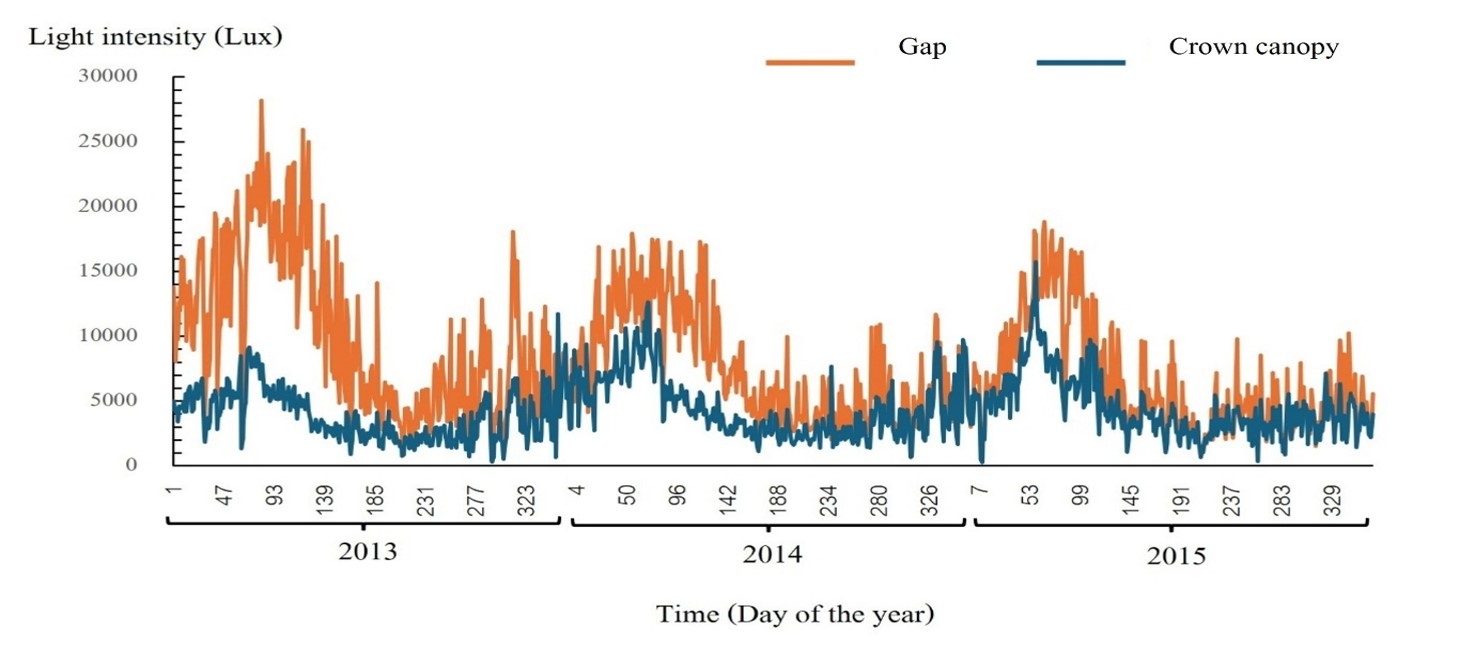
Background and Objectives: Natural forests are dynamic ecosystems in which the structure and composition of plant communities continuously change through the process of natural regeneration. This regeneration process is an important ecological mechanism that maintains forest structure, species composition, and plant diversity over long periods of time. The seedling stage represents a critical phase in the life cycle of forest plants because seedlings must cope with intense competition and environmental filtering, which influence germination, growth, and survival. This process is particularly important in ecosystems with specific environmental characteristics, such as montane forests, which generally occur at elevations higher than 1,000 meters above mean sea level and are characterized by cool and humid conditions as well as dense forest canopies that limit light penetration to the forest floor. As a result, many plant species exhibit shade-tolerant characteristics. However, disturbances such as the fall or death of large trees can create forest gaps, which alter local environmental conditions, including light intensity, temperature, and humidity. These environmental differences influence seed germination and seedling establishment. Light-demanding species generally exhibit higher recruitment and growth rates in forest gap areas, whereas shade-tolerant species are better able to establish and survive under low-light conditions beneath the crown canopy. In addition, variations in light intensity and temperature also affect seedling mortality rates, reflecting the adaptive capacity of each species under different environmental conditions. However, quantitative information on the relationships between light intensity and temperature and the recruitment and mortality rates of seedlings in montane forest remain limited. Therefore, this study aims to: 1) compare light intensity and temperature between forest gap areas and crown canopy areas; 2) examine the recruitment and mortality rates of different seedling species in both habitat types; and 3) analyze the relationship between light intensity and seedling recruitment rates in both habitat types during 2013 - 2015. This study is expected to enhance the understanding of some role of environmental factors in natural regeneration processes of plant communities in a lower montane forest at Huai Kog Ma watershed, Doi Suthep–Pui National Park, Chiang Mai Province.
Methodology: The study was conducted in a 16-hectare permanent plot measuring 400 × 400 meters located within Doi Suthep–Pui National Park, Chiang Mai Province. Two types of forest environments were investigated: forest gap areas and areas under crown canopy. Nine sampling locations were selected for each type of environment, resulting in a total of 18 study locations. At each location, five seedling subplots measuring 1 × 1 meter were established, giving a total of 90 seedling plots. All seedlings occurring within each subplot were tagged and identified to species level. Each seedling was assigned an identification number in order to monitor its survival and recruitment over time. Field observations were conducted monthly from August 2012 to December 2015. During each monitoring period, newly recruited seedlings and dead seedlings were recorded. The collected data were then analyzed to calculate seedling species diversity, seedling density, recruitment rates, and mortality rates in both forest gap areas and crown canopies. The relationships between environmental factors and seedling recruitment were examined in both gap and crown canopy using Spearman’s rank correlation in R.
Main Results: A total of 105 seedling species belonging to 80 genera and 48 families were recorded during the study period, with an overall seedling density of 293,222 individuals.ha-1. Most seedlings belonged to the families Fagaceae and Lauraceae, which are dominant components of montane forests in northern Thailand. When the two habitat types were considered separately, 77 species representing 62 genera and 39 families were recorded in forest gap areas, whereas 70 species representing 53 genera and 36 families were found under the forest canopy. In both environments, Castanopsis acuminatissima were the most abundant species, with seedling densities of 210,000 and 136,444 individuals.ha-1 under forest gap and crown canopy conditions, respectively. Seedling recruitment and mortality in both forest gap and under crown canopies varied among years and also showed seasonal variation. The highest seedling recruitment was observed during the late rainy season to the early dry season, indicating that favorable moisture conditions during the rainy season may enhance seed germination and early seedling establishment. In contrast, seedling mortality occurred intermittently throughout the study period and remained lower than recruitment overall. When focusing on species with more than 10 individuals recorded between 2013 and 2015, a total of 11 species were analyzed. The results showed that recruitment and mortality rates differed among species. Seedlings in the family Fagaceae, including Castanopsis acuminatissima and Castanopsis tribuloides were found in both forest gaps and crown canopies, indicating that these species are able to establish under a wide range of light intensity. For species in the family Lauraceae, including Litsea martabanica and Persea gamblei, seedling recruitment occurred more frequently under the forest canopy than in forest gaps, reflecting the shade-tolerant characteristics of these species. In contrast, Cinnamomum iners seedlings were found only in forest gap areas, suggesting that this species requires higher light availability for successful establishment. The relationships between light intensity and seedling recruitment and mortality of all 11 species did not differ significantly between forest gap and under crown canopy conditions (p > 0.05). However, Castanopsis acuminatissima, Castanopsis tribuloides and Syzygium tetragonum showed a tendency to occur under lower light conditions, whereas Macaranga indica and Memecylon plebejum tended to be associated with higher light intensities.
Conclusion: Seedling recruitment and mortality rates varied among species which related to the ecological niches, in particular species light demanding. Differences in light availability between under gap and crown canopy had influenced seedling establishments in montane evergreen forest. The formation of canopy gaps therefore play an important role in natural regeneration processes and contributes to the maintenance of plant diversity and forest dynamics in tropical forest ecosystems.
Downloads
References
Asanok, L., D. Marod, A. Pattanavibool, T. Nakashizuka. 2012. Colonization of tree species along an interior-exterior gradient across the forest edge in a tropical montane forest, northwest Thailand. Tropics 21(3): 67-80. https://doi.org/10.3759/tropics.21.67 DOI: https://doi.org/10.3759/tropics.21.67
Asanok, L., J. Kotkangphlu, S. Rodkongrai, D. Janduang, P. Ketdee & M. Kamsuk. 2017. The influencing of canopy gap and conspecific adult tree determined the characteristic of dominant species in Ban Se Pa La freshwater swamp forest, Umphang district, Tak province. Thai Forest Ecological Research Journal 1(1): 19-26 (in Thai).
Brokaw, N. V. L. 1985. Gap-phase regeneration in a tropical forest. Ecology 66(3): 682-687. https://doi.org/10.2307/1940529 DOI: https://doi.org/10.2307/1940529
De Frenne, P., J. Lenoir, M. Luoto, B. R. Scheffers, F, Zellweger, J. Aalto, M. B. Ashcroft, D. M. Christiansen, G. Decocq, K. De Pauw, S. Govaert, C. Greiser, E. Gril, A. Hampe, T.Jucker, D. H. Klinges, I. A. Koelemeijer, J. J. Lembrechts, R. Marrec, C. Meeussen, J. Ogée, J. Tyystjärvi, P. Vangansbeke & K. Hylander. 2021. Forest microclimates and climate change: Importance, drivers and future research agenda. Global Change Biology 27: 2279-2297. https://doi.org/10.1111/gcb.15569 DOI: https://doi.org/10.1111/gcb.15569
Denslow, J. S. 1987. Tropical rainforest gaps and tree species diversity. Annual Review of Ecology, Evolution, and Systematics 18: 431-451. https://doi.org/10.1146/annurev.es.18.110187.002243 DOI: https://doi.org/10.1146/annurev.es.18.110187.002243
Du, X., Q. Guo, X. Gao & K. Ma. 2007. Seed rain, soil seed bank, seed loss and regeneration of Castanopsis fargesii (Fagaceae) in a subtropical evergreen broad-leaved forest. Forest Ecology and Management 238(2007): 212-219. https://doi.org/10.1016/j.foreco.2006.10.018 DOI: https://doi.org/10.1016/j.foreco.2006.10.018
Elliott, S. D., D. Blakesley & K. Hardwick. 2013. Restoring Tropical Forest: a practical guide. Royal Botanic Gardens, Kew.
Glomvinya, S., C. Tantasirin, P. Tongdeenok & N. Tanaka. 2016. Changes in rainfall characteristics at Huai Kog-ma Watershed, Chiang Mai province. Thai Journal of Forestry 35: 66-77. (in Thai)
Lawton, R. O. 1990. Canopy gaps and light penetration into a wind-exposed tropical lower montane rain forest. Canadian Journal of Forest Research 20: 659-667. https://doi.org/10.1139/x90-088 DOI: https://doi.org/10.1139/x90-088
Lieberman, D. & M. Lieberman. 1987. Forest tree growth and dynamics at La Selva, Costa Rica (1969-1982). Journal of Tropical Ecology 3: 347-358. https://doi.org/10.2307/2261127 DOI: https://doi.org/10.1017/S0266467400002327
Liu, J. 2025. Progress in research on the effects of environmental factors on natural forest regeneration. Frontiers in Forests and Global Change 8: 1525461. https://doi.org/10.3389/ffgc.2025.1525461 DOI: https://doi.org/10.3389/ffgc.2025.1525461
Lumsonjitt, K., S. Khamyong, N. Anongrak & P. Kachina. 2021. Species diversity, quantitative features and forest condition in montane forest at Doi Suthep-Pui national park, Chiang Mai province. KKU Science Journal 49(4): 324-335. (in Thai)
Noguchi, H., A. Itoh, T. Mizuno, K. Sri-ngernyuang, M. Kanzaki, S. Teejuntuk, W. Sungpalee, M. Hara, T. Ohkubo, P. Sahunalu, P. Dhammanonda & T. Yamakura. 2007. Habitat divergence in sympatric Fagaceae tree species of a tropical montane forest in norther Thailand. Journal of Tropical Ecology 23: 549-558. https://doi.org/10.1017/S0266467407004403 DOI: https://doi.org/10.1017/S0266467407004403
Marod, D. 2012. Applied Forest Ecology. Kasetsart University Press, Bangkok. (in Thai)
Marod, D. & U. Kutintara. 2009. Forest Ecology. Faculty of Forestry, Kasetsart University, Bangkok. (in Thai)
Marod, D., U. Kutintara, H. Tanaka & T. Nakashizuka. 2002. The effects of drought and fire on seed and seedling dynamics in a tropical seasonal forest in Thailand. Plant Ecology 161:41-57. https://doi.org/10.1023/A:1020372401313 DOI: https://doi.org/10.1023/A:1020372401313
Marod, D., S. Thinkampheang, W. Phumpuang, A. Yarnvudhi, J. Thongsawi, P. Kachina, T. Nakashizuka, H. Kurokawa & S. Heumhuk. 2025. Relationship between climate changes and forest dynamics along altitudinal gradients at Doi Suthep-Pui National Park, Northern Thailand. Forests 16(1). https://doi.org/10.3390/f16010114 DOI: https://doi.org/10.3390/f16010114
Marod, D., P. Duengkae, S. Sangkaew, P. Racharak, W. Suksavate, S. Uthairatsamee, L. Asanok, T. Kamyo, S. Thinkampheang, S. Heumhuk, P. Kachina, J. Thongsawi, W. Phumpuang, P. Paansri, W. Nuipakdee, P. Nakmuenwai & S. Pattanakiat. 2022. Population structure and spatial distribution of tree species in lower montane forest, Doi Suthep-Pui national park, northern Thailand. Environment and Natural Resources Journal 20(6): 644-663. https://doi.org/10.32526/ennrj/20/202100168
Montgomery, R. A. & R. L. Chazdon. 2001. Forest structure, canopy architecture, and light transmittance in tropical wet forests. Ecology 82(10): 2707-2718. https://doi.org/10.1890/0012-9658(2001)082[2707:FSCAAL]2.0.CO;2 DOI: https://doi.org/10.1890/0012-9658(2001)082[2707:FSCAAL]2.0.CO;2
R Core Team. 2025. R: A Language and Environment for Statistical Computing. R Foundation for Statistical Computing, Vienna, Austria. Available source: http://www.R-project.org. (Accessed: April 10, 2025)
Ruangpanit, N. 2005. Forest and forestry in Thailand. Academic promotion centre publishing house, Bangkok. (in Thai)
Rueangket, A. 2016. Interaction between plant phenology of lower montane evergreen forest and herbivores at Doi Suthep-Pui national park, Chiang Mai province. M.S. Thesis, Kasetsart University. Bangkok, Thailand. (in Thai)
Rueangket, A., S. Siri, Y. Ponpituk, S. Thinkampheang & P. Duengkae. 2025. Relationship between fruiting phenology and climatic factors in lower montane forest at Doi Suthep–Pui National Park, Chiang Mai Province. Thai Forest Ecological Research Journal 9(2): 157-172. https://doi.org/10.34044/tferj.2025.9.2.6304 DOI: https://doi.org/10.34044/tferj.2025.9.2.6304
Rueangruea, S. 2009. Vegetation structure of montane forests in Thailand. M.S. Thesis, Kasetsart University. Bangkok, Thailand.
(in Thai)
Santisuk, T. 1988. An Account of the Vegetation of Northern Thailand. Royal Forest Department, Bangkok.
Sri-Ngernyuang, K., M. Kanzaki, T. Mizuno, H. Noguchi, S. Teejuntuk, C. Sungpalee, M. Hara, T. Yamakura, P. Sahunalu, P. Dhanmanonda & S. Bunyavejchewin. 2003. Habitat differentiation of Lauraceae species in a tropical lower montane forest in northern Thailand. Ecological Research 18: 1-14. https://doi.org/10.1046/j.1440-1703.2003.00539.x DOI: https://doi.org/10.1046/j.1440-1703.2003.00539.x
Stickley, S.F. & J. M. Fraterrigo. 2021. Understory vegetation contributes to microclimatic buffering of near-surface temperatures in temperate deciduous forests. Landscape Ecology 36: 1197-1213. https://doi.org/10.1007/s10980-021-01195-w DOI: https://doi.org/10.1007/s10980-021-01195-w
Swaine, M. D. & T. C. Whitmore. 1988. On the definition of ecological species groups in tropical rain forests. Vegetation 75: 81-86. https://doi.org/10.2307/2265545 DOI: https://doi.org/10.1007/BF00044629
Thinkampheang, S., T. Nakashizuka, W. Suksavate, P. Kachina, S. Hermhuk, L. Asanok, W. Phumphuang, B. Chouibumroong, J. Wu, H. Kurokawa & D. Marod. 2024. Impacts of climate change on forest restoration dynamics in the lower montane forest of Doi Suthep- Pui National Park, Northern Thailand. Biodiversitas 25: 4829-4845. https://doi.org/10.13057/biodiv/d251219 DOI: https://doi.org/10.13057/biodiv/d251219
Vandekerkhove, K., R. De Wulf & N. N. Chinh. 1993. Dendrological composition and forest structure in Nam Bai Cat Tien national park, Vietnam. Silva Gandavensis 58: 41-84. DOI: https://doi.org/10.21825/sg.v58i0.878
Whitmore, T. C. 1989. Canopy gaps and the two major groups of forest trees. Ecology 70(3): 536-538. https://doi.org/10.2307/2260477 DOI: https://doi.org/10.2307/1940195
Witno, H. A. K., A. Prabowo & A. U. B. Putri. 2024. The generation potential of Kasa (Castanopsis acuminatissima Blume) in Kalaena nature reserve, East Luwu Regency. Media Konservasi 29(4): 557-568. https://doi.org/10.29244/medkon.29.4.557 DOI: https://doi.org/10.29244/medkon.29.4.557
Xue, G., J. Wu, B. Zhou, X. Zhu, J. Zeng, Y. Ma, Y. Wang & H. Jia. 2023. Effects of shading on the growth and photosynthetic fluorescence characteristics of Castanopsis hystrix seedlings of top community-building species in southern subtropical China. Forests 14(1659). https://doi.org/10.3390/f14081659 DOI: https://doi.org/10.3390/f14081659
Downloads
Published
Issue
Section






.png)