Natural Succession of Lower Montane Forest in Shifting Cultivation Systems at Namtok Mae Surin National Park, Northern Thailand
DOI:
https://doi.org/10.34044/tferj.2026.10.1.6670Keywords:
biodiversity, forest structure, ordinationAbstract
Background and Objectives: Forest recovery in shifting cultivation systems plays a crucial role in shaping forest structure and species composition in tropical mountainous regions. In northern Thailand, lower montane forests represent one of the most ecologically important ecosystems, characterized by high biodiversity and complex vegetation structure. However, land-use changes, particularly shifting cultivation practices, have significantly altered these ecosystems, leading to forest degradation and initiating natural succession processes. The recovery of plant communities following disturbance is a dynamic and complex process influenced not only by the time since abandonment but also by environmental conditions and site-specific factors. Understanding how these factors interact to influence forest recovery is essential for developing effective strategies for forest restoration and sustainable land management. Therefore, this study aimed to (1) investigate the natural succession of plant communities in lower montane forests across a chronosequence of shifting cultivation fallows, and (2) examine the relationships between environmental factors and plant species distribution.
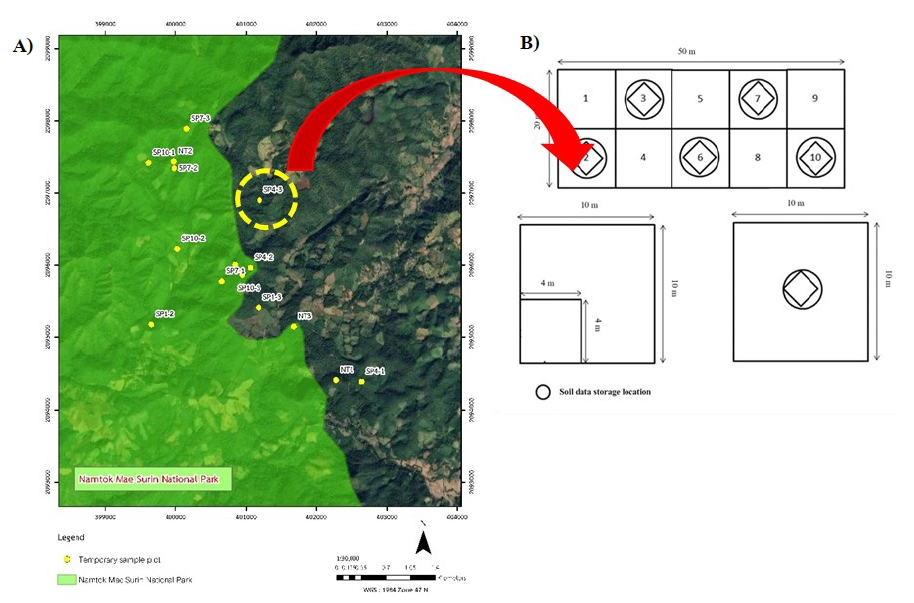
Methodology: The study was conducted in Namtok Mae Surin National Park, Mae Hong Son Province, northern Thailand, which is characterized by mountainous terrain and a tropical monsoon climate. A total of 15 temporary sample plots were established across five land-use stages: natural forest and shifting cultivation fallows of 1, 4, 7, and 10 years. Three plots were established for each stage. Within each plot, all trees with a diameter at breast height (DBH) ≥ 4.5 cm were measured and identified to species level. Saplings were also surveyed in subplots to assess regeneration patterns. In addition, soil samples were collected for the analysis of physical and chemical properties, including soil organic matter, soil moisture, and soil texture. Vegetation data were analyzed using the Importance Value Index (IVI) to determine dominant species and their ecological significance. Species diversity was assessed using the Shannon–Wiener diversity index (H′). Cluster analysis was performed to classify plant communities based on species composition, while Canonical Correspondence Analysis (CCA) was applied to examine the relationships between species distribution and environmental variables. These analytical approaches allowed for the identification of patterns in community composition along successional gradients and environmental conditions.
Main Results: The natural forest exhibited high structural complexity and species diversity, with 70 tree species belonging to 35 families and 52 genera. The stand density was 1,074 stems ha-1, with a basal area of 9.26 m² ha-1 and a Shannon–Wiener diversity index of H′ = 3.69. In contrast, the 1-year fallow exhibited a very simple forest structure, with a low stand density of 23.33 stems ha-1 and a basal area of only 0.021 m² ha-1. This stage was dominated by pioneer species, reflecting the early stage of succession following disturbance. As the fallow age increased, forest structure showed a clear and continuous recovery trend. In the 4-year fallow, stand density increased to 1,030 stems ha-1, with a basal area of 1.12 m² ha-1. In the 7-year fallow, stand density further increased to 2,084 stems ha-1, with a basal area of 3.12 m² ha-1. In the 10-year fallow, basal area increased substantially to 7.48 m² ha-1, and species diversity (H′ = 3.64) approached that of the natural forest. These findings indicate a gradual transition from early successional stages dominated by pioneer species to more complex communities with increasing contributions from shade-tolerant species, particularly those in the family of Fagaceae and Lauraceae. The diameter class distribution of trees (DBH ≥ 4.5 cm) across all five land-use stages exhibited a negative exponential (L-shaped) pattern, characterized by a large number of small individuals and progressively fewer large trees. This pattern reflects a stable regeneration structure, suggesting that the forest has the potential to sustain itself through continuous recruitment and replacement of individuals over time. Cluster analysis classified the plant communities into three main groups corresponding to different stages of disturbance and recovery: (1) early disturbed sites dominated by pioneer species with low diversity and simple structure, (2) intermediate recovery sites characterized by the coexistence of pioneer and shade-tolerant species, and (3) natural forest sites with high species diversity and complex structure dominated by late-successional species. The results of CCA indicated that species distribution was strongly associated with environmental factors, including soil organic matter, soil moisture, soil texture, and canopy cover. These factors act as environmental filters, influencing species establishment, survival, and competitive interactions under different site conditions. Shade-tolerant species were primarily associated with areas of high canopy cover, high soil moisture, and high organic matter content, whereas pioneer species were more abundant in open areas with lower soil fertility and higher light availability. Soil texture also played an important role in determining water retention capacity and root establishment, thereby contributing to spatial variation in plant community composition.
Conclusion: This study demonstrates that natural succession in shifting cultivation systems can lead to the recovery of plant communities with structural and compositional characteristics similar to those of natural lower montane forests. Time since abandonment is a key driver of forest recovery, controlling changes in species composition and forest structure from pioneer-dominated communities to more complex and stable systems. However, environmental factors such as soil organic matter, soil moisture, soil texture, and canopy cover also play critical roles in shaping successional trajectories through environmental filtering processes. These findings highlight that forest recovery is not solely dependent on time but is the result of interactions between successional processes and environmental conditions. While species diversity can recover relatively quickly, full structural recovery, particularly the development of large trees and biomass accumulation, requires longer time periods. Therefore, maintaining sufficient fallow periods and minimizing further disturbances are essential for promoting sustainable forest restoration and biodiversity conservation in the shifting cultivation landscapes of mountain forest ecosystem.
Downloads
References
Asanok, L., D. Marod, A. Pattanavibool & T. Nakashizuka. 2012. Colonization of tree species along an interior–exterior gradient across the forest edge in a tropical montane forest, northwest Thailand. Tropics 21(3): 67–82. https://doi.org/10.3759/tropics.21.67 DOI: https://doi.org/10.3759/tropics.21.67
Bray, J. R. & J. T. Curtis. 1957. An ordination of the upland forest communities of southern Wisconsin. Ecological Monographs 27(4): 325–349. https://doi.org/10.2307/1942268 DOI: https://doi.org/10.2307/1942268
Bunyavejchewin, S., P. J. Baker & S. J. Davies. 2001. Stand structure of a seasonal dry evergreen forest at Huai Kha Khaeng Wildlife Sanctuary, western Thailand. Journal of Tropical Forest Science 13(3): 388–400.
Chazdon, R. L. 2014. Second growth: The promise of tropical forest regeneration. Chicago: University of Chicago Press. https://doi.org/10.7208/chicago/9780226118109.001.0001 DOI: https://doi.org/10.7208/chicago/9780226118109.001.0001
Chazdon, R. L., E. N. Broadbent, D. M. A. Rozendaal, F. Bongers, A. M. A. Zambrano, T. M. Aide, P. Balvanera, J. M. Becknell, V. Boukili, P. H. S. Brancalion et al. 2016. Carbon sequestration potential of second-growth forest regeneration in the Latin American tropics. Science Advances 2(5): e1501639. https://doi.org/10.1126/sciadv.1501639 DOI: https://doi.org/10.1126/sciadv.1501639
Clements, F. E. 1916. Plant succession: An analysis of the development of vegetation. Washington, D.C.: Carnegie Institution of Washington. DOI: https://doi.org/10.5962/bhl.title.56234
Condit, R. 1998. Tropical forest census plots: Methods and results from Barro Colorado Island, Panama and a comparison with other plots. Berlin: Springer. https://doi.org/10.1007/978-3-662-03664-8 DOI: https://doi.org/10.1007/978-3-662-03664-8
Connell, J. H. & R. O. Slatyer. 1977. Mechanisms of succession in natural communities and their role in community stability and organization. The American Naturalist 111(982): 1119–1144. https://doi.org/10.1086/283241 DOI: https://doi.org/10.1086/283241
Craine, J. M., B. M. J. Engelbrecht, C. H. Lusk, N. G. McDowell & H. Poorter. 2012. Resource limitation, tolerance, and the future of ecological plant classification. Frontiers in Plant Science 3: 246. https://doi.org/10.3389/fpls.2012.00246 DOI: https://doi.org/10.3389/fpls.2012.00246
Curtis, J. T. & R. P. McIntosh. 1951. An upland forest continuum in the prairie–forest border region of Wisconsin. Ecology 32(3): 476–496. https://doi.org/10.2307/1931725 DOI: https://doi.org/10.2307/1931725
Dent, D. H., S. J. DeWalt & J. S. Denslow. 2013. Secondary forests of Central America and the Caribbean: Insights from long-term studies. Forest Ecology and Management 306: 30–47. https://doi.org/10.1016/j.foreco.2013.06.021 DOI: https://doi.org/10.1016/j.foreco.2013.06.021
Drury, W. H. & I. C. T. Nisbet. 1973. Succession. Journal of the Arnold Arboretum 54(3): 331–368. DOI: https://doi.org/10.5962/p.325716
Egler, F. E. 1954. Vegetation science concepts I. Initial floristic composition—a factor in old-field vegetation development. Vegetatio 4: 412–417. https://doi.org/10.1007/BF00275587 DOI: https://doi.org/10.1007/BF00275587
Foley, J. A., R. DeFries, G. P. Asner, C. Barford, G. Bonan, S. R. Carpenter, F. S. Chapin, M. T. Coe, G. C. Daily, H. K. Gibbs et al. 2005. Global consequences of land use. Science 309(5734): 570–574. https://doi.org/10.1126/science.1111772 DOI: https://doi.org/10.1126/science.1111772
Fox, J., D. M. Truong, A. T. Rambo, N. P. Tuyen, L. T. Cuc & S. Leisz. 2000. Shifting cultivation: A new old paradigm for managing tropical forests. BioScience 50(6): 521–528. https://doi.org/10.1641/0006-3568(2000)050[0521:SCANOP]2.0.CO;2 DOI: https://doi.org/10.1641/0006-3568(2000)050[0521:SCANOP]2.0.CO;2
Houghton, R. A. 2005. Tropical deforestation as a source of greenhouse gas emissions. In: P. Moutinho & S. Schwartzman (eds.). Tropical deforestation and climate change. E-Publishing Inc., New York, pp.13–21.
Kale, M. P. 2011. Consequences of shifting cultivation on soil, water and forest resources in the Eastern Himalaya, India. Environmental Monitoring and Assessment 178: 523–535. https://doi.org/10.1007/s10661-010-1706-6
Kraft, N. J. B., P. B. Adler, O. Godoy, E. C. James, S. Fuller & J. M. Levine. 2015. Community assembly, coexistence, and the environmental filtering metaphor. Functional Ecology 29(5): 592–599. https://doi.org/10.1111/1365-2435.12345 DOI: https://doi.org/10.1111/1365-2435.12345
Legendre, P. & L. Legendre. 2012. Numerical ecology. 3rd ed. Amsterdam: Elsevier.
Lewis, S. L., D. P. Edwards & D. Galbraith. 2015. Increasing human dominance of tropical forests. Science 349(6250): 827–832. https://doi.org/10.1126/science.aaa9932 DOI: https://doi.org/10.1126/science.aaa9932
Marod, D., U. Kutintara, H. Tanaka & T. Nakashizuka. 2002. The effects of drought and fire on seed and seedling dynamics in a tropical seasonal forest in Thailand. Plant Ecology 161(1): 41–57. https://doi.org/10.1023/A:1020372401313 DOI: https://doi.org/10.1023/A:1020372401313
McCune, B. & J.B. Grace. 2002. Analysis of Ecological Communities. MjM Software Design, Gleneden Beach, Oregon.
McCune, B. & M. J. Mefford. 2011. PC-ORD: Multivariate analysis of ecological data. Version 6. MjM Software Design, Oregon, U.S.A.
Mertz, O., C. Padoch, J. Fox, R. A. Cramb, S. J. Leisz, N. T. Lam & T. D. Vien. 2009. Swidden change in Southeast Asia: Understanding causes and consequences. Human Ecology 37: 259–264. https://doi.org/10.1007/s10745-009-9245-2 DOI: https://doi.org/10.1007/s10745-009-9245-2
Newton, A. C. 2007. Forest ecology and conservation: A handbook of techniques. Oxford: Oxford University Press.
Norden, N., H. A. Angarita, F. Bongers, M. Martínez-Ramos, Í. Granzow-de la Cerda, M. van Breugel, E. Lebrija-Trejos, J. A. Meave, J. Vandermeer & G. B. Williamson et al. 2015. Successional dynamics in Neotropical forests are as uncertain as they are predictable. Proceedings of the National Academy of Sciences 112(26): 8013–8018. https://doi.org/10.1073/pnas.1500403112 DOI: https://doi.org/10.1073/pnas.1500403112
Ogawa, H., K. Yoda, K. Ogino & T. Kira. 1965. Comparative ecological studies on three main types of forest vegetation in Thailand. II. Plant biomass. Nature and Life in Southeast Asia 4: 49–80.
Pickett, S. T. A., S. L. Collins & J. J. Armesto. 1987. Models, mechanisms and pathways of succession. The Botanical Review 53(3): 335–371. https://doi.org/10.1007/BF02858321 DOI: https://doi.org/10.1007/BF02858321
Poorter, L., F. Bongers, T. M. Aide, A. M. A. Zambrano, P. Balvanera, J. M. Becknell, P. H. S. Brancalion, E. N. Broadbent, R. L. Chazdon, D. Craven et al. 2016. Biomass resilience of Neotropical secondary forests. Nature 530: 211–214. https://doi.org/10.1038/nature16512 DOI: https://doi.org/10.1038/nature16512
Rozendaal, D. M. A., F. Bongers, T. M. Aide, E. Alvarez-Dávila, N. Ascarrunz, P. Balvanera, J. M. Becknell, T. V. Bentos, P. H. S. Brancalion, G. A. L. Cabral, et al. 2019. Biodiversity recovery of Neotropical secondary forests. Science Advances 5(3): eaau3114. https://doi.org/10.1126/sciadv.aau3114 DOI: https://doi.org/10.1126/sciadv.aau3114
Saikhammoon, R., S. Sungkaew, S. Thinkampheang, W. Phumphuang, T. Kamyo & D. Marod. 2023. Forest restoration in an abandoned seasonally dry tropical forest in the Mae Klong watershed, western Thailand. Environment and Natural Resources Journal 21(5): 443–457. https://doi.org/10.32526/ennrj/21/20230121 DOI: https://doi.org/10.32526/ennrj/21/20230121
Shannon, C. E. & W. Weaver. 1949. The mathematical theory of communication. Urbana: University of Illinois Press.
Smitinand, T. 2014. Thai plant names. Bangkok: Department of National Parks, Wildlife and Plant Conservation. (in Thai)
ter Braak, C. J. F. 1986. Canonical correspondence analysis: A new eigenvector technique for multivariate direct gradient analysis. Ecology 67(5): 1167–1179. https://doi.org/10.2307/1938672 DOI: https://doi.org/10.2307/1938672
Thinkampheang, S., T. Nakashizuka, W. Suksavate, P. Kachina, S. Hermhuk, L. Asanok, W. Phumphuang, B. Chouibumroong, J. Wu, H. Kurokawa & D. Marod. 2024. Impacts of climate change on forest restoration dynamics in the lower montane forest of Doi Suthep-Pui National Park, northern Thailand. Biodiversitas 25(12): 4829–4845. https://doi.org/10.13057/biodiv/d251219 DOI: https://doi.org/10.13057/biodiv/d251219
Tilman, D. 1985. The resource-ratio hypothesis of plant succession. The American Naturalist 125(6): 827–852. https://doi.org/10.1086/284382 DOI: https://doi.org/10.1086/284382
Downloads
Published
Issue
Section






.png)