
The Relationship Between Teak Growth and Climatic Factors by Using Satellite Data in Huai Tak Teak Biosphere Reserve, Lampang Province
DOI:
https://doi.org/10.34044/tferj.2026.10.2.6719Keywords:
Growth, climate, dendrochronology, Teak, satellite dataAbstract
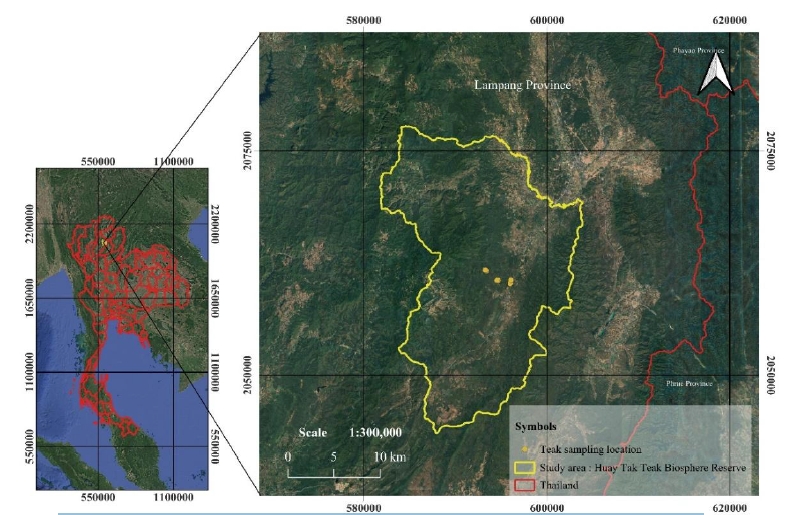
Background and Objectives: Contemporary climate change has intensified in recent decades and is exerting substantial impacts on ecosystems worldwide. However, long-term studies evaluating its effects on trees growth in Thailand remain limited, primarily due to the substantial time and financial constraints associated with traditional research methodologies. Consequently, this research employed dendrochronological techniques, which offer high-resolution accuracy and mitigate the temporal limitations inherent in studying tree growth. Nevertheless, data analysis frequently encounters spatial gap issues, as meteorological stations are typically situated in urban areas distant from forest ecosystems. This discrepancy results in climate data that does not accurately reflect the actual environmental conditions of the study site. To address this limitation, this study incorporates satellite-derived climate data. Therefore, the primary objective focused on investigating the relationship between climatic factors and the growth of teak in the Huai Tak Teak Biosphere Reserve, Lampang province. The integrating tree-ring data with satellite datasets was employed to ensure that the environmental impact assessment is accurate, precise, and reliable as possible.
Methodology: This research applied dendrochronological principles to study the growth of teak. Teak samples were randomly collected from 35 trees, with extractions taken from two opposite directions per individual tree. Following sample preparation using sandpaper, all samples were cross-dated by comparing tree-ring patterns both within individual trees and among different trees. Tree-ring widths were measured using a Velmex measuring system (0.001 mm resolution) in conjunction with a microscope, and the results were recorded using Measure J2X software. Subsequently, measurement accuracy was verified using the COFECHA program, and key dendrochronological statistics were analyzed, namely correlation with the master series, mean sensitivity, autocorrelation, and standard deviation. Thereafter, a tree-ring index chronology was constructed to remove age-related influences using the ARSTAN program, and the reliability of the chronology was evaluated using the Expressed Population Signal (EPS). The derived index was then analyzed for correlations with climate data—specifically precipitation and average temperature—over a 43-year period, from 1981 to 2024. This climate data was acquired from satellites via Google Earth Engine, utilizing monthly total precipitation datasets from CHIRPS Precipitation Pentad: Climate Hazards Center InfraRed Precipitation with Station Data (Version 3.0), and monthly average temperature data from ERA5-Land Monthly Aggregated - ECMWF Climate Reanalysis covering the study area. Finally, simple correlation, multiple regression, and stepwise variable selection were employed to precisely identify the climatic factors and time periods correlated with teak growth.
Results: The teak tree-ring width dataset from the Huai Tak Teak Biosphere Reserve in Lampang Province comprises a total of 3,818 rings, establishing a chronology that extends back 78 years, spanning from 1947 to 2024 Teak growth exhibited relatively high variability throughout its lifespan. The mean annual tree-ring width was 3.511 mm, corresponding to an average annual diameter increment of approximately 0.7 cm. Subsequently, the relationship between the teak tree-ring index and both total monthly precipitation and mean monthly temperature was analyzed using data from CHIRPS (V.3) and ERA5, covering the study area from 1981 to 2024 The results revealed that the total precipitation in May of each year exhibited a highly significant positive correlation (p < 0.01) with the teak tree-ring index. The correlation coefficient for May precipitation was 0.177, indicating that increased rainfall during this month tends to enhance the teak growth index. Conversely, the analysis of monthly mean temperatures demonstrated that the mean May temperature was significantly (p < 0.01) negative correlated with the tree-ring index. The correlation coefficient for the May mean temperature was 0.223, suggesting that elevated temperatures in May lead to a decline in teak growth. Furthermore, upon evaluating the combined relationships between the tree-ring index, total monthly precipitation, and mean monthly temperature, it was found that the mean temperature in May and the total precipitation in June were significantly correlated (p < 0.05) with the tree-ring index. The multiple correlation coefficient for May precipitation and May mean temperature was 0.298. This finding supports that an increase in May precipitation promotes the teak growth index, whereas an increase of temperature exerts a suppressive effect on growth.
Conclusions: Based on a comprehensive dendrochronological analysis of teak (Tectona grandis) tree-ring widths spanning a substantial 78-year historical time frame specifically covering the continuous period from 1947-2024 the empirical findings clearly elucidate the long-term radial growth dynamics of this ecologically valuable species. The quantitative results of the study revealed that teak exhibits a consistent mean annual diameter increment of 0.7 centimeters throughout the study periods. Upon statistically correlating this extensive dendrochronological dataset with regional climatic variations by systematically assessing the physiological responses of the standardized tree-ring index, it became evident that meteorological variables occurring during the crucial seasonal transition period play a fundamental role. Specifically, the total monthly precipitation alongside the mean monthly temperature during the month of May—which geographically marks the critical onset of the tropical monsoon and the commencement of the early wet season—exert a profound and measurable influence on tree development. Indicating that early-season precipitation serves as a primary environmental catalyst, effectively promoting robust cell division and cambial reactivation. Consequently, an increase in total accumulated rainfall during this specific temporal window leads to a significantly enhanced and accelerated growth rate in the teak populations. Conversely, increased mean temperature during this month was negative and suppressive impacted on the radial growth process. Therefore, based on these robust correlations, it can be firmly concluded that both the amount of precipitation and the prevailing temperature regimes during May play the important role as the critical climatic factors on overall annual teak growth.
Downloads
References
Auykim, A., K. Duangsathaporn & P. Prasomsin. 2017. Growth of teak regenerated by coppice and stump planting in MaeMoh Plantation, Lampang province, Thailand. Agriculture and Natural Resources 51: 273-277. https://doi.org/10.1016/j.anres.2016.12.009
Buajan, S., N. Pumijumnong, Q. Li & Y. Liu. 2016. Oxygen isotope (δ18o) of teak tree-rings in northwest Thailand. Journal of Tropical Forest Science 28(4): 396–405.
Choiraioi, A. 2014. A study of the growth and yield of teak using dendrochronological techniques in Huai Thak plantation, Ngao district, Lampang province. M.Sc. thesis, Faculty of Forestry, Bangkok, Thailand.
Cook, E. R. 1985. A Time series analysis approach to tree ring standardization. Ph.D. thesis, Faculty of the school of renewable natural resources, Arizona, America.
Cook, E. R. & K. Peters. 1981. The smoothing spline: A new approach to standardizing forest interior tree-ring width series for dendroclimatic studies. Tree-Ring Bulletin 41: 45-53.
Holmes, R. L. 1983. Computer-assisted quality control in tree-ring dating and measurement. Tree-Ring Bulletin 43:69-79.
Fritts, H. C. 1976. Tree rings and climate. London, New York, San Francisco. Academic Press.
Lumyai, P. 2018. Impact of climate variability on the growth of teak (Tectona grandis L.f.) in natural forest in northern Thailand. Ph.D. Thesis, Faculty of Forestry, Bangkok, Thailand.
Muñoz Sabater, J. 2019. ERA5-Land monthly averaged data from 1981 to present. Copernicus Climate Change Service (C3S) Climate Data Store (CDS). Available source: https://cds.climate.copernicus.eu/datasets/reanalysis-era5-land-monthly-means?tab=quality_assurance_tab. (Accessed: November 1, 2025)
NOAA. 2025. Climate change impacts. National Oceanic and Atmospheric Administration. Available source: https://www.noaa.gov/education/resource-collections/climate/climate-change-impacts. (Accessed: November 18, 2025)
Palakit, K., K. Duangsathaporn, N. Pumijumnong, S. Sriarkarin, T. Bungbai & P. Lumyai. 2026. Tree-ring based climate reconstruction and growth-climate analysis of Pinus kesiya Royle ex Gordon in Doi Khuntan National Park, northern Thailand. Journal of Forest Science 72(4):174-187. https://doi.org/10.17221/78/2025-jfs
Palakit, K., P. Lumyai & K. Duangsathaporn. 2019. Influence of climate on the growth of Teak (Tectona grandis Linn. f.) at a non-native distributed Site in Northeastern Thailand. Chiang Mai Journal of Science 46(6): 1113-1128. (in Thai)
Pumijumnong, N. 2012. Teak tree ring widths: Ecology and climatology research in Northwest Thailand. Science, Technology and Development 31 (2): 165-174.
Pumijumnong, N. 2013. Tree-ring and applications in Thailand. Faculty of Environment and Resource Studies, Mahidol University. Amarin Corporations Public Company Limited.
Sangram, N. 2015. The effect of gas and particulate matter from electricity generation process on teak growth surrounding Mae Moh power plant, Lampang province. M.Sc. Thesis, Faculty of Forestry, Bangkok, Thailand.
UNESCO. n.d. Biosphere reserves. Available source:UNESCO. Available source: https://www.unesco.org/en/mab/map?hub=66369. (Accessed: November 18, 2025)
University of California. 2025. CHIRPS: Rainfall estimates from rain gauge and satellite observations. Available source: https://chc.ucsb.edu/data/chirps3. (Accessed: November 1, 2025)
Voortech Consulting. 2017. Measure J2X. Available source: http://www.voortech.com/projectj2x/docs/install.htm#4.3. (Accessed: March 5, 2025)
Wigley, T. M. L., K. R. Briffa & P. D. Jones. 1984. On the average value of correlated time series, with applications in dendroclimatology and hydrometeorology. Journal of Climate and Applied Meteorology 23(2), 201–213. https://doi.org/10.1175/1520-0450(1984)023<0201:OTAVOC>2.0.CO;2
Yordtong, K., K. Duangsathaporn & K. Palakit. 2019. Climatic Factors on Growth of Pinus latteri Mason in Hill Evergreen Forest at Phu Kradueng National Park, Loei Province. Thai Journal of Forestry. 38 (2) : 124-135. (in Thai)
Downloads
Published
Issue
Section






.png)