
Clutch Size and Volume Variations in Seven Anuran Species from Thailand
DOI:
https://doi.org/10.34044/tferj.2026.10.2.6833Keywords:
Amphibian ecology, reproductive strategy, snout – vent length (SVL), fecundity, life history traits, tropical forestAbstract
Background and Objectives: Amphibians represent indispensable components of tropical forest ecosystems, functioning as sensitive bioindicators of environmental health, energetic linkages facilitating nutrient cycling between aquatic and terrestrial habitats, and vital natural regulators of invertebrate populations. A comprehensive understanding of the biological mechanisms governing amphibian reproduction is fundamental for developing accurate demographic matrix models, assessing population viability, and formulating effective conservation strategies. Maternal reproductive output–quantified primarily by clutch size (the total number of eggs produced during a single oviposition event) and cumulative clutch volume–serves as a primary index of female fecundity, energetic allocation, and evolutionary fitness. In female anurans, reproductive capacity is frequently constrained by maternal snout – vent length (SVL), wherein physical body dimensions dictate abdominal volumetric limits and available metabolic reserves. Classical life-history theory predicts fundamental trade-offs between maternal energy investment, numerical egg output, and individual egg size across diverse microhabitats. Species spawning in lotic environments often prioritize larger egg sizes to provide higher yolk reserves for hatchling development, whereas those in ephemeral habitats maximize numerical egg output to ensure survival against rapid desiccation. Although Thailand is located within the Indochinese biodiversity hotspot and harbors a species-rich anuran fauna, empirical baseline data on clutch size variations, volumetric properties, and their mathematical relationships with maternal body size remain remarkably scarce. Resolving these natural history data gaps is essential for establishing robust baseline parameters that inform global amphibian conservation frameworks and ecological modeling. To address these empirical baseline gaps, this study aimed to: (1) quantify clutch sizes, linear egg dimensions along two perpendicular axes (length and width), and individual egg volumes across seven native Thai anuran species representing diverse taxonomic families and ecological niches; and (2) evaluate dimensional variations between the two measured axes to determine egg morphology and precise shape characteristics.
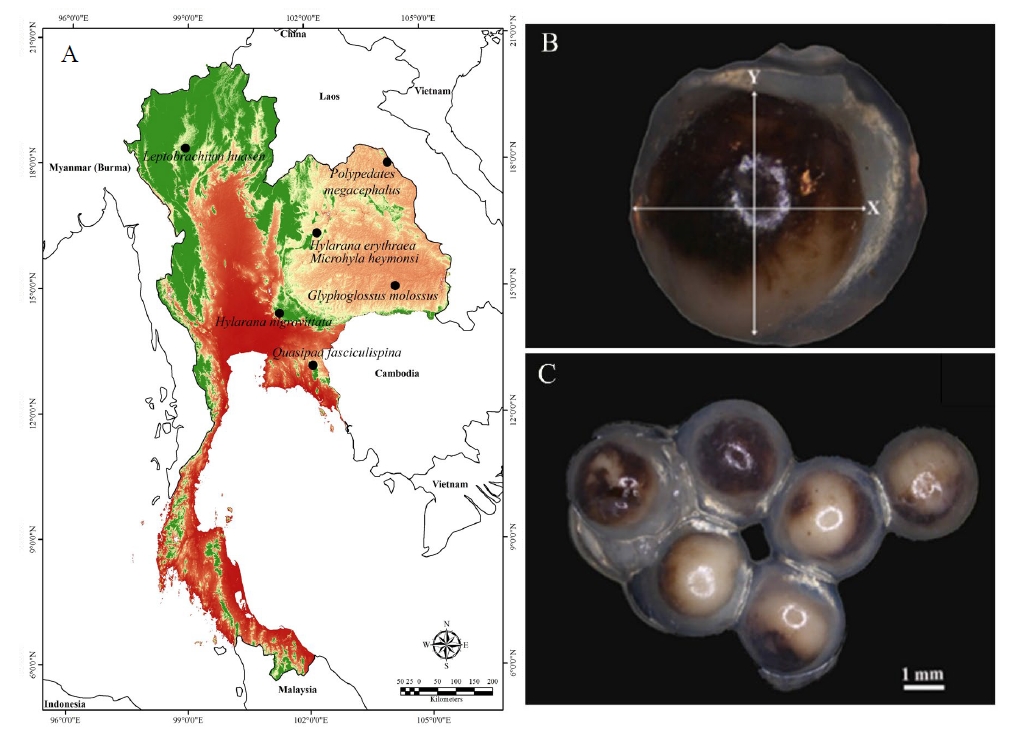
Methodology: Egg specimens representing seven species were examined from the vertebrate specimen collection of the Department of Biology, Faculty of Science, Khon Kaen University, Khon Kaen Province, Thailand and the Thailand Natural History Museum, National Science Museum, Pathum Thani Province, Thailand. The specimens had been collected from four regions of Thailand: northern Thailand (Chiang Mai), northeastern Thailand (Bueng Kan, Khon Kaen, and Si Sa Ket), eastern Thailand (Chanthaburi), and central Thailand (Nakhon Nayok). The sampling localities and number of female specimens examined were as follows: Chiang Mai Province, Leptobrachium huashen (n = 1); Bueng Kan Province, Polypedates megacephalus (n = 1); Khon Kaen University, Khon Kaen Province, Microhyla heymonsi (n = 3) and Hylarana erythraea (n = 3); Si Sa Ket Province, Glyphoglossus molossus (n = 1); Chanthaburi Province, Quasipaa fasciculispina (n = 1); and Nakhon Nayok Province, H. nigrovittata (n = 1). The specimens were preserved in a solution containing 10% formalin and 70% alcohol. The total number of eggs in each clutch was counted, and egg length (X-dimension) and width (Y-dimension) were measured using an ocular micrometer attached to a stereomicroscope. Individual egg volumes (mm3) were calculated using the spherical volume formula V = 4/3 * π * r3, where radius (r) was calculated as the average of the two measured dimensions divided by two. Descriptive statistics (mean ± standard deviation and range) were calculated for clutch size, linear egg dimensions, and egg volumes.
Main Results: Clutch sizes showed extreme interspecific variation spanning over two orders of magnitude, ranging from 42 eggs in Q. fasciculispina (n = 1) to 6,269 eggs in G. molossus (n = 1). Among species evaluated with multiple clutches (n = 3), H. erythraea yielded a mean clutch size of 498.00 ± 36.39 eggs (456 – 520), whereas M. heymonsi demonstrated higher intraspecific variation with a mean of 395.33 ± 116.76 eggs (292 – 522). For single observations (n = 1), clutch sizes were 431 eggs in L. huashen, 1,171 eggs in H. nigrovittata, and 122 eggs in P. megacephalus. Clear physical trade-offs were observed in egg size and calculated volumes: stream-adapted species produced the largest individual egg dimensions and volumes, dominated by Q. fasciculispina (16.54 ± 3.59 mm3/egg; X: 3.15 ± 0.25 mm, Y: 3.19 ± 0.25 mm and L. huashen (14.40 ± 2.21 mm3/egg; X: 3.01 ± 0.15 mm, Y: 3.08 ± 0.14 mm). Conversely, the explosive-breeding burrowing species G. molossus produced high numbers of moderate-volume eggs (3.60 ± 1.45 mm3/egg; X: 1.87 ± 0.24 mm, Y: 1.92 ± 0.36 mm). Intermediate egg volumes were recorded in P. megacephalus (2.24 ± 0.42 mm3/egg), H. erythraea (2.14 ± 0.48 mm3/egg), and H. nigrovittata (1.64 ± 0.26 mm3/egg). M. heymonsi produced the smallest eggs among all evaluated taxa (0.57 ± 0.26 mm3/egg; X: 1.01 ± 0.15 mm, Y: 1.11 ± 0.14 mm). Clutch volume also varied among species. G. molossus had the largest estimated total clutch volume (22,539.11 mm³), followed by L. huashen (6,204.62 mm³) and H. nigrovittata (1,914.90 mm³). The estimated total clutch volumes of H. erythraea, Q. fasciculispina, P. megacephalus, and M. heymonsi were 1,067.47, 694.84, 273.52, and 224.89 mm³, respectively.
Conclusion: Reproductive output parameters in tropical Thai anurans demonstrate explicit life-history trade-offs dictated by microhabitat stability, deposition site hydrodynamics, and maternal physical capacity. Stream-associated taxa invest in low-fecundity, high-volume eggs enriched with energy reserves to prevent hydrodynamic displacement in fast-flowing lotic environments. Conversely, species utilizing temporary rain pools adopt an r-selected reproductive strategy, prioritizing high numerical fecundity and smaller egg volumes to facilitate rapid embryonic development and maximize overall offspring survival before pool desiccation. Establishing these baseline empirical parameters provides critical quantitative inputs for population matrix models, demographic assessments, and evidence-based amphibian conservation planning in tropical forest ecosystems.
Downloads
References
Al-Razi, H., M. Maria, & N. A. Poyarkov. 2021. Integrative taxonomic analysis reveals a new species of Leptobrachium Tschudi, 1838 (Anura, Megophryidae) from Bangladesh. Journal of Natural History 55 (1–2): 85–114. https://doi.org/10.1080/00222933.2021.1894365
Brown, G. P., & R. Shine. 2009. Beyond size–number trade-offs: clutch size as a maternal effect. Philosophical Transactions of the Royal Society B: Biological Sciences 364(1519): 1097–1106. https://doi.org/10.1098/rstb.2008.0247
Chuaynkern, C., N. Kaewtongkum, A. Ohler, P. Duengkae, S. Duangjai, S. Makchai, & Y. Chuaynkern. 2018. First description of the Nanorana (Chaparana) aenea (Smith, 1922) tadpole from northern Thailand and additional information on the Quasipaa (Eripaa) fasciculispina (Inger, 1970) tadpole buccopharyngeal anatomy. Alytes 36(1–4): 93–108.
Chuaynkern, Y., & C. Chuaynkern. 2012. Checklist of amphibians in Thailand. Journal of Wildlife in Thailand 19(1): 163–211.
Chuaynkern, Y., P. Duengkae, P. Sribandit, K. Bunchornratana, C. Chuaynkern, N. Khewwan, & S. Tipayanukul. 2011. Amphibia, Anura, Dicroglossidae, Quasipaa fasciculispina (Inger, 1970): Distribution extension. Check List 7(2): 114–116.
Das, I., & A. Haas. 2010. New species of Microhyla from Sarawak: Old World's smallest frogs crawl out of miniature pitcher plants on Borneo (Amphibia: Anura: Microhylidae). Zootaxa 2571: 37–52.
Duellman, W. E., & L. Trueb. 1994. Biology of Amphibians. Johns Hopkins University Press.
Frost, D. R. 2026. Amphibian Species of the World: an Online Reference. Available source: https://amphibiansoftheworld.amnh.org/index.php. (Accessed 20 October 2026)
Gosner, K. L. 1960. A simplified table for staging anuran embryos and larvae with notes on identification. Herpetologica 16: 183–190. http://www.jstor.org/stable/3890061
Howard, R. D. 1978. The influence of maledefended oviposition sites on early embryonic mortality in bullfrogs. Ecology 59: 789–798.
Inthara, C., Y. Chuaynkern, P. Duengkae, P., & S. Grosjean. 2009. The tadpole of Quasipaa fasciculispina (Inger, 1970) from southeastern Thailand, with the description of its buccal anatomy. Alytes 26(1–4): 86–96.
Kuramoto, M. 1978. Correclations of quantitative parameters of fecundity in amphibians. Evolution 32: 287–296.
Malagoli, L. R., T. L. Pezzuti, D. L. Bang, J. Faivovich, M. L. Lyra, J. G. R. Giovanelli, P. C. de Anchietta Garcia, R. J. Sawaya, & C. F. B. Haddad. 2021. A new reproductive mode in anurans: Natural history of Bokermannohyla astartea (Anura: Hylidae) with the description of its tadpole and vocal repertoire. PLoS ONE 16(2): e0246401.
Ngo, B. V., C. D. Ngo, & P.-C. L. Hou. 2013. Reproductive ecology of Quasipaa verrucospinosa (Bourret, 1937): Living in the Tropical Rain Forests of Central Vietnam. Journal of Herpetology 47: 138–147. https://doi.org/10.1670/11-286
Oonraun, W., P. Duengkae, C. Chuaynkern, & Y. Chuaynkern. 2015. A relative abundance of Quasipaa fasciculispina between interior and exterior areas of Khao Soi Dao Wildlife Sanctuary, Chanthaburi Province. Journal of Wildlife in Thailand 22: 141–154.
Roff, D. A. 1992. The Evolution of Life Histories: Theory and Analysis. Chapman and Hall, New York.
Sheridan, J. A. 2009. Reproductive variation corresponding to breeding season length in three tropical frog species. Journal of Tropical Ecology 25: 583–592.
Smith, C. C., & S. D. Fretwell. 1974. The optimal balance between size and number of offspring. American Naturalist 108: 499–506.
Unsrisong, G., U. Joradol, P. Pronsopin, & S. Kantiyawong. 2002. Breeding of Rana pileata (Boulenger). The 40th Proceedings of the Kasetsart University. Kasetsart University-Press. pp. 531–536.
Vassilieva, A. B., V. L. Trounov, N. A. Poyarkov, Jr., & E. A. Galoyan. 2017. The phytotelm tadpoles of Microhyla arboricola (Anura: Microhylidae) from Vietnam, with comments on reproductive biology and development. Zootaxa 4247(4): 413–428.
Vitt, L. J., & J. P. Caldwell. 2014. Herpetology: An Introductory Biology of Amphibians and Reptiles. Fourth Edition. Academic Press, Paris.
Wells, K. D. 2007. The Ecology and Behavior of Amphibians. University of Chicago Press.
Downloads
Published
Issue
Section