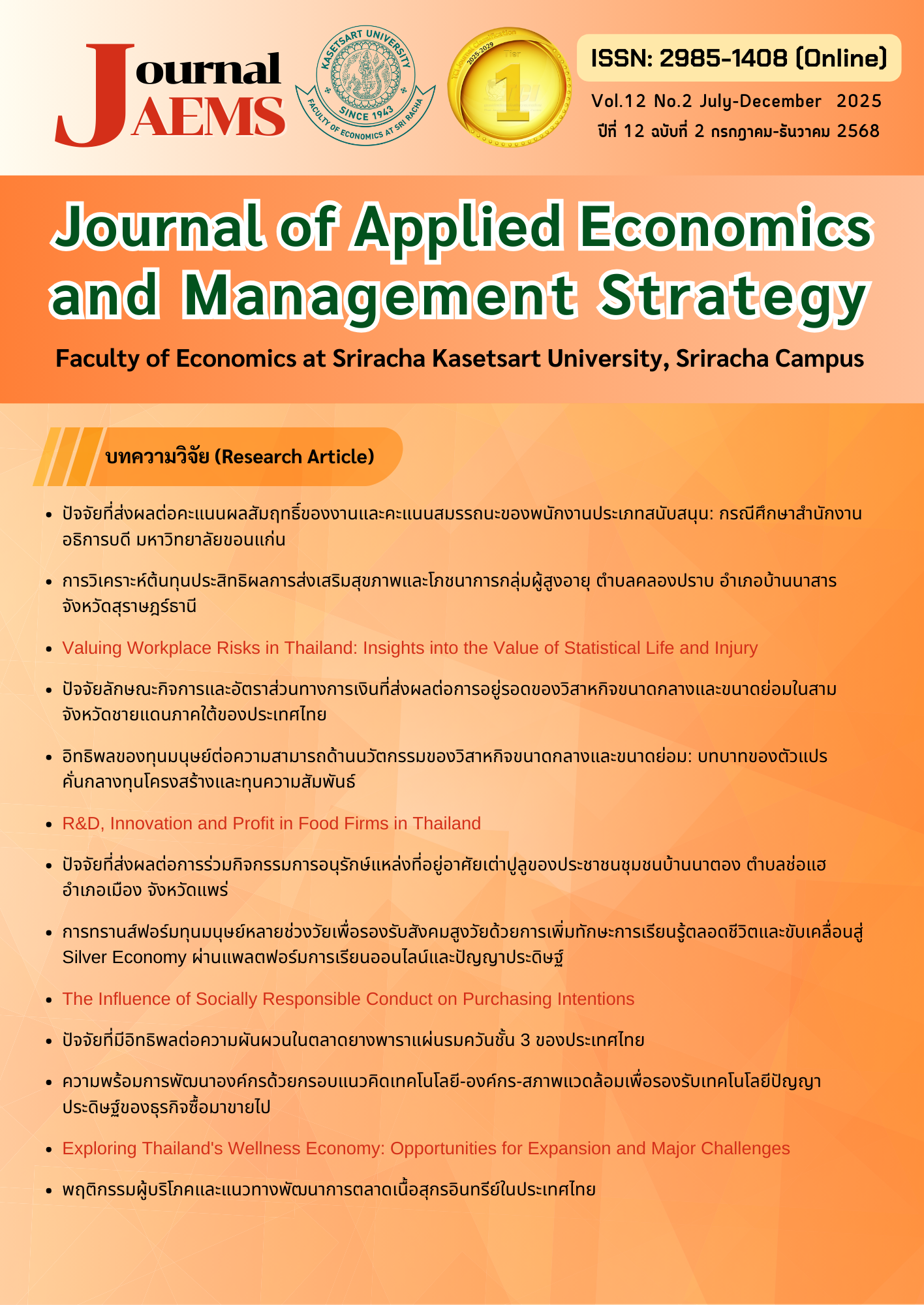
Transforming Multi-Generational Human Capital to Support an Aging Society by Enhancing Lifelong Learning Skills and Driving toward a Silver Economy through Online Learning Platforms and Artificial Intelligence
Article Sidebar
Main Article Content
Abstract
The purpose of this research is 1) to study the needs of multi-age entrepreneurial courses, 2) to develop multiple entrepreneurial courses using online platforms and artificial intelligence, and 3) to compare the knowledge from both teachings during teaching through the online platform with the use of AI in teaching. The tool used for data collection consists of questionnaires and test models. Data analysis used percentage, average, standard deviation, t-test, One-way ANOVA, Paired–Sample t-test, and Logistic model. The samples group consisted of 759 persons from 6 age groups: 1) 20-29 years old, 2) 30-39 years old, 3) 40-49 years old, 4) 50-59 years old, 5) 60-69 years old, 6) 70 years and over, and from 5 occupational groups: 1) manufacturing industry, 2) trading industry, 3) service industry, 4) community enterprise, 5) others, using a random sampling method. The duration of the trial was 1 year.
The research results can be summarized as follows: 1) The need for multi-age entrepreneurship courses is to seek additional knowledge (25.91%), followed by the need to increase knowledge and skills for modern work (19.09%) and the need to use knowledge to improve their own business/workplace (18.32%), respectively. 2) The developed multi-age entrepreneurship curriculum consists of 4 subjects: Innovation/Business and Technology, Plant/Production and Maintenance Management, Logistics and Supply Chain Management, and Human Resource Management. 3) Teaching Method 2, which incorporates AI into teaching, results in learners achieving higher average scores than Teaching Method 1. There are statistically significant differences between the two teaching methods, with a high effect size indicating a clear difference between the two teaching methods. The research results show that applying the ADDIE model concept in the development process of a multi-age entrepreneurship curriculum using online platforms and artificial intelligence makes the entrepreneurship curriculum highly appropriate and applicable in teaching.
Downloads
Article Details

This work is licensed under a Creative Commons Attribution-NonCommercial-NoDerivatives 4.0 International License.




References
ไทยพีบีเอส (2567, 16 พฤศจิกายน). คนไทยว่างงาน พุ่ง 4.1 แสนคน สสช.เผย 59.25 % ให้เหตุผล “ลาออก”. https://www.thaipbs.or.th/news/content/340062
ธวัลรัตน์ คายันต์ (2566). การศึกษาความตั้งใจในการเป็นผู้ประกอบการของนิสิต-นักศึกษาเภสัชศาสตร์ในประเทศไทย. [วิทยานิพนธ์ปริญญามหาบัณฑิต, มหาวิทยาลัยมหิดล].
พรประสิทธิ์ เด่นโมฬี. (2564). การพัฒนาหลักสูตรผู้ประกอบการด้วยการเรียนผ่านออนไลน์เพื่อส่งเสริมความเป็นผู้ประกอบการของนิสิตนักศึกษาในสถาบันอุดมศึกษา. [วิทยานิพนธ์ปริญญาดุษฎีบัณฑิต, จุฬาลงกรณ์มหาวิทยาลัย].
พีรญา กัณฑบุตร. (2559). ปัจจัยแห่งความสำเร็จในการเป็นผู้ประกอบการธุรกิจขนาดกลางและขนาดเล็ก. วารสารวิจัยมหาวิทยาลัยเวสเทิร์น มนุษยศาสตร์และสังคมศาสตร์, 2(1), 59-76.
มูลนิธิยุวพัฒน์. (2566, 29 มิถุนายน). Generation Gap เข้าใจ “ความต่าง” ระหว่างวัย ความท้าทายใหม่โลกการศึกษา. https://kasets.art/a6BkZQ
เมธาวี เกียรติพรพิเชฐ และจรัญญา ปานเจริญ. (2560). คุณสมบัติและความตั้งใจที่จะเป็นผู้ประกอบการของนักศึกษาระดับปริญญาตรีของมหาวิทยาลัยธุรกิจบัณฑิตย์. วารสารมหาวิทยาลัยธุรกิจบัณฑิตย์, 7(2). 153-165.
วิชยาภรณ์ ระจิตร. (2557). การประยุกต์ใช้การเรียนการสอนสื่ออิเลคทรอนิกส์. [วิทยานิพนธ์หลักสูตรวิทยาศาสตร์มหาบัณฑิต, มหาวิทยาลัยเทคโนโลยีมหานคร].
ศักดิ์คเรศ ประกอบผล. (2563). การออกแบบและพัฒนาบทเรียนคอมพิวเตอร์ช่วยสอนโดยใช้แอดดี้โมเดลและแนวคิดของกาเย่. วารสารครุศาสตร์สาร, 14(1), 17-30.
ศิริวัฒน์ ตั้งทรงเจริญ. (2558). คุณลักษณะของการเป็นผู้ประกอบการของนักศึกษาระดับปริญญาโทด้านบริหารธุรกิจในเขตกรุงเทพมหานคร. [วิทยานิพนธ์ปริญญามหาบัณฑิต ,มหาวิทยาลัยธรรมศาสตร์].
สำนักงานเลขาธิการสภาการศึกษา. (2564). การสังเคราะห์งานวิจัยผู้สูงอายุในประเทศไทย. (พิมพ์ครั้งที่ 1). บริษัท พริกหวานกราฟฟิค จำกัด.
สุภโชค ตันพิชัย. (2566, 3 พฤษภาคม). จากการสอนแบบดั้งเดิมสู่การเรียนรู้ที่มีเทคโนโลยีเป็นเพื่อนคู่คิด: การเดินทางสู่อนาคตของการศึกษา. สถาบันการเรียนรู้. https://li.kmutt.ac.th/from-traditional-teaching-to-technology-enabled-learning/knowledge/
Kaur, S., Budhraja, K., Pahuja, A., Nayyar, V., & Saluja, S. (2024). Leveraging artificial intelligence in education: Enhancing learning experience. In Ethical AI and Data Management Strategies in Marketing. [Publisher]. DOI: https://doi.org/10.4018/979-8-3693-6660-8.ch010
Liu, S., Sun, H.,Zhuang, J., & Xiong, R. (2023). The Impact of E-Learning Technologies on Entrepreneurial and Sustainability Performance. Sustainability, 15(21). Retrieved September 2, 2025 from https://doi.org/10.3390/su152115660 DOI: https://doi.org/10.3390/su152115660
Ryzheva, N., Nefodov, D., Romanyuk, S., Marynchenko, H., & Kudla, M. (2024). Artificial Intelligence in higher education: Opportunities and challenges. Amazonia Investiga. 13(73), 284-296. https://doi.org/10.34069/AI/2024.73.01.24 DOI: https://doi.org/10.34069/AI/2024.73.01.24