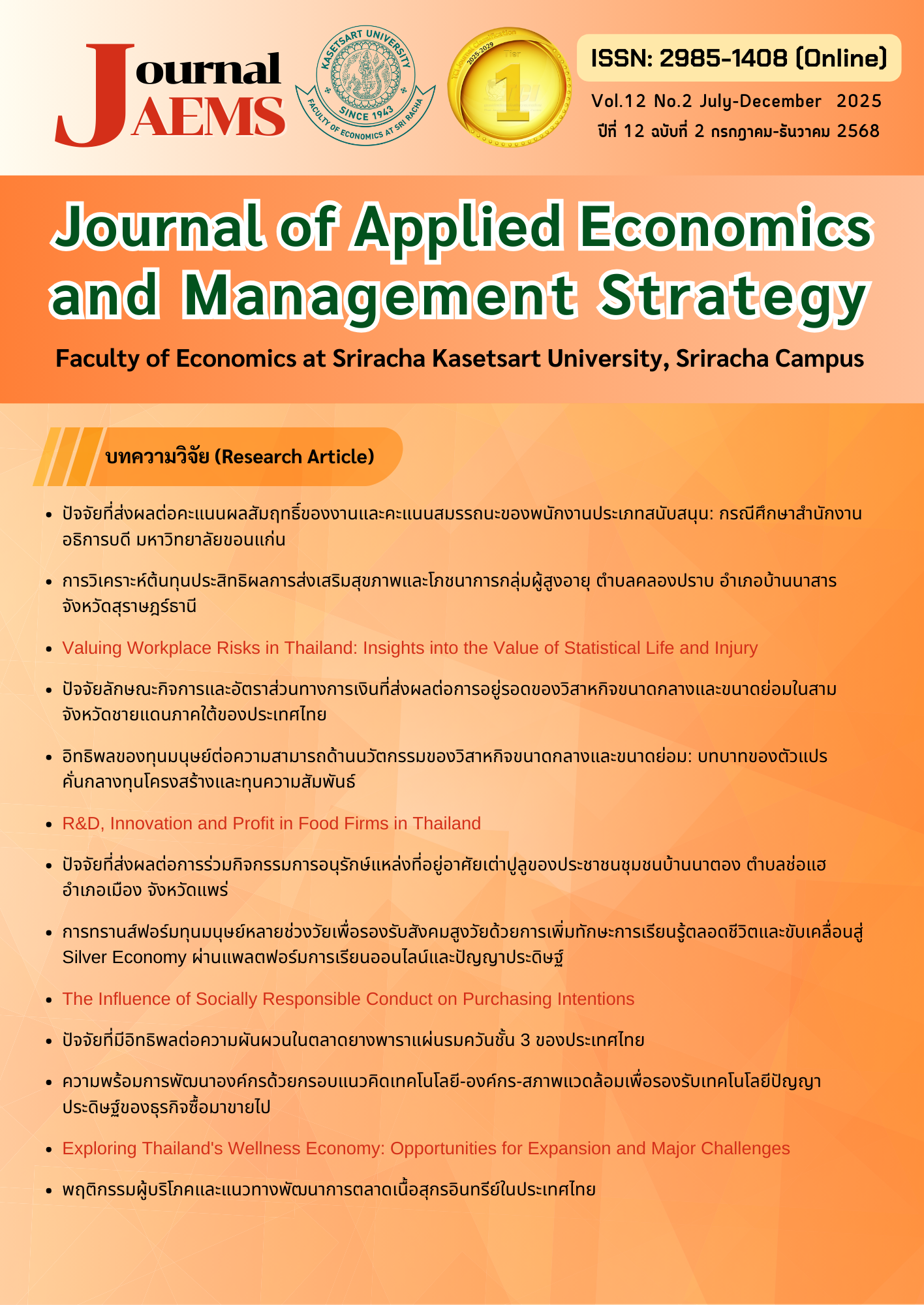
The Readiness of Organizational Development with A Framework of Technology-Organization-Environment to Support Artificial Intelligence Technology for Trading Business
Article Sidebar
Main Article Content
Abstract
This research aims to 1) study the level of opinion on the technology characteristics, organizational characteristics, environmental characteristics, and the readiness of organizational development, 2) study the causal relationship model of the technology characteristics, organizational characteristics, and environmental characteristics affecting the readiness of organizational development, and 3) test the type of business as a moderating variable in the Technology-Organization-Environment Framework (TOE) toward the readiness of organizational development to support artificial intelligence technology for trading business. This is quantitative research by using a non-probability sampling method from 354 business owners of trading business in northern Thailand. The model will be analyzed using structural equation modeling.
The research findings are as follows: 1) Entrepreneurs' opinions on technology characteristics and readiness of organizational development are a high level (mean = 4.11), followed by environmental characteristics (mean = 3.99) and organizational characteristics (mean = 3.93), respectively. 2) The technology characteristics factor has the greatest direct influence on readiness of organizational development (total influence = 0.518), followed by environmental characteristics (total influence = 0.190) and organizational characteristics (total influence = 0.146), respectively. 3) The analysis of moderating variables showed that the type of business is a moderating variable influencing the path of technology characteristics toward the readiness of organizational development (Effect = -0.198, t = 2.188, p-value = 0.05) and higher predictive power (from R² = 0.647 to R² = 0.660). The research findings can be used as guidelines for developing technological, personnel, and management capabilities to adapt to change and appropriately enhance business efficiency in the digital age.
Downloads
Article Details

This work is licensed under a Creative Commons Attribution-NonCommercial-NoDerivatives 4.0 International License.




References
กรมพัฒนาธุรกิจการค้า. (2566). สถิติจำนวน SMEs ในประเทศไทย. https://www.tcg.or.th/news_inside.php?news_id=37
บุญชม ศรีสะอาด. (2560). การวิจัยเบื้องต้น (พิมพ์ครั้งที่10). สุวีริยาสาส์น.
มหาวิทยาลัยธรรมศาสตร์. (2567). ใช้ AI อย่างมีกลยุทธ์ อย่างชาญฉลาด เพื่อเตรียมความพร้อมสู่ปี 2025. วิทยาลัยนวัตกรรม มหาวิทยาลัยธรรมศาสตร์.
สำนักงานพัฒนาธุรกรรมทางอิเล็กทรอนิกส์. (2567). ความพร้อมในการประยุกต์ใช้เทคโนโลยีปัญญาประดิษฐ์ (AI) สำหรับบริการดิจิทัล. สำนักงานพัฒนาธุรกรรมทางอิเล็กทรอนิกส์.
สุกมล มุ่งพัฒนสุนทร. (2563). มานุษยวิทยาดิจิทัลภายใต้กรอบแนวคิดทฤษฎีเทคโนโลยีสื่อกลาง. Journal of MCU Social Science Review, 9(1), 82-97.
Ahmad, S. F., Han, H., Alam, M. M., Rehmat, M., Irshad, M., Arraño-Muñoz, M., & Ariza-Montes, A. (2023). Impact of artificial intelligence on human loss in decision making, laziness and safety in education. Humanities and Social Sciences Communications, 10(1), 1-14. DOI: https://doi.org/10.1057/s41599-023-01842-4
Akpoviroro, S. A., & Owotutu, S. O. (2018). Impact of external environment characteristics on organizational performance. IJARIIE, 4(3), 498-505.
Arun, K.B. (2015). Plantain peel-a potential source of antioxidant dietary fibre for developing functional cookies. Journal of Food Science and Technology, 52, 6355-6364. DOI: https://doi.org/10.1007/s13197-015-1727-1
Assaye, B. T., Endalew, B., Tadele, M. M., Teferie, H. G, Teym, A., Melese, Y. H., Senishaw, A. F., Wubante, S. M., Ngusie, H. S., & Haimanot, A. B. (2024). Readiness of big health data analytics by technology-organization-environment (TOE) framework in Ethiopian health sectors. Heliyon, 10(19), 1-14. DOI: https://doi.org/10.1016/j.heliyon.2024.e38570
Balan, P., & Lindsay, N. (2010). Innovation capability, entrepreneurial orientation and performance in Australian hotels: An empirical study. Australia: Sustainable Tourism Cooperative Research Centre.
Cohen, J. (1992). Quantitative methods in psychology: a power primer. Psychological Bulletin, 112(1), 155-159. DOI: https://doi.org/10.1037/0033-2909.112.1.155
Comrey, A. L. & Lee, H. B. (1992). A first course in factor analysis. Erlbaum.
Cronbach, L. J. (1990). Essentials of psychological testing (5th ed.). Harper Collins.
Diamantopoulos, A., & Siguaw, J. A. (2000). Introducing LISREL. Sage Publications. DOI: https://doi.org/10.4135/9781849209359
Dolgui, A., & Sokolov, B. (2019). The impact of digital technology and Industry 4.0 on the ripple effect and supply chain risk analytics. International Journal of Production Research, 57(3), 829-846. DOI: https://doi.org/10.1080/00207543.2018.1488086
Felemban, H. (2024). Exploring the readiness of organizations to adopt artificial intelligence (AI): A TOE framework perspective. Journal of Construction Innovation, 24(2), 210-228.
Fornell, C., & Larcker, D. F. (1981). Structural Equation Models with Unobservable Variables and Measurement Error: Algebra and Statistics. Journal of Marketing Research. 18(1), 382-388. DOI: https://doi.org/10.1177/002224378101800313
Hair, J. F., Black, W. C., Babin, B. J., & Anderson, R. E. (2019). Multivariate data analysis (8th ed.). Cengage Learning.
Hans, V. B. (2018). Business environment–conceptual framework and polices. International Educational Scientific Research Journal, 4(3), 67-74.
Hradecky, D, Kennell, J., Cai, W., & Davidson, R. (2022). Organizational readiness to adopt artificial intelligence in the exhibition sector in Western Europe. International Journal of Information Management, 65, 1-13. DOI: https://doi.org/10.1016/j.ijinfomgt.2022.102497
Johnk, J., Weißert, M., & Wyrtki, K. (2021). Ready or not, AI comes: An interview study of organizational AI readiness factors. Business Research, 14(3), 1103-1133. DOI: https://doi.org/10.1007/s12599-020-00676-7
Johnson, S. (2024). Technology and Inequality in the Age of AI. Chalmers University of Technology.
Kopalle P., Gangwar M., Kaplan A., Ramachandran D., Reinartz W., & Rindfleisch A. (2022). Examining artificial intelligence (AI) technologies in marketing via a global lens: Current trends and future research opportunities. International Journal of Research in Marketing, 39(3), 1-19. DOI: https://doi.org/10.1016/j.ijresmar.2021.11.002
Lee, S.M., & Lim, S. (2009). Entrepreneurial orientation and the performance of service business. Service Business, 3, 1-13. DOI 10.1007/s11628-008-0051-5 DOI: https://doi.org/10.1007/s11628-008-0051-5
Likert, R. (1970). A technique for the measurement of attitude. Ronal McNally& Company.
OECD. (2024). AI readiness and workforce adaptability report. OECD Publishing.
Qalati, S. A., Li, W., Vela, E. G., Bux, A., Barbosa, B., & Herzallah, A. M. (2020). Effects of technological, organizational, and environmental factors on social media adoption. Journal of Asian Finance, Economics and Business, 7(10), 989-998. DOI: https://doi.org/10.13106/jafeb.2020.vol7.no10.989
Rahman, A. (2024). Spatial analysis of narcotics abuse based on knowledge, socio-demographics, social environment, and swamp land. Journal of Ecohumanis, 3(6), 1895-1907. DOI: https://doi.org/10.62754/joe.v3i6.4140
Shaikh, N. (2023). Generative AI use cases for e-commerce. International Journal of Computer Science and Mobile Computing, 12(9), 10-14. DOI: https://doi.org/10.47760/ijcsmc.2023.v12i09.002
Sharma, A. K., & Sharma, R. (2024). How artificial intelligence is transforming social media marketing: Analysing its potential and addressing concerns. Journal of Cultural Strategy Marketing, 9(1), 75-90. DOI: https://doi.org/10.69554/CWQB3739
Singh, B., Srivastava, S., Chaudhuri, R., Chatterjee, S., & Vrontis, D. (2024). Assessing the entrepreneurial business performance from a dynamic capability and TOE framework: moderating role of crowdfunding support. Journal of Small Business and Enterprise Development, 62(2), 824-846.
Smith, E. (2023). Artificial Intelligence and education: current applications and future directions. Educational Technology Research and Development, 30(3), 321-345.
Weiner, B. J. (2009). A theory of organizational readiness for change. Implementation Science, 4(1), 1-9. DOI: https://doi.org/10.1186/1748-5908-4-67
Williams, P., Johnson, K., & Chen, R. (2023). Technology acceptance in AI-enhanced communication systems. MIS Quarterly, 47(2), 389-412.
World Economic Forum. (2024). The future of jobs report 2024. WEF.
Yang, J., Sun, Z., & Lee, H. (2024). Artificial intelligence adoption in professional service firms: A TOE-based analysis. Journal of Business Research, 170(1), 1-18.