Balancing Flexibility and Fairness: Job and Personality Drivers of Hybrid and Remote Work in Thailand
Article Sidebar
Main Article Content
Abstract
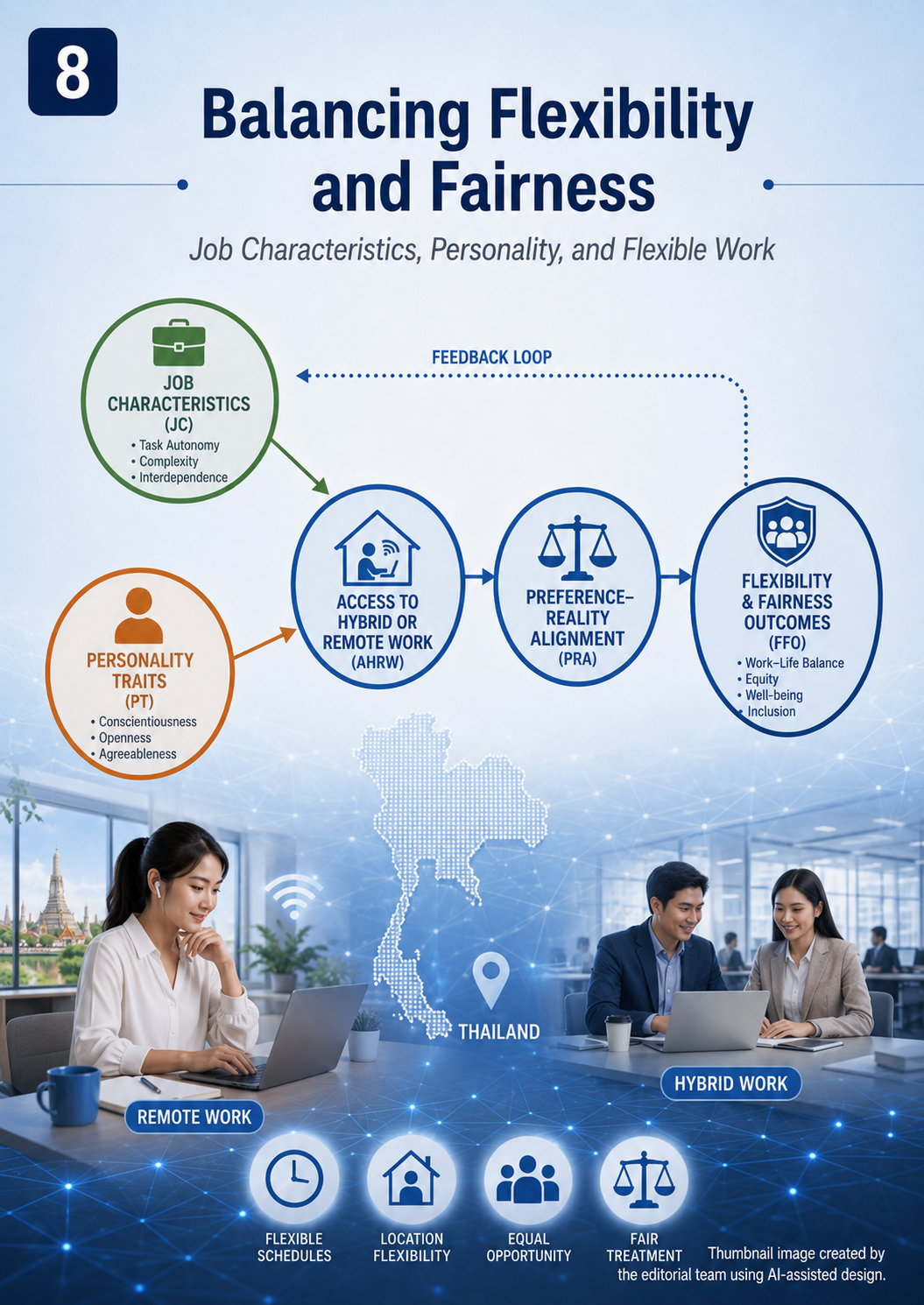
Flexible work has reshaped employment relations after COVID-19, raising concerns about fairness in access to hybrid and remote arrangements. This study examines how job characteristics and personality traits influence both access to and alignment with flexible work in Thailand, a context marked by hierarchical management and uneven flexibility adoption. Using survey data from 400 urban employees across multiple industries in Thailand—predominantly female (67.2%), university-educated (74.3%), and concentrated in the Bangkok metropolitan area—ordered and binary logistic regressions models were employed to identify how structural and psychological factors shape current work formats, preferences, and misalignment.
Results show persistent inequalities. Jobs requiring high levels of cooperation and attention to detail are less compatible with remote work, while introverted employees are more likely to experience preference–reality misalignment. Income and job level strongly predict access to flexibility, with managerial and higher-income employees benefiting disproportionately. Women also report greater scheduling mismatches, indicating gendered barriers to temporal flexibility.
By integrating job design, personality, and Person–Environment Fit perspectives, the study highlights flexibility as both a structural and a fairness issue. The findings underscore the need for transparent, flexible policies and trust-based management to ensure equitable access amid evolving employment relations.
Downloads
Article Details

This work is licensed under a Creative Commons Attribution-NonCommercial-NoDerivatives 4.0 International License.




References
Allen, T. D., Merlo, K., Lawrence, R. C., Slutsky, J., & Gray, C. E. (2021). Boundary management and work–nonwork balance while working from home. Applied Psychology, 70(1), 60–84. https://doi.org/10.1111/apps.12300
Allen, T. D., Golden, T. D., & Shockley, K. M. (2015). How effective is telecommuting? Assessing the evidence. Psychological Science in the Public Interest, 16(2), 40–68. https://doi.org/10.1177/1529100615593273
Cain, S. (2012). Quiet: The power of introverts in a world that can’t stop talking. Crown Publishing.
Chung, H., & van der Lippe, T. (2020). Flexible working, work–life balance, and gender equality: Introduction. Social Indicators Research, 151(2), 365–381. https://doi.org/10.1007/s11205-018-2025-x
Chung, H. (2023). The flexibility paradox: Why flexible working leads to (self-)exploitation. Policy Press.
Carnevale, J. B., & Hatak, I. (2020). Employee adjustment and well-being in the era of COVID-19: Implications for human resource management. Journal of Business Research, 116, 183–187. https://doi.org/10.1016/j.jbusres.2020.05.037
Greenberg, J. (1987). A taxonomy of organizational justice theories. Academy of Management Review, 12(1), 9–22. https://doi.org/10.2307/257990
Kniffin, K. M., Narayanan, J., Anseel, F., Antonakis, J., Ashford, S. P., Bakker, A. B., Bamberger, P., Bapuji, H., Bhave, D. P., Choi, V. K., Creary, S. J., Demerouti, E., Flynn, F. J., Gelfand, M. J., Greer, L. L., Johns, G., Kesebir, S., Klein, P. G., Lee, S. Y., ... & Vugt, M. V. (2021). COVID-19 and the workplace: Implications, issues, and insights for future research and action. American Psychologist, 76(1), 63–77. https://doi.org/10.1037/amp0000716
Gavoille, N., & Hazans, M. (2022). Personality traits, remote work and productivity. SSRN. https://ssrn.com/abstract=4233436
Hackman, J. R., & Oldham, G. R. (1976). Motivation through the design of work: Test of a theory. Organizational Behavior and Human Performance, 16(2), 250–279. https://doi.org/10.1016/0030-5073(76)90016-7
Hofstede, G. (2001). Culture’s consequences: Comparing values, behaviors, institutions, and organizations across nations (2nd ed.). Sage.
Humphrey, S. E., Nahrgang, J. D., & Morgeson, F. P. (2007). Integrating motivational, social, and contextual work design features: A meta-analytic summary and theoretical extension of the work design literature. Journal of Applied Psychology, 92(5), 1332–1356. https://doi.org/10.1037/0021-9010.92.5.1332
Kelliher, C., & Anderson, D. (2010). Doing more with less? Flexible working practices and the intensification of work. Human Relations, 63(1), 83–106. https://doi.org/10.1177/0018726709349199
Kossek, E. E., Perrigino, M., & Lautsch, B. A. (2023). Work–life flexibility policies from a boundary control and implementation perspective: A review and research framework. Journal of Management, 49(6), 2062–2108. https://doi.org/10.1177/01492063221140354
Kristof-Brown, A. L., Zimmerman, R. D., & Johnson, E. C. (2005). Consequences of individuals’ fit at work: Meta-analysis of person–job, person–organization, person–group, and person–supervisor fit. Personnel Psychology, 58(2), 281–342. https://doi.org/10.1111/j.1744-6570.2005.00672.x
McCrae, R. R., & Costa, P. T. (1997). Personality trait structure as a human universal. American Psychologist, 52(5), 509–516. https://doi.org/10.1037/0003-066X.52.5.509
Tett, R. P., & Burnett, D. D. (2003). A personality trait–based interactionist model of job performance. Journal of Applied Psychology, 88(3), 500–517. https://doi.org/10.1037/0021-9010.88.3.500
Williams, J. C., Blair-Loy, M., & Berdahl, J. L. (2013). Cultural schemas, social class, and the flexibility stigma. Journal of Social Issues, 69(2), 209–234. https://doi.org/10.1111/josi.12012