Equity–Cryptocurrency Substitution and Risk-Adjusted Portfolio Performance: A Comparative Study of Growth vs. Value Stocks Across Regions
Article Sidebar
Main Article Content
Abstract
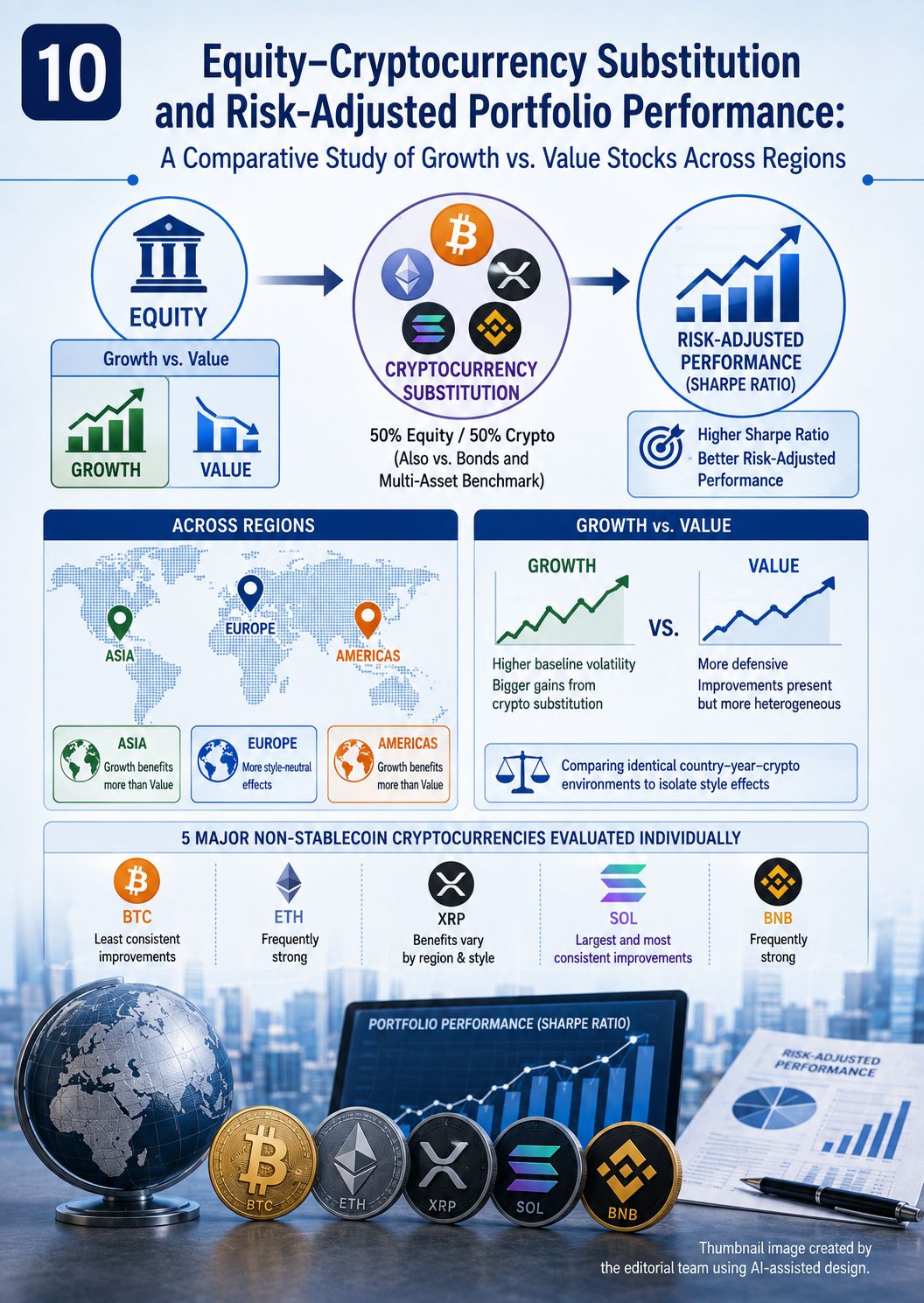
This study evaluates the risk-adjusted consequences of large-weight equity–cryptocurrency substitution and examines whether these effects differ systematically across equity styles (Growth vs. Value) and regions (Asia, Europe, and the Americas). Using daily data from January 1, 2021 to December 31, 2023, the analysis constructs style-segmented MSCI country equity indices and compares annual Sharpe ratios under four constant-mix, daily rebalanced strategies: (S1) 100% equity; (S2) 50% equity / 50% cryptocurrency; (S3) 50% equity / 50% global bonds; and (S4) 33.33% equity / 33.33% global bonds / 33.33% cryptocurrency. Five major non-stablecoin cryptocurrencies—Bitcoin (BTC), Ethereum (ETH), Ripple (XRP), Solana (SOL), and Binance Coin (BNB)—are evaluated individually to isolate coin-specific substitution effects. Performance is assessed annually and compared across Growth and Value portfolios within identical country–year–cryptocurrency environments to identify style-dependent outcomes. The results show that cryptocurrency substitution generally improves Sharpe ratios, but the effects are benchmark-, coin-, style-, and region-dependent. Improvements are more heterogeneous under direct 50% equity–crypto substitution, especially for Value portfolios, but become uniformly positive when crypto is introduced within an equity–bond benchmark. SOL provides the largest and most consistent improvements, while ETH and BNB are frequently strong and BTC is the least consistent. Growth portfolios benefit more than Value portfolios in Asia and the Americas, whereas Europe shows more style-neutral effects. Because cryptocurrency shocks are common within a given coin-year, statistical inference is interpreted as cross-market evidence rather than fully independent observations.
Downloads
Article Details

This work is licensed under a Creative Commons Attribution-NonCommercial-NoDerivatives 4.0 International License.




References
Bariviera, A. F. (2017). The inefficiency of Bitcoin revisited: A dynamic approach. Economics Letters, 161, 1–4. https://doi.org/10.1016/j.econlet.2017.09.013
Bodie, Z., Kane, A., & Marcus, A. J. (2021). Investments (12th ed.). McGraw-Hill Education.
Bouri, E., Molnár, P., Azzi, G., Roubaud, D., & Hagfors, L. I. (2017). On the hedge and safe haven properties of Bitcoin: Is it really more than a diversifier? Finance Research Letters, 20, 192–198. https://doi.org/10.1016/j.frl.2016.09.025
Bouri, E., Shahzad, S. J. H., Roubaud, D., Kristoufek, L., & Lucey, B. M. (2020). Bitcoin, gold, and commodities as safe havens for stocks: New insight through wavelet analysis. The Quarterly Review of Economics and Finance, 77, 156–164. https://doi.org/10.1016/j.qref.2020.03.004
Brière, M., Oosterlinck, K., & Szafarz, A. (2015). Virtual currency, tangible return: Portfolio diversification with Bitcoin. Journal of Asset Management, 16(6), 365–373. https://doi.org/10.1057/jam.2015.5
Campbell, J. Y., & Vuolteenaho, T. (2004). Bad beta, good beta. American Economic Review, 94(5), 1249–1275. https://doi.org/10.1257/0002828043052240
Carhart, M. M. (1997). On persistence in mutual fund performance. The Journal of Finance, 52(1), 57–82. https://doi.org/10.1111/j.1540-6261.1997.tb03808.x
CoinMarketCap. (2024, November 11). Cryptocurrency historical data snapshot [Data set]. https://coinmarketcap.com/historical/
Conlon, T., & McGee, R. (2020). Safe haven or risky hazard? Bitcoin during the COVID-19 bear market. Finance Research Letters, 35, Article 101607. https://doi.org/10.1016/j.frl.2020.101607
Conlon, T., Corbet, S., & McGee, R. J. (2020). Are cryptocurrencies a safe haven for equity markets? An international perspective from the COVID-19 pandemic. Research in International Business and Finance, 54, Article 101248. https://doi.org/10.1016/j.ribaf.2020.101248
Diebold, F. X., & Yilmaz, K. (2012). Better to give than to receive: Predictive Directional measurement of volatility spillovers. International Journal of Forecasting, 28(1), 57–66. https://doi.org/10.1016/j.ijforecast.2011.02.006
Diebold, F. X., & Yilmaz, K. (2014). On the network topology of variance decompositions: Measuring the connectedness of financial firms. Journal of Econometrics, 182(1), 119–134. https://doi.org/10.1016/j.jeconom.2014.04.012
Dyhrberg, A. H. (2016). Bitcoin, gold and the dollar—A GARCH volatility analysis. Finance Research Letters, 16, 85–92. https://doi.org/10.1016/j.frl.2015.10.008
Engle, R. (2002). Dynamic conditional correlation: A simple class of multivariate generalized autoregressive conditional heteroskedasticity models. Journal of Business & Economic Statistics, 20(3), 339–350. https://doi.org/10.1198/073500102288618487
Fama, E. F., & French, K. R. (1993). Common risk factors in the returns on stocks and bonds. Journal of Financial Economics, 33(1), 3–56. https://doi.org/10.1016/0304-405X(93)90023-5
Guesmi, K., Saadi, S., Abid, I., & Ftiti, Z. (2019). Portfolio diversification with virtual currency: Evidence from Bitcoin. International Review of Financial Analysis, 63, 431–437. https://doi.org/10.1016/j.irfa.2018.03.004
Jayawardhana, A., & Colombage, S. R. N. (2024). Portfolio diversification possibilities of cryptocurrency: Global evidence. Applied Economics, 56(47), 5618–5633. https://doi.org/10.1080/00036846.2023.2257928
Ji, Q., Bouri, E., Lau, C. K. M., & Roubaud, D. (2019). Dynamic connectedness and integration in cryptocurrency markets. International Review of Financial Analysis, 63, 257–272. https://doi.org/10.1016/j.irfa.2018.12.002
Katsiampa, P. (2017). Volatility estimation for Bitcoin: A comparison of GARCH models. Economics Letters, 158, 3–6. https://doi.org/10.1016/j.econlet.2017.06.023
Kogan, S., Makarov, I., Niessner, M., & Schoar, A. (2024). Are cryptos different? Evidence from retail trading. Journal of Financial Economics, 159, Article 103897. https://doi.org/10.1016/j.jfineco.2024.103897
Lakonishok, J., Shleifer, A., & Vishny, R. W. (1994). Contrarian investment, extrapolation, and risk. The Journal of Finance, 49(5), 1541–1578. https://doi.org/10.1111/j.1540-6261.1994.tb04772.x
Liu, Y., & Tsyvinski, A. (2021). Risks and returns of cryptocurrency. The Review of Financial Studies, 34(6), 2689–2727. https://doi.org/10.1093/rfs/hhaa113
Liu, Y., Tsyvinski, A., & Wu, X. (2022). Common risk factors in cryptocurrency. The Journal of Finance, 77(2), 1133–1177. https://doi.org/10.1111/jofi.13119
Lo, A. W. (2002). The statistics of Sharpe ratios. Financial Analysts Journal, 58(4), 36–52. https://doi.org/10.2469/faj.v58.n4.2453
Markowitz, H. (1952). Portfolio selection. The Journal of Finance, 7(1), 77–91. https://doi.org/10.1111/j.1540-6261.1952.tb01525.x
Narayanan, A., Bonneau, J., Felten, E., Miller, A., & Goldfeder, S. (2016). Bitcoin and cryptocurrency technologies: A comprehensive introduction. Princeton University Press.
Novy-Marx, R. (2013). The other side of value: The gross profitability premium. Journal of Financial Economics, 108(1), 1–28. https://doi.org/10.1016/j.jfineco.2013.01.003
Pástor, Ľ., & Stambaugh, R. F. (2003). Liquidity risk and expected stock returns. Journal of Political Economy, 111(3), 642–685. https://doi.org/10.1086/374184
Patton, A. J. (2006). Modelling asymmetric exchange rate dependence. International Economic Review, 47(2), 527–556. https://doi.org/10.1111/j.1468-2354.2006.00387.x
Perold, A. F., & Sharpe, W. F. (1988). Dynamic strategies for asset allocation. Financial Analysts Journal, 44(1), 16–27. https://doi.org/10.2469/faj.v44.n1.16
Platanakis, E., & Urquhart, A. (2020). Should investors include Bitcoin in their portfolios? A portfolio theory approach. The British Accounting Review, 52(4), Article 100837. https://doi.org/10.1016/j.bar.2019.100837
Sharpe, W. F. (1966). Mutual fund performance. The Journal of Business, 39(1), 119–138. https://doi.org/10.1086/294846
Sharpe, W. F. (1994). The Sharpe ratio. The Journal of Portfolio Management, 21(1), 49–58. https://doi.org/10.3905/jpm.1994.409501
Symitsi, E., & Chalvatzis, K. J. (2019). The economic value of Bitcoin: A portfolio analysis of currencies, gold, oil and stocks. Research in International Business and Finance, 48, 97–110. https://doi.org/10.1016/j.ribaf.2018.12.001
Ugolini, A., Reboredo, J. C., & Mensi, W. (2023). Connectedness between DeFi, cryptocurrency, stock, and safe-haven assets. Finance Research Letters, 53, Article 103692. https://doi.org/10.1016/j.frl.2023.103692