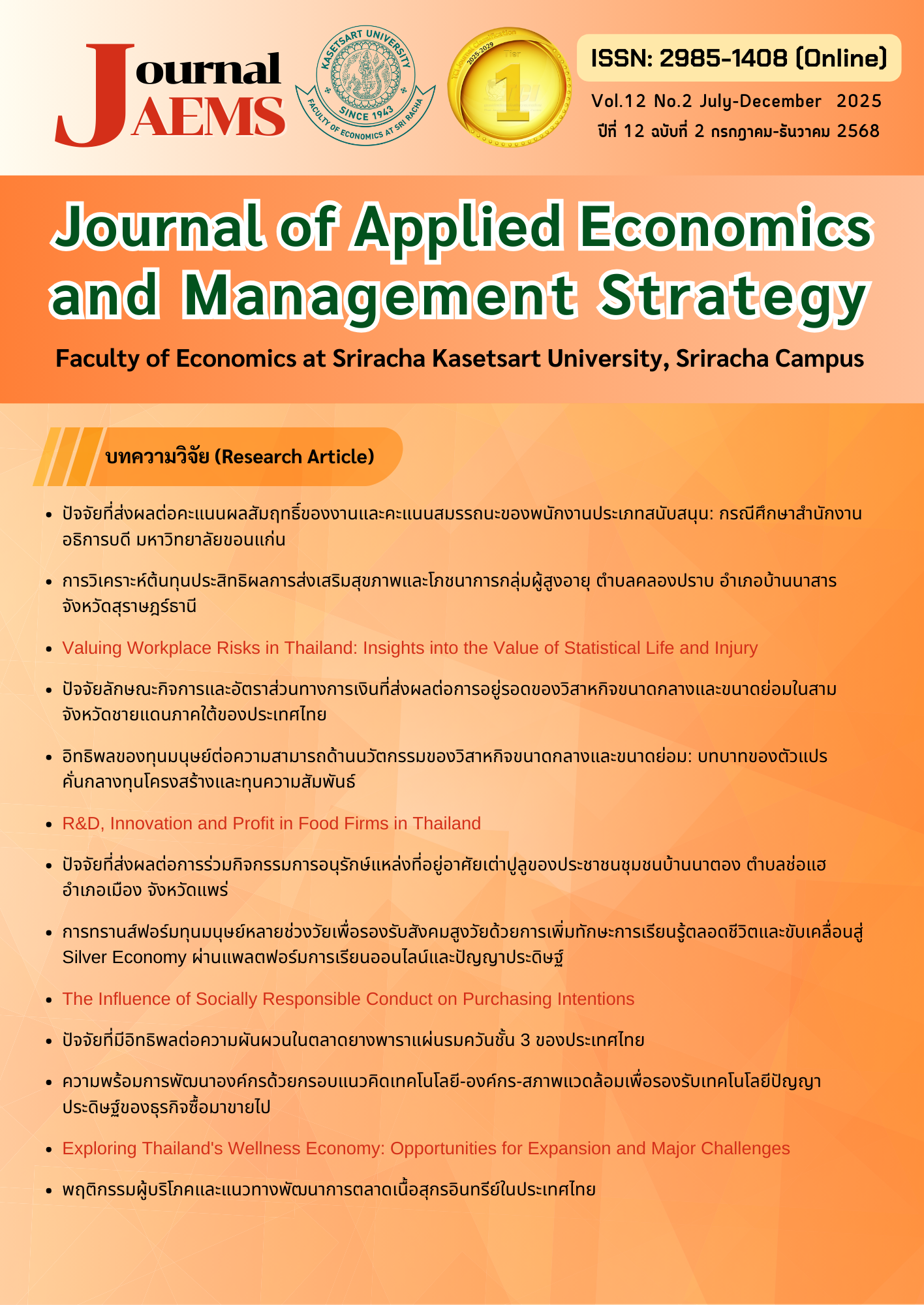
The Factors Affecting Achievement Orientation Scores and Individual Competency Scores: A Case Study of Supporting Staff at the Office of the President, Khon Kaen University
Article Sidebar
Main Article Content
Abstract
This quantitative research study utilized secondary data and employed both descriptive and inferential statistics through regression analysis to examine the factors affecting achievement orientation scores and individual competency scores among support staff at the Office of the Rector, Khon Kaen University. The research analyzed performance evaluation data from 349 support staff members obtained from the university's Human Resources Division, covering the evaluation period from June 1, 2023 to May 31, 2024. The findings revealed several key insights. First, the average overall performance score was 90.94 out of 100 points, indicating excellent performance according to the university's evaluation criteria. This comprised an average achievement-oriented performance score of 53.06 points and an average competency score of 37.88 points. Second, female employees demonstrated significantly higher job performance scores compared to their male counterparts. Third, departments focusing on people-oriented work exhibited superior performance scores relative to other department types. Fourth, work experience showed a positive impact on evaluation scores during the initial career phase (p-value < 0.10), though the rate of score improvement decelerated over time. The statistical analysis identified three significant factors affecting job performance scores: gender, departmental work characteristics, and work experience. Educational level did not demonstrate a statistically significant impact on performance outcomes. The regression models explained 23.55% of the variance in achievement-oriented performance scores, 4.96% of competency scores, and 13.76% of overall performance scores. These research findings provide valuable insights for strategic human resource development planning, recruitment processes, organizational structure design, and appropriate task allocation to enhance overall work efficiency and organizational effectiveness.
Downloads
Article Details

This work is licensed under a Creative Commons Attribution-NonCommercial-NoDerivatives 4.0 International License.




References
เกียรติพงษ์ อุดมธนะธีระ. (2565, 14 กันยายน). แนวคิดสมรรถนะ (Compctency) และทฤษฎีภูเขาน้ำแข็ง IOK2U. https://www.iok2u.com/news/administrator-gov/hr-competenc-ies
ขวัญใจ วงศ์ช่วย และเกิดศิริ เจริญวิศาล. (2559). ความสามารถเชิงสมรรถนะตามวิชาชีพ สำหรับเจ้าหน้าที่พยาบาลในการให้บริการชาวต่างชาติที่เข้ามารับการรักษาในโรงพยาบาลเอกชนของประเทศไทย. วารสารวิทยาลัยบัณฑิตศึกษาการจัดการ มหาวิทยาลัยขอนแก่น, 9(1), 23–48.
นงลักษณ์ วิรัชชัย และสุวิมล ว่องวาณิช. (2558). การวิเคราะห์ปัจจัยเชิงสาเหตุของผลสัมฤทธิ์ในการปฏิบัติงานของข้าราชการไทย. วารสารวิธีวิทยาการวิจัย, 28(2), 166-185.
พีรญา ชื่อวงศ์. (2561). ประสิทธิภาพในการปฏิบัติงานของพนักงาน: กรณีศึกษา ธุรกิจการขนส่งในจังหวัดเชียงราย: Operational Efficiency of Workers: A Case of Transportation Business in Chiang Rai Province. วารสารเศรษฐศาสตร์ประยุกต์และกลยุทธการจัดการ, 4(2), 92–100.
วิจิตร ศรีสอ้าน. (2550). ผลตอบแทนจากการศึกษาในตลาดแรงงานไทย. วารสารเศรษฐศาสตร์ประยุกต์, 14(2), 78-95.
สถาบันพัฒนาอนามัยเด็กแห่งชาติ. (n.d.). เอกสารเผยแพร่เกี่ยวกับทรัพยากรมนุษย์. https://nich.anamai.moph.go.th/th
สำนักงาน ก.พ. (2553). คู่มือการกำหนดสมรรถนะในราชการพลเรือน: คู่มือสมรรถนะหลัก. สำนักงานคณะกรรมการข้าราชการพลเรือน.
สุกัญญา รัศมีธรรมโชติ. (2567). Competency: เครื่องมือการบริหารที่ปฏิเสธไม่ได้. Productivity, 9 (53), 44–48.
สุชาดา รักไทย. (2564). การศึกษาเปรียบเทียบแรงจูงใจภายในระหว่างบุคลากรชายและหญิงในระบบราชการไทย. วารสารการบริหารรัฐกิจ, 12(2), 78-95.
สุเมธ แย้มพวง. (2562). สมรรถนะกับผลการปฏิบัติงานของข้าราชการพลเรือน. วารสารพัฒนาสังคม, 21(3), 114-128.
Aguinis, H. (2019). Performance management (4th ed.). Pearson.
Armstrong, M., & Taylor, S. (2020). Armstrong's Handbook of Human Resource Management Practice (15th ed.). Kogan Page Publishers.
Atkinson, J. W. (1957). Motivational determinants of risk-taking behavior. Psychological Review, 64(6), 359-372. DOI: https://doi.org/10.1037/h0043445
Becker, G. S. (1964, January). Human capital: A theoretical and empirical analysis, with special reference to education. National Bureau of Economic Research. https://www.nber.org/books-and-chapters/human-capital-theoretical-and-empirical-analysis-special-reference-education-first-edition
Blau, F. D., & Kahn, L. M. (2017). The gender wage gap: Extent, trends, and explanations. Journal of Economic Literature, 55(3), 789-865. https://doi.org/10.1257/jel.20160995 DOI: https://doi.org/10.1257/jel.20160995
Boyatzis, R. E. (1982). The competent manager: A model for effective performance. John Wiley & Sons.
Card, D. (1999). The causal effect of education on earnings. In O. Ashenfelter & D. Card (Eds.), Handbook of labor economics (Vol. 3, pp. 1801-1863). Elsevier. DOI: https://doi.org/10.1016/S1573-4463(99)03011-4
Chuang, S. (2016). Human capital investment and job performance in Thai public universities. Asian Journal of Management Research, 7(2), 245-261.
Clark, J. B. (1899). The distribution of wealth: A theory of wages, interest and profits. Macmillan.
Croson, R., & Gneezy, U. (2009). Gender differences in preferences. Journal of Economic Literature, 47(2), 448-474. https://doi.org/10.1257/jel.47.2.448 DOI: https://doi.org/10.1257/jel.47.2.448
Doeringer, P. B., & Piore, M. J. (1971). Internal labor markets and manpower analysis. Heath Lexington Books.
Ference, T. P., Stoner, J. A., & Warren, E. K. (1977). Managing the career plateau. Academy of Management Review, 2(4), 602-612. https://journals.aom.org/journal/amr DOI: https://doi.org/10.5465/amr.1977.4406740
Grote, D. (2017). How to be good at performance appraisals: Simple, effective, done right. Harvard Business Review Press.
Hall, D. T., & Chandler, D. E. (2005). Psychological success: When the career is a calling. Journal of Organizational Behavior, 26(2), 155-176. DOI: https://doi.org/10.1002/job.301
Hofstede, G. (2001). Culture’s consequences: Comparing values, behaviors, institutions and organizations across nations (2nd ed.). Sage Publications.
Hunter, J. E., Schmidt, F. L., & Judiesch, M. K. (1990). Individual differences in output variability as a function of job complexity. Journal of Applied Psychology, 75(1), 28-42. DOI: https://doi.org/10.1037//0021-9010.75.1.28
Ichniowski, C., Shaw, K., & Prennushi, G. (1997). The effects of human resource management practices on productivity: A study of steel finishing lines. The American Economic Review, 87(3), 291-313.
Judge, T. A., Higgins, C. A., Thoresen, C. J., & Barrick, M. R. (2001). The big five personality traits, general mental ability, and career success across the life span. Personnel Psychology, 52(3), 621-652. DOI: https://doi.org/10.1111/j.1744-6570.1999.tb00174.x
Kahneman, D. (1973). Attention and effort. Prentice-Hall.
Koshal, R. K., & Koshal, M. (1999). Economies of scale and scope in higher education: A case of comprehensive universities. Economics of Education Review, 18(2), 269-277. DOI: https://doi.org/10.1016/S0272-7757(98)00035-1
Lawler, E. E. (1994). From job-based to competency-based organizations. Journal of Organizational Behavior, 15(1), 3-15. DOI: https://doi.org/10.1002/job.4030150103
Lazear, E. P. (1981). Agency, earnings profiles, productivity, and hours restrictions. The American Economic Review, 71(4), 606-620.
Levy, P. E., & Williams, J. R. (2004). The social context of performance appraisal: A review and framework for the future. Journal of Management, 30(6), 881-905. https://doi.org/10.1016/j.jm.2004.06.005 DOI: https://doi.org/10.1016/j.jm.2004.06.005
Marshall, A. (1890). Principles of economics. Macmillan.
Maslach, C., & Leiter, M. P. (2008). Early predictors of job burnout and engagement. Journal of Applied Psychology, 93(3), 498-512. https://doi.org/10.1037/0021-9010.93.3.498 DOI: https://doi.org/10.1037/0021-9010.93.3.498
McClelland, D. C. (1961). The achieving society. Princeton, NJ: Van Nostrand. DOI: https://doi.org/10.1037/14359-000
MacLeod, W. B., & Malcomson, J. M. (1989). Implicit contracts, incentive compatibility, and involuntary unemployment. Econometrica, 57(2), 447-480. https://doi.org/10.2307/1912561 DOI: https://doi.org/10.2307/1912562
Morgeson, F. P., & Humphrey, S. E. (2006). The Work Design Questionnaire (WDQ): Developing and validating a comprehensive measure for assessing job design and the nature of work. Journal of Applied Psychology, 91(6), 1321-1339. https://doi.org/10.1037/0021-9010.91.6.1321 DOI: https://doi.org/10.1037/0021-9010.91.6.1321
Murphy, K. R. (2020). Performance evaluation will not die, but it should. Human Resource Management Journal, 30(1), 13-31. DOI: https://doi.org/10.1111/1748-8583.12259
Murray, H. A. (1938). Explorations in personality. Oxford University Press.
Posthuma, R. A., Campion, M. C., & Campion, M. A. (2018). A taxonomic foundation for evidence-based research on employee performance management. European Journal of Work and Organizational Psychology, 27(2), 168-187. DOI: https://doi.org/10.1080/1359432X.2018.1438411
Powell, G. N., & Butterfield, D. A. (2015). The preference to work for a man or a woman: A matter of sex and gender? Journal of Vocational Behavior, 86, 28-37. DOI: https://doi.org/10.1016/j.jvb.2014.10.002
Psacharopoulos, G., & Patrinos, H. A. (2004). Returns to investment in education: A further update. Education Economics, 12(2), 111-134. DOI: https://doi.org/10.1080/0964529042000239140
Pulakos, E. D., Mueller-Hanson, R., & Arad, S. (2019). The evolution of performance management: Searching for value. Annual Review of Organizational Psychology and Organizational Behavior, 6, 249-271. DOI: https://doi.org/10.1146/annurev-orgpsych-012218-015009
Rossi, P. H., & Freeman, H. E. (1993). Evaluation: A Systematic Approach (5th ed.). Newbury Park, California: Sage Publications.
Salthouse, T. A. (2006). Mental exercise and mental aging. Perspectives on Psychological Science, 1(1), 68-87. https://doi.org/10.1111/j.1745-6916.2006.00005.x DOI: https://doi.org/10.1111/j.1745-6916.2006.00005.x
Schleicher, D. J., Baumann, H. M., Sullivan, D. W., Levy, P. E., Hargrove, D. C., & Barros-Rivera, B. A. (2018). Putting the system into performance management systems: A review and agenda for performance management research. Journal of Management, 44(6), 2209-2245. https://doi.org/10.1177/0149206318755303 DOI: https://doi.org/10.1177/0149206318755303
Spencer, L. M., & Spencer, S. M. (1993). Competence at work: Models for superior performance. John Wiley & Sons.
Stronge, J. H., & Tucker, P. D. (1995). Performance evaluation of professional support personnel: A survey of the states. Journal of Personnel Evaluation in Education, 9(2), 123-137. DOI: https://doi.org/10.1007/BF00972655
White, R. W. (1959). Motivation reconsidered: The concept of competence. Psychological Review, 66(5), 297–333. DOI: https://doi.org/10.1037/h0040934
Wooldridge, J. M. (2020). Introductory econometrics: A modern approach (7th ed.). Cengage Learning.
Wright, T. P. (1936). Factors Affecting the Cost of Airplanes. Journal of the Aeronautical Sciences, 3(4), 122-128. https://arc.aiaa.org/doi/10.2514/8.155 DOI: https://doi.org/10.2514/8.155