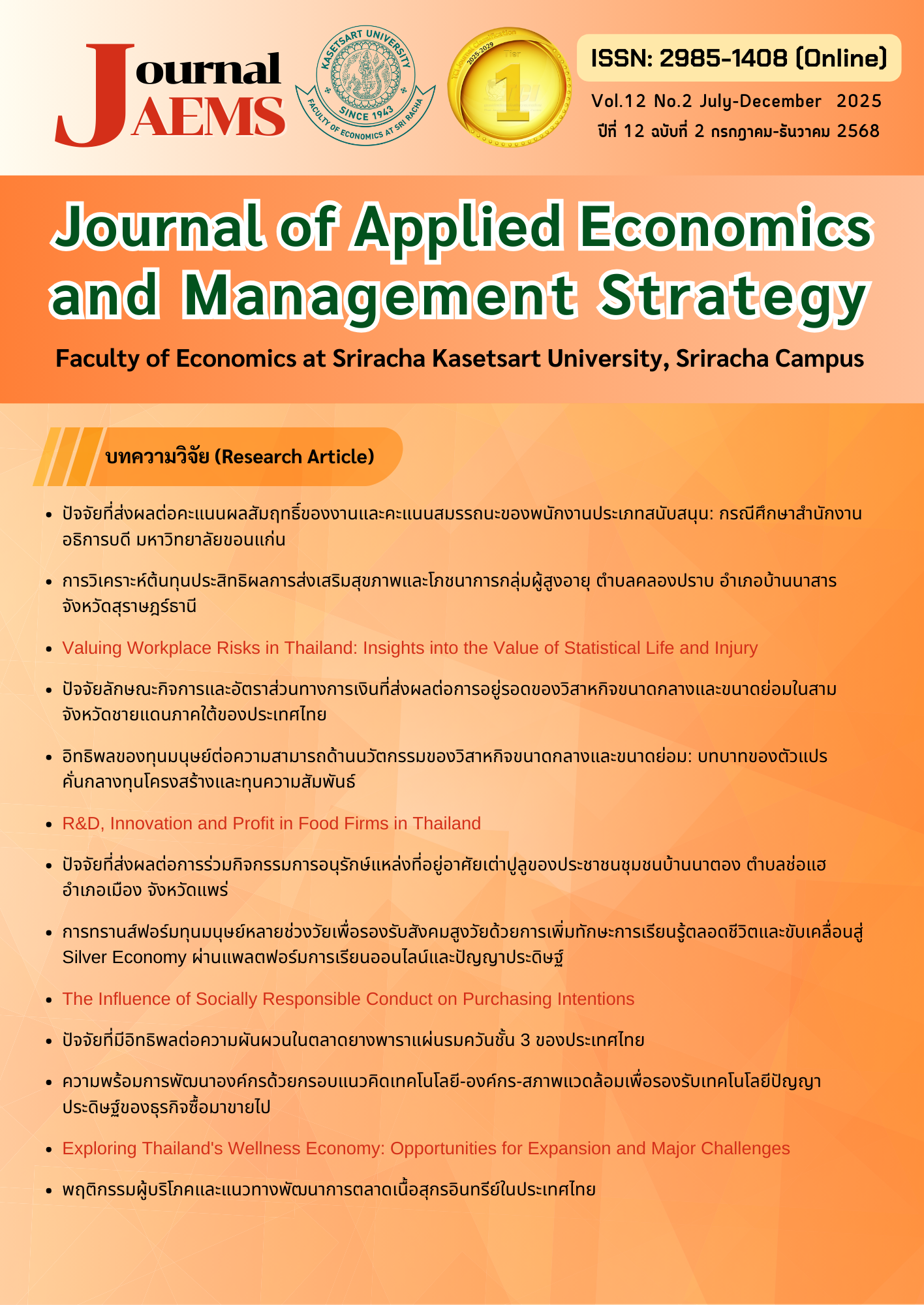
The Influence of Human Capital on Innovation Capabilities of Small and Medium Enterprises: The Mediating Roles of Structural Capital and Relational Capital
Article Sidebar
Main Article Content
Abstract
Human capital plays an important role in enhancing firms’ innovation capabilities. However, relatively few studies have examined the underlying explanation for this virtuous effect. This research aims to study the influence of human capital on small and medium enterprises’ innovation capabilities and to examine the mediating roles of structural capital and relational capital in the relationship between human capital and innovation capabilities. Survey data were collected by mail from 109 business owners or top executives from 109 SMEs in the manufacturing sector in the southern region of Thailand. Structural equation modeling (SEM) was used for the analysis of the proposed mediation model, this comprises two specific procedures: testing a measurement model and testing a structural model. Confirmatory Factor Analysis (CFA) was used in testing the measurement model. The results confirmed that human capital had a direct positive influence on structural capital and relational capital (β=0.736, β=0.604, p<0.001). Furthermore, human capital had an indirect positive influence on SMEs’ innovation capabilities via the mediating roles of structural capital and relational capital (β=0.241, β=0.175, p<0.05). The results from this research indicate that the human capital of SMEs plays an important role in fostering their firms’ structural and relational capital. Therefore, SME leaders should promote and develop human capital, structural capital, and relational capital, leading to the development of the organization's innovation capabilities.
Downloads
Article Details

This work is licensed under a Creative Commons Attribution-NonCommercial-NoDerivatives 4.0 International License.




References
สำนักงานส่งเสริมวิสาหกิจขนาดกลางและขนาดย่อม (สสว.). (2567). Dashboard SME Big Data. https://sme.go.th/th/page.php?modulekey=348
อิศรัฏฐ์ รินไธสง. (2564). การวิเคราะห์โมเดลสมการโครงสร้างสำหรับการวิจัยทางพฤติกรรมศาสตร์และสังคมศาสตร์. บริษัท นีโอพ้อยท์ (1995) จำกัด.
Adler, P. S., & Kwon, S. W. (2002). Social capital: Prospects for a new concept. Academy of management review, 27(1), 17-40. DOI: https://doi.org/10.2307/4134367
Alavi, M., & Leidner, D. E. (2001). Knowledge management and knowledge management systems: Conceptual foundations and research issues. MIS quarterly, 25(1). 107-136. DOI: https://doi.org/10.2307/3250961
AlQershi, N. (2024). Strategic thinking, strategic planning, strategic innovation and the performance of SMEs: The mediating role of human capital. Management Science and Education Innovations, 11, 1003-1012. doi: 10.5267/j.msl.2020.9.042 DOI: https://doi.org/10.5267/j.msl.2020.9.042
AlQershi, N., Abas, Z., & Mokhtar, S. (2021). The intervening effect of structural capital on the relationship between strategic innovation and manufacturing SMEs’ performance in Yemen. Management Science Letters, 11(1), 21-30. DOI: https://doi.org/10.5267/j.msl.2020.8.034
Barney, J. (1991). Firm resources and sustained competitive advantage. Journal of management, 17(1), 99-120. DOI: https://doi.org/10.1177/014920639101700108
Becker, G. S. (1964). Human capital: A theoretical and empirical analysis, with special reference to education. University of Chicago press.
Beltramino, N. S., García-Perez-de-Lema, D., & Valdez-Juárez, L. E. (2020). The structural capital, the innovation and the performance of the industrial SMES. Journal of Intellectual Capital, 21(6), 913-945. DOI: https://doi.org/10.1108/JIC-01-2019-0020
Bontis, N. (1999). Managing organizational knowledge by diagnosing intellectual capital: Framing and advancing the state of the filed. International Journal of Technology Management, 18(5-8), 433-462 DOI: https://doi.org/10.1504/IJTM.1999.002780
Coder, L., Peake, W. O., & Spiller, M. S. (2017). Do high performance work systems pay for small firms? An intellectual capital building perspective. Journal of Small Business Strategy, 27(2), 13-35.
Cohen, W. M., & Levinthal, D. A. (1990). Absorptive capacity: A new perspective on learning and innovation. Administrative science quarterly, 35(1), 128-152. DOI: https://doi.org/10.2307/2393553
Dwikat, S. Y., Arshad, D., & Mohd Shariff, M. N. (2023). Effect of competent human capital, strategic flexibility and turbulent environment on sustainable performance of SMEs in manufacturing industries in palestine. Sustainability, 15(6), 4781. DOI: https://doi.org/10.3390/su15064781
Edvinsson, L. (1997). Developing intellectual capital at Skandia. Long range planning, 30(3), 366-373. DOI: https://doi.org/10.1016/S0024-6301(97)90248-X
Fleming, L., & Sorenson, O. (2004). Science as a map in technological search. Strategic management journal, 25(8-9), 909-928. DOI: https://doi.org/10.1002/smj.384
Hair, J. F., Black, W. C., Babin, B. J., & Anderson, R. E. (2019). Multivariate data analysis: Pearson new international (8th ed.). Cengage Learning EMEA.
Huang, C. C., & Huang, S. M. (2020). External and internal capabilities and organizational performance: Does intellectual capital matter?. Asia Pacific Management Review, 25(2), 111-120. DOI: https://doi.org/10.1016/j.apmrv.2019.12.001
Hanaysha, J. R., Al-Shaikh, M. E., Joghee, S., & Alzoubi, H. M. (2022). Impact of innovation capabilities on business sustainability in small and medium enterprises. FIIB Business Review, 11(1), 67-78. DOI: https://doi.org/10.1177/23197145211042232
Jalil, M. F., Ali, A., & Kamarulzaman, R. (2022). Does innovation capability improve SME performance in Malaysia? The mediating effect of technology adoption. The International Journal of Entrepreneurship and Innovation, 23(4), 253-267. DOI: https://doi.org/10.1177/14657503211048967
Kianto, A., Sáenz, J., & Aramburu, N. (2017). Knowledge-based human resource management practices, intellectual capital and innovation. Journal of Business Research, 81, 11-20. DOI: https://doi.org/10.1016/j.jbusres.2017.07.018
Liu, C. H., Chang, A. Y. P., & Fang, Y. P. (2020). Network activities as critical sources of creating capability and competitive advantage: The mediating role of innovation capability and human capital. Management Decision, 58(3), 544-568. DOI: https://doi.org/10.1108/MD-08-2017-0733
Massaro, M., Bagnoli, C., & Dal Mas, F. (2020). The role of human sustainability in professional service firms. Evidence from Italy. Business Strategy and the Environment, 29(6), 2668-2678. DOI: https://doi.org/10.1002/bse.2528
McDowell, W. C., Peake, W. O., Coder, L., & Harris, M. L. (2018). Building small firm performance through intellectual capital development: Exploring innovation as the “black box”. Journal of business research, 88, 321-327. DOI: https://doi.org/10.1016/j.jbusres.2018.01.025
Oliveira, M., Curado, C., Balle, A. R., & Kianto, A. (2020). Knowledge sharing, intellectual capital and organizational results in SMES: are they related?. Journal of Intellectual Capital. 21(6): 893–911. https://doi.org/10.1108/JIC-04-2019-0077 DOI: https://doi.org/10.1108/JIC-04-2019-0077
Ramírez-Solis, E. R., Llonch-Andreu, J., & Malpica-Romero, A. D. (2022). How beneficial are relational capital and technology orientation for innovation? Evidence from Mexican SMEs. International Journal of Innovation Studies, 6(1), 1-10. DOI: https://doi.org/10.1016/j.ijis.2022.02.001
Ryu, D., Baek, K. H., & Yoon, J. (2021). Open innovation with relational capital, technological innovation capital, and international performance in SMEs. Sustainability, 13(6), 3418. DOI: https://doi.org/10.3390/su13063418
Sardo, F., Serrasqueiro, Z., & Alves, H. (2018). On the relationship between intellectual capital and financial performance: A panel data analysis on SME hotels. International Journal of Hospitality Management, 75, 67-74. DOI: https://doi.org/10.1016/j.ijhm.2018.03.001
Schultz, T. W. (1961). Investment in human capital. The American economic review, 51(1), 1-17.
Stewart, T. A. (2010). Intellectual Capital: The new wealth of organization. Currency.
Subramaniam, M., & Youndt, M. A. (2005). The influence of intellectual capital on the types of innovative capabilities. Academy of Management journal, 48(3), 450-463. DOI: https://doi.org/10.5465/amj.2005.17407911
Youndt, M. A., & Snell, S. A. (2004). Human resource configurations, intellectual capital, and organizational performance. Journal of managerial issues, 16(3), 337-360. DOI: https://doi.org/10.1037/t68746-000