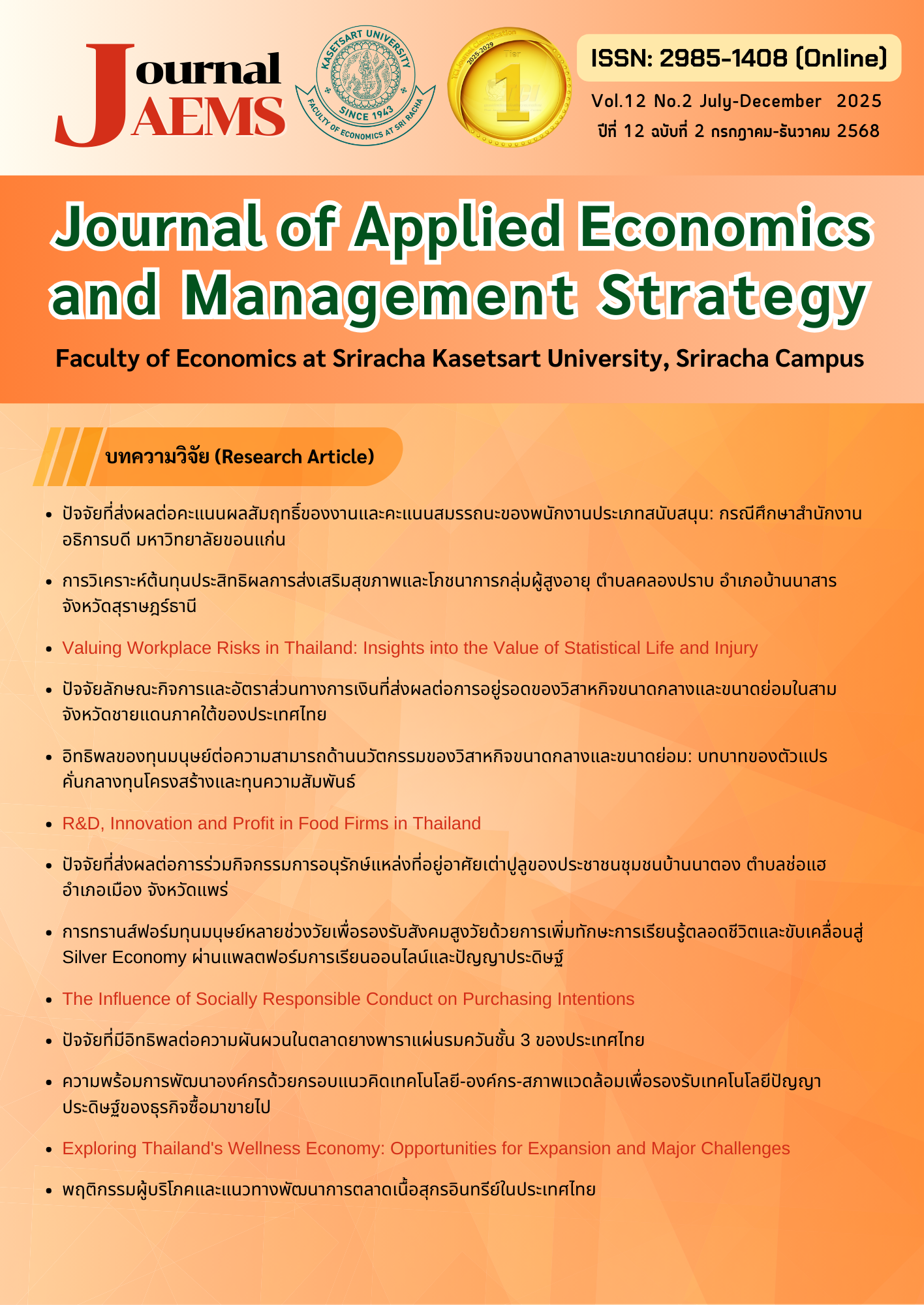
Consumer Behavior and Marketing Development Strategies for Organic Pork in Thailand
Article Sidebar
Main Article Content
Abstract
Currently, consumers are increasingly concerned about health and safety from meat consumption, making organic pork a new alternative that has gained attention. However, there are limitations in production and product accessibility. This study aimed to analyze factors influencing the decision to consume organic pork, as well as to study appropriate marketing management strategies for developing the organic pork market. Data collection involved surveying 400 consumers using questionnaires and interviewing stakeholders in the organic pork supply chain. The analysis was divided into three parts: consumer behavior analysis using descriptive statistics, analysis of factors influencing purchasing decisions using a Binary Logit Model and a Linear Regression Model, and marketing analysis using SWOT and TOWS Matrix.
The results showed that although most consumers were aware of organic pork, only a small proportion had consumed it. Consumers perceived the value, safety, and environmental benefits of organic pork but lacked understanding of the impact of hormones in production. The analysis of factors influencing purchasing decisions revealed that age, education, product perception, and household's consumption behavior of pesticide-free food significantly affected the decision. Additionally, production standards and brand influenced both consumers with and without prior consumption experience, with the former prioritizing pork characteristics and the latter considering product appearance. For market development, strategies should focus on building a credible brand, emphasizing health, environmental, and animal welfare selling points, while promoting farmer groups, developing certification systems, and planning comprehensive marketing for the long-term sustainability of the production system and market.
Downloads
Article Details

This work is licensed under a Creative Commons Attribution-NonCommercial-NoDerivatives 4.0 International License.




References
คณะกรรมการพัฒนาเกษตรอินทรีย์แห่งชาติ. (2565). แผนปฏิบัติด้านเกษตรอินทรีย์ พ.ศ. 2566–2570. สำนักงานเศรษฐกิจการเกษตร. https://mhesi.go.th/index.php/all-media/book/8857-2566-2570.html
ฉัตยาพร เสมอใจ. (2550). พฤติกรรมผู้บริโภค (พิมพ์ครั้งที่ 1). ซีเอ็ดยูเคชั่น.
ซุน ยุ่นหนาน. (2560). การรับรู้คุณค่าที่ส่งผลต่อความตั้งใจซื้อผักและผลไม้ออร์แกนิคของผู้บริโภคในเขตกรุงเทพมหานคร [การค้นคว้าอิสระปริญญามหาบัณฑิต มหาวิทยาลัยกรุงเทพ].
เบญจมาศ สันต์สวัสดิ์ และปภากร สุทธิภาศิลป์. (2562). การส่งเสริมการผลิตสินค้าเกษตรอินทรีย์ในชุมชนจังหวัดเชียงใหม่ให้มีศักยภาพการแข่งขันในประชาคมอาเซียน. Community and Social Development Journal, 20(1), 19–29. https://doi.org/10.14456/rcmrj.2019.181525
มุทิตา เกษประสิทธิ.(2561). ปัจจัยที่มีอิทธิพลต่อการตัดสินใจซื้ออาหารอินทรีย์บรรจุหีบห่อ ในเขตกรุงเทพมหานคร. https://www.tci-thaijo.org/index.php
เยาวรัตน์ ศรีวรานันท์. (2556). ความเต็มใจจ่ายของผู้บริโภคในจังหวัดขอนแก่นที่มีต่อเนื้อหมูอินทรีย์. วารสารเศรษฐศาสตร์และนโยบายสาธารณะ, 4(7), 1–24.
สำนักงานสถิติแห่งชาติ. (2560). รายงานการสำรวจภาวะเศรษฐกิจและสังคมของครัวเรือน พ.ศ. 2560. สำนักงานสถิติแห่งชาติ. https://www.nso.go.th
อดิศักดิ์ อ่ำเทศ, สุณีพร สุวรรณมณีพงศ์ และดวงกมล ปานรศทิพ ธรรมาธิวัฒน์. (2565). การถอดบทเรียนกระบวนการพัฒนาระบบรับรองเกษตรอินทรีย์แบบมีส่วนร่วม: กรณีศึกษาเครือข่ายเกษตรอินทรีย์แบบมีส่วนร่วม (PGS) แปดริ้ว จังหวัดฉะเชิงเทรา. วารสารแก่นเกษตร, 50(5), 1413–1428.
Abrams, K. M., Meyers, C. A., & Irani, T. A. (2010). Naturally confused: Consumers’ perceptions of all-natural and organic pork products. Agriculture and Human Values, 27(3), 365–374. https://doi.org/10.1007/s10460-009-9221-1 DOI: https://doi.org/10.1007/s10460-009-9234-5
Ajzen, I. (1991). The theory of planned behavior. Organizational Behavior and Human Decision Processes, 50(2), 179–211. https://doi.org/10.1016/0749-5978(91)90020-T DOI: https://doi.org/10.1016/0749-5978(91)90020-T
Cochran, W. G. (1977). Sampling techniques (3rd ed.). John Wiley & Sons.
Cognitive Market Research. (2024). Organic pork market size, share and trends analysis report: 2024–2031. https://www.cognitivemarketresearch.com/organic-pork-market-report
Font-i-Furnols, M., & Guerrero, L. (2014). Consumer preference, behavior and perception of meat and meat products: An overview. Meat Science, 98(3), 361–371. https://doi.org/10.1016/j.meatsci.2014.06.025 DOI: https://doi.org/10.1016/j.meatsci.2014.06.025
Food and Agriculture Organization of the United Nations (FAO). (2021). Food and agriculture data. FAO. https://www.fao.org/faostat
Geier, B., & Vogtmann, H. (1984). Marketing and pricing of biological products in West Germany: A comparative study. DOI: https://doi.org/10.1080/01448765.1984.9754425
Grunert, K. G. (2005). Food quality and safety: Consumer perception and demand. European Review of Agricultural Economics, 32(3), 369–391. https://doi.org/10.1093/eurrag/jbi011 DOI: https://doi.org/10.1093/eurrag/jbi011
Hawkins, D. I., Best, R. J., & Coney, K. A. (2001). Consumer behavior: Building marketing strategy (8th ed.). McGraw-Hill.
HelgiLibrary. (2023). Pork meat consumption per capita. https://www.helgilibrary.com
Hughner, R. S., McDonagh, P., Prothero, A., Shultz, C. J., II, & Stanton, J. (2007). Who are organic food consumers? A compilation and review of why people purchase organic food. Journal of Consumer Behaviour, 6(2–3), 94–110. https://doi.org/10.1002/cb.210 DOI: https://doi.org/10.1002/cb.210
Kahneman, D., Wakker, P. P., & Sarin, R. (1997). Back to Bentham? Explorations of experienced utility. Quarterly Journal of Economics, 112(2), 375–405. https://doi.org/10.1162/003355397555235 DOI: https://doi.org/10.1162/003355397555235
Kantamaturapoj, K., & Marshall, A. (2020). Providing organic food to urban consumers: Case studies of supermarkets in Bangkok and metropolitan area. Heliyon, 6(5), e04003. https://doi.org/10.1016/j.heliyon.2020.e04003 DOI: https://doi.org/10.1016/j.heliyon.2020.e04003
Kotler, P. (2000). Marketing management (10th ed.). Prentice Hall.
Kotler, P., & Armstrong, G. (2017). Principles of marketing (17th ed.). Pearson.
Krystallis, A., & Chryssohoidis, G. (2006). Consumers’ willingness to pay for organic food: Factors that affect it and variation per organic product type. New Medit, 5(4), 31–38. https://newmedit.iamb.it/2010/12/30/consumers-willingness-to-pay-for-organic-food-
factors-that-affect-it-and-variation-per-organic-product-type/
Latacz-Lohmann, U., & Foster, C. (1997). From “niche” to “mainstream”: Strategies for marketing organic food in Germany and the UK. British Food Journal, 99(8), 275–282. https://doi.org/10.1108/00070709710188336 DOI: https://doi.org/10.1108/00070709710188336
Lind, V. (2007). Consumer involvement and perceived differentiation of different kinds of pork – A means-end chain analysis. Food Quality and Preference, 18(4), 690–700. https://doi.org/10.1016/j.foodqual.2006.10.004 DOI: https://doi.org/10.1016/j.foodqual.2006.10.004
Lockie, S., Lyons, K., Lawrence, G., & Mummery, K. (2002). Eating “green”: Motivations behind organic food consumption in Australia. Sociologia Ruralis, 42(1), 23–40. https://doi.org/10.1111/1467-9523.00200 DOI: https://doi.org/10.1111/1467-9523.00200
Magnusson, M. K., Arvola, A., Hursti, U. K. K., Åberg, L., & Sjödén, P.-O. (2001). Attitudes towards organic foods among Swedish consumers. British Food Journal, 103(3), 209–227. https://doi.org/10.1108/00070700110386755 DOI: https://doi.org/10.1108/00070700110386755
Manida, M., & Nedumaran, G. (2019). Consumer perception and SWOT analysis of organic food products. SEUSL Journal of Marketing, 4(2), 11–20. https://www.seu.ac.lk/seusljm/publication/volume4/no2/p2.pdf
McEachern, M. G., & Schroder, M. J. A. (2002). The role of livestock production ethics in consumer values towards meat. Journal of Agricultural and Environmental Ethics, 15(2), 221–237. https://doi.org/10.1023/A:1015052816477 DOI: https://doi.org/10.1023/A:1015052816477
Najib, M., Sumarwan, U., Septiani, S., & Fahma, F. (2021). Application of SWOT–AHP to develop organic food marketing strategy. Academy of Strategic Management Journal, 20(1). https://www.abacademies.org/articles/application-of-swotahp-to-develop-organic-food-marketing-strategy-9999.html
Norman, G. (2010). Likert scales, levels of measurement and the “laws” of statistics. Advances in Health Sciences Education, 15(5), 625–632. https://doi.org/10.1007/s10459-010-9222-y DOI: https://doi.org/10.1007/s10459-010-9222-y
Observatory of Economic Complexity. (2024). Pork exports by country. https://oec.world/en/profile/hs/pork
Padel, S., & Foster, C. (2005). Exploring the gap between attitudes and behaviour: Understanding why consumers buy or do not buy organic food. British Food Journal, 107(8), 606–625. https://doi.org/10.1108/00070700510611002 DOI: https://doi.org/10.1108/00070700510611002
Pomsanam, P., Napompech, K., & Suwanmaneepong, S. (2014). Factors driving Thai consumers’ intention to purchase organic foods. Mediterranean Journal of Social Sciences, 5(20), 761–767. https://doi.org/10.5901/mjss.2014.v5n20p761
Research Institute of Organic Agriculture (FiBL), & IFOAM – Organics International. (2023). The world of organic agriculture: Statistics and emerging trends 2023. FiBL; IFOAM – Organics International. https://www.organic-world.net/yearbook/yearbook-2023.html
Rhemtulla, M., Brosseau-Liard, P. É., & Savalei, V. (2012). When can we treat Likert-type scales as interval scales? Canadian Journal of Behavioural Science, 44(2), 97–104. https://doi.org/10.1037/a0028617 DOI: https://doi.org/10.1037/a0028617
Roitner-Schobesberger, B., Darnhofer, I., Somsook, S., & Vogl, C. R. (2008). Consumer perceptions of organic foods in Bangkok, Thailand. Food Policy, 33(2), 112–121. https://doi.org/10.1016/j.foodpol.2007.09.004 DOI: https://doi.org/10.1016/j.foodpol.2007.09.004
Schiffman, L. G., & Kanuk, L. L. (2007). Consumer behavior (9th ed.). Pearson/Prentice Hall.
Sriwaranun, Y., Gan, C., Lee, M., & Cohen, D. A. (2015). Consumers’ willingness to pay for organic products in Thailand. International Journal of Social Economics, 42(5), 480–510. https://doi.org/10.1108/IJSE-09-2013-0204 DOI: https://doi.org/10.1108/IJSE-09-2013-0204
The World Bank. (2024). World Integrated Trade Solution (WITS): Pork products exports. https://wits.worldbank.org
Visetnoi, S., & Nelles, W. (2023). Can organic pork help achieve sustainable development goals in Thailand? Agriculture, 13(9), 1822. https://doi.org/10.3390/agriculture13091822 DOI: https://doi.org/10.3390/agriculture13091822
Weihrich, H. (1982). The TOWS matrix—A tool for situational analysis. Long Range Planning, 15(2), 54–66. https://doi.org/10.1016/0024-6301(82)90120-0 DOI: https://doi.org/10.1016/0024-6301(82)90120-0
Zepeda, L., & Deal, D. (2009). Organic and local food consumer behaviour: Alphabet theory. International Journal of Consumer Studies, 33(6), 697–705. https://doi.org/10.1111/j.1470-6431.2009.00814.x DOI: https://doi.org/10.1111/j.1470-6431.2009.00814.x