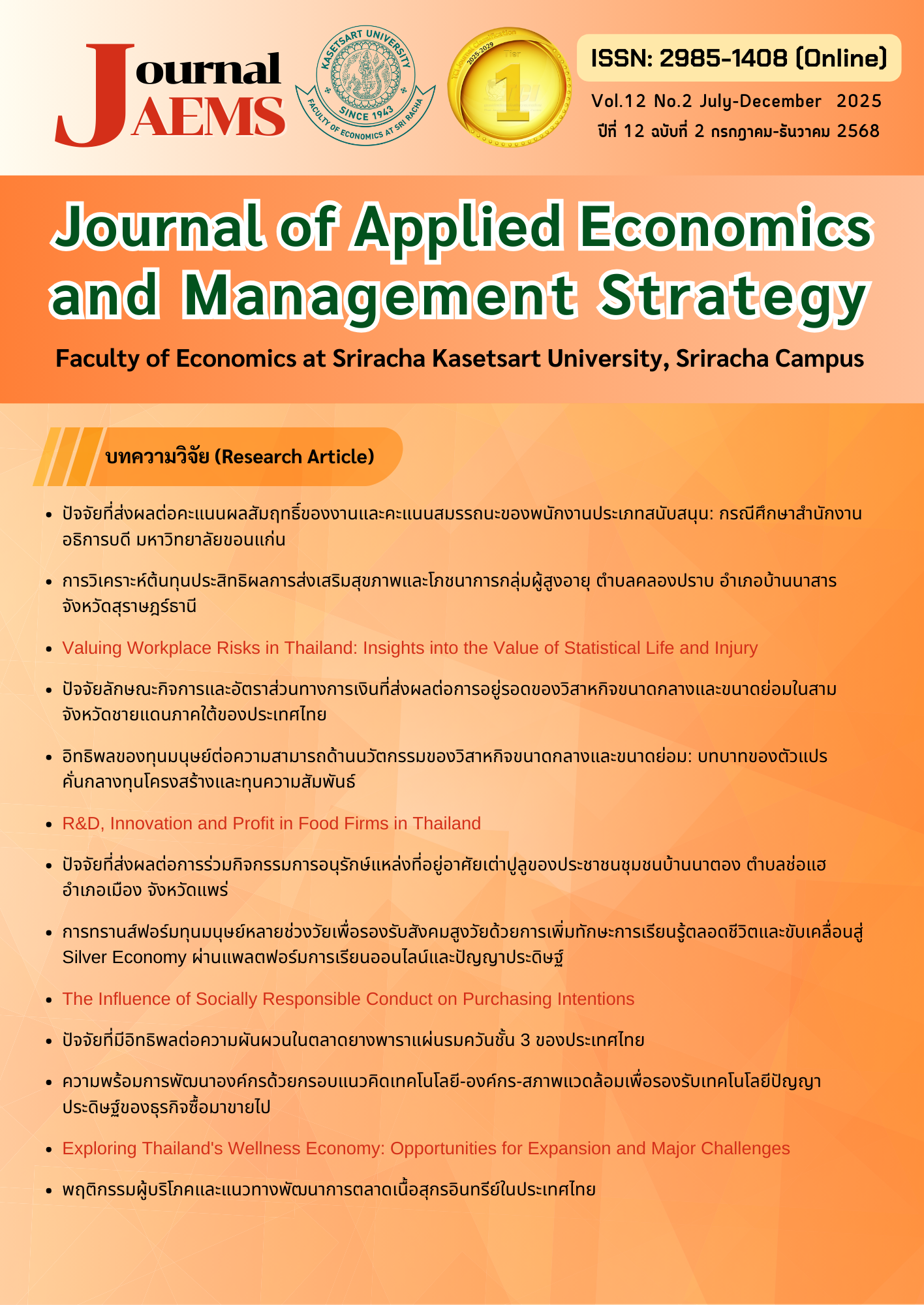
พฤติกรรมผู้บริโภคและแนวทางพัฒนาการตลาดเนื้อสุกรอินทรีย์ในประเทศไทย
##plugins.themes.bootstrap3.article.sidebar##
##plugins.themes.bootstrap3.article.main##
บทคัดย่อ
ในปัจจุบันผู้บริโภคให้ความสำคัญกับสุขภาพและความปลอดภัยจากการบริโภคเนื้อสัตว์เพิ่มมากขึ้น ทำให้เนื้อสุกรอินทรีย์กลายเป็นทางเลือกใหม่ที่ได้รับความสนใจ แต่ยังมีข้อจำกัดด้านการผลิตและการเข้าถึงสินค้า การศึกษานี้จึงมีวัตถุประสงค์เพื่อวิเคราะห์ปัจจัยที่มีอิทธิพลต่อการตัดสินใจบริโภคเนื้อสุกรอินทรีย์ รวมถึงศึกษากลยุทธ์การจัดการด้านการตลาดที่เหมาะสมในการพัฒนาตลาดเนื้อสุกรอินทรีย์ การเก็บรวบรวมข้อมูลใช้แบบสอบถามสำรวจกลุ่มผู้บริโภคจำนวน 400 ตัวอย่าง รวมถึงการสัมภาษณ์ผู้ที่เกี่ยวข้องในห่วงโซ่อุปทานสุกรอินทรีย์ การวิเคราะห์แบ่งเป็น 3 ส่วน ได้แก่ การวิเคราะห์พฤติกรรมผู้บริโภคด้วยสถิติพรรณนา การวิเคราะห์ปัจจัยที่มีอิทธิพลต่อการตัดสินใจซื้อด้วยแบบจำลองถดถอยโลจิสติกทวิ (Binary Logit Model) และแบบจำลองถดถอยเชิงเส้น (Linear Regression Model) และการวิเคราะห์ด้านการตลาดด้วย SWOT และ TOWS Matrix
ผลการศึกษา พบว่า แม้ผู้บริโภคส่วนใหญ่รู้จักเนื้อสุกรอินทรีย์แต่มีเพียงส่วนน้อยที่เคยบริโภค ผู้บริโภครับรู้ถึงคุณค่า ความปลอดภัย และผลดีต่อสิ่งแวดล้อมของเนื้อสุกรอินทรีย์ แต่ยังขาดความเข้าใจเกี่ยวกับผลกระทบของฮอร์โมนในการผลิต การวิเคราะห์ปัจจัยที่มีอิทธิพลต่อการตัดสินใจซื้อ พบว่า อายุ การศึกษา การรับรู้ในตัวสินค้า และพฤติกรรมบริโภคอาหารปลอดสารพิษของครัวเรือน มีผลต่อการตัดสินใจอย่างมีนัยสำคัญ นอกจากนี้มาตรฐานการผลิตและแบรนด์สินค้ามีอิทธิพลทั้งต่อผู้บริโภคที่เคยมีและไม่มีประสบการณ์ในการบริโภค โดยกลุ่มแรกให้ความสำคัญกับคุณลักษณะเนื้อสุกร ส่วนกลุ่มหลังพิจารณาจากรูปลักษณ์สินค้า สำหรับแนวทางพัฒนาตลาด ควรมุ่งเน้นการสร้างแบรนด์ที่น่าเชื่อถือ เน้นจุดขายด้านสุขภาพ สิ่งแวดล้อม และสวัสดิภาพสัตว์ พร้อมทั้งส่งเสริมการรวมกลุ่มเกษตรกร พัฒนาระบบรับรอง และวางแผนการตลาดอย่างครบวงจรเพื่อความยั่งยืนของระบบการผลิตและตลาดในระยะยาว
##plugins.generic.usageStats.downloads##
##plugins.themes.bootstrap3.article.details##

This work is licensed under a Creative Commons Attribution-NonCommercial-NoDerivatives 4.0 International License.




เอกสารอ้างอิง
คณะกรรมการพัฒนาเกษตรอินทรีย์แห่งชาติ. (2565). แผนปฏิบัติด้านเกษตรอินทรีย์ พ.ศ. 2566–2570. สำนักงานเศรษฐกิจการเกษตร. https://mhesi.go.th/index.php/all-media/book/8857-2566-2570.html
ฉัตยาพร เสมอใจ. (2550). พฤติกรรมผู้บริโภค (พิมพ์ครั้งที่ 1). ซีเอ็ดยูเคชั่น.
ซุน ยุ่นหนาน. (2560). การรับรู้คุณค่าที่ส่งผลต่อความตั้งใจซื้อผักและผลไม้ออร์แกนิคของผู้บริโภคในเขตกรุงเทพมหานคร [การค้นคว้าอิสระปริญญามหาบัณฑิต มหาวิทยาลัยกรุงเทพ].
เบญจมาศ สันต์สวัสดิ์ และปภากร สุทธิภาศิลป์. (2562). การส่งเสริมการผลิตสินค้าเกษตรอินทรีย์ในชุมชนจังหวัดเชียงใหม่ให้มีศักยภาพการแข่งขันในประชาคมอาเซียน. Community and Social Development Journal, 20(1), 19–29. https://doi.org/10.14456/rcmrj.2019.181525
มุทิตา เกษประสิทธิ.(2561). ปัจจัยที่มีอิทธิพลต่อการตัดสินใจซื้ออาหารอินทรีย์บรรจุหีบห่อ ในเขตกรุงเทพมหานคร. https://www.tci-thaijo.org/index.php
เยาวรัตน์ ศรีวรานันท์. (2556). ความเต็มใจจ่ายของผู้บริโภคในจังหวัดขอนแก่นที่มีต่อเนื้อหมูอินทรีย์. วารสารเศรษฐศาสตร์และนโยบายสาธารณะ, 4(7), 1–24.
สำนักงานสถิติแห่งชาติ. (2560). รายงานการสำรวจภาวะเศรษฐกิจและสังคมของครัวเรือน พ.ศ. 2560. สำนักงานสถิติแห่งชาติ. https://www.nso.go.th
อดิศักดิ์ อ่ำเทศ, สุณีพร สุวรรณมณีพงศ์ และดวงกมล ปานรศทิพ ธรรมาธิวัฒน์. (2565). การถอดบทเรียนกระบวนการพัฒนาระบบรับรองเกษตรอินทรีย์แบบมีส่วนร่วม: กรณีศึกษาเครือข่ายเกษตรอินทรีย์แบบมีส่วนร่วม (PGS) แปดริ้ว จังหวัดฉะเชิงเทรา. วารสารแก่นเกษตร, 50(5), 1413–1428.
Abrams, K. M., Meyers, C. A., & Irani, T. A. (2010). Naturally confused: Consumers’ perceptions of all-natural and organic pork products. Agriculture and Human Values, 27(3), 365–374. https://doi.org/10.1007/s10460-009-9221-1 DOI: https://doi.org/10.1007/s10460-009-9234-5
Ajzen, I. (1991). The theory of planned behavior. Organizational Behavior and Human Decision Processes, 50(2), 179–211. https://doi.org/10.1016/0749-5978(91)90020-T DOI: https://doi.org/10.1016/0749-5978(91)90020-T
Cochran, W. G. (1977). Sampling techniques (3rd ed.). John Wiley & Sons.
Cognitive Market Research. (2024). Organic pork market size, share and trends analysis report: 2024–2031. https://www.cognitivemarketresearch.com/organic-pork-market-report
Font-i-Furnols, M., & Guerrero, L. (2014). Consumer preference, behavior and perception of meat and meat products: An overview. Meat Science, 98(3), 361–371. https://doi.org/10.1016/j.meatsci.2014.06.025 DOI: https://doi.org/10.1016/j.meatsci.2014.06.025
Food and Agriculture Organization of the United Nations (FAO). (2021). Food and agriculture data. FAO. https://www.fao.org/faostat
Geier, B., & Vogtmann, H. (1984). Marketing and pricing of biological products in West Germany: A comparative study. DOI: https://doi.org/10.1080/01448765.1984.9754425
Grunert, K. G. (2005). Food quality and safety: Consumer perception and demand. European Review of Agricultural Economics, 32(3), 369–391. https://doi.org/10.1093/eurrag/jbi011 DOI: https://doi.org/10.1093/eurrag/jbi011
Hawkins, D. I., Best, R. J., & Coney, K. A. (2001). Consumer behavior: Building marketing strategy (8th ed.). McGraw-Hill.
HelgiLibrary. (2023). Pork meat consumption per capita. https://www.helgilibrary.com
Hughner, R. S., McDonagh, P., Prothero, A., Shultz, C. J., II, & Stanton, J. (2007). Who are organic food consumers? A compilation and review of why people purchase organic food. Journal of Consumer Behaviour, 6(2–3), 94–110. https://doi.org/10.1002/cb.210 DOI: https://doi.org/10.1002/cb.210
Kahneman, D., Wakker, P. P., & Sarin, R. (1997). Back to Bentham? Explorations of experienced utility. Quarterly Journal of Economics, 112(2), 375–405. https://doi.org/10.1162/003355397555235 DOI: https://doi.org/10.1162/003355397555235
Kantamaturapoj, K., & Marshall, A. (2020). Providing organic food to urban consumers: Case studies of supermarkets in Bangkok and metropolitan area. Heliyon, 6(5), e04003. https://doi.org/10.1016/j.heliyon.2020.e04003 DOI: https://doi.org/10.1016/j.heliyon.2020.e04003
Kotler, P. (2000). Marketing management (10th ed.). Prentice Hall.
Kotler, P., & Armstrong, G. (2017). Principles of marketing (17th ed.). Pearson.
Krystallis, A., & Chryssohoidis, G. (2006). Consumers’ willingness to pay for organic food: Factors that affect it and variation per organic product type. New Medit, 5(4), 31–38. https://newmedit.iamb.it/2010/12/30/consumers-willingness-to-pay-for-organic-food-
factors-that-affect-it-and-variation-per-organic-product-type/
Latacz-Lohmann, U., & Foster, C. (1997). From “niche” to “mainstream”: Strategies for marketing organic food in Germany and the UK. British Food Journal, 99(8), 275–282. https://doi.org/10.1108/00070709710188336 DOI: https://doi.org/10.1108/00070709710188336
Lind, V. (2007). Consumer involvement and perceived differentiation of different kinds of pork – A means-end chain analysis. Food Quality and Preference, 18(4), 690–700. https://doi.org/10.1016/j.foodqual.2006.10.004 DOI: https://doi.org/10.1016/j.foodqual.2006.10.004
Lockie, S., Lyons, K., Lawrence, G., & Mummery, K. (2002). Eating “green”: Motivations behind organic food consumption in Australia. Sociologia Ruralis, 42(1), 23–40. https://doi.org/10.1111/1467-9523.00200 DOI: https://doi.org/10.1111/1467-9523.00200
Magnusson, M. K., Arvola, A., Hursti, U. K. K., Åberg, L., & Sjödén, P.-O. (2001). Attitudes towards organic foods among Swedish consumers. British Food Journal, 103(3), 209–227. https://doi.org/10.1108/00070700110386755 DOI: https://doi.org/10.1108/00070700110386755
Manida, M., & Nedumaran, G. (2019). Consumer perception and SWOT analysis of organic food products. SEUSL Journal of Marketing, 4(2), 11–20. https://www.seu.ac.lk/seusljm/publication/volume4/no2/p2.pdf
McEachern, M. G., & Schroder, M. J. A. (2002). The role of livestock production ethics in consumer values towards meat. Journal of Agricultural and Environmental Ethics, 15(2), 221–237. https://doi.org/10.1023/A:1015052816477 DOI: https://doi.org/10.1023/A:1015052816477
Najib, M., Sumarwan, U., Septiani, S., & Fahma, F. (2021). Application of SWOT–AHP to develop organic food marketing strategy. Academy of Strategic Management Journal, 20(1). https://www.abacademies.org/articles/application-of-swotahp-to-develop-organic-food-marketing-strategy-9999.html
Norman, G. (2010). Likert scales, levels of measurement and the “laws” of statistics. Advances in Health Sciences Education, 15(5), 625–632. https://doi.org/10.1007/s10459-010-9222-y DOI: https://doi.org/10.1007/s10459-010-9222-y
Observatory of Economic Complexity. (2024). Pork exports by country. https://oec.world/en/profile/hs/pork
Padel, S., & Foster, C. (2005). Exploring the gap between attitudes and behaviour: Understanding why consumers buy or do not buy organic food. British Food Journal, 107(8), 606–625. https://doi.org/10.1108/00070700510611002 DOI: https://doi.org/10.1108/00070700510611002
Pomsanam, P., Napompech, K., & Suwanmaneepong, S. (2014). Factors driving Thai consumers’ intention to purchase organic foods. Mediterranean Journal of Social Sciences, 5(20), 761–767. https://doi.org/10.5901/mjss.2014.v5n20p761
Research Institute of Organic Agriculture (FiBL), & IFOAM – Organics International. (2023). The world of organic agriculture: Statistics and emerging trends 2023. FiBL; IFOAM – Organics International. https://www.organic-world.net/yearbook/yearbook-2023.html
Rhemtulla, M., Brosseau-Liard, P. É., & Savalei, V. (2012). When can we treat Likert-type scales as interval scales? Canadian Journal of Behavioural Science, 44(2), 97–104. https://doi.org/10.1037/a0028617 DOI: https://doi.org/10.1037/a0028617
Roitner-Schobesberger, B., Darnhofer, I., Somsook, S., & Vogl, C. R. (2008). Consumer perceptions of organic foods in Bangkok, Thailand. Food Policy, 33(2), 112–121. https://doi.org/10.1016/j.foodpol.2007.09.004 DOI: https://doi.org/10.1016/j.foodpol.2007.09.004
Schiffman, L. G., & Kanuk, L. L. (2007). Consumer behavior (9th ed.). Pearson/Prentice Hall.
Sriwaranun, Y., Gan, C., Lee, M., & Cohen, D. A. (2015). Consumers’ willingness to pay for organic products in Thailand. International Journal of Social Economics, 42(5), 480–510. https://doi.org/10.1108/IJSE-09-2013-0204 DOI: https://doi.org/10.1108/IJSE-09-2013-0204
The World Bank. (2024). World Integrated Trade Solution (WITS): Pork products exports. https://wits.worldbank.org
Visetnoi, S., & Nelles, W. (2023). Can organic pork help achieve sustainable development goals in Thailand? Agriculture, 13(9), 1822. https://doi.org/10.3390/agriculture13091822 DOI: https://doi.org/10.3390/agriculture13091822
Weihrich, H. (1982). The TOWS matrix—A tool for situational analysis. Long Range Planning, 15(2), 54–66. https://doi.org/10.1016/0024-6301(82)90120-0 DOI: https://doi.org/10.1016/0024-6301(82)90120-0
Zepeda, L., & Deal, D. (2009). Organic and local food consumer behaviour: Alphabet theory. International Journal of Consumer Studies, 33(6), 697–705. https://doi.org/10.1111/j.1470-6431.2009.00814.x DOI: https://doi.org/10.1111/j.1470-6431.2009.00814.x