Community Business Model Development for Bio-Organic Agricultural Products: A Case Study of Ban San Kang Pla, Saimoon Subdistrict, Chiang Mai Province
Article Sidebar
Main Article Content
Abstract
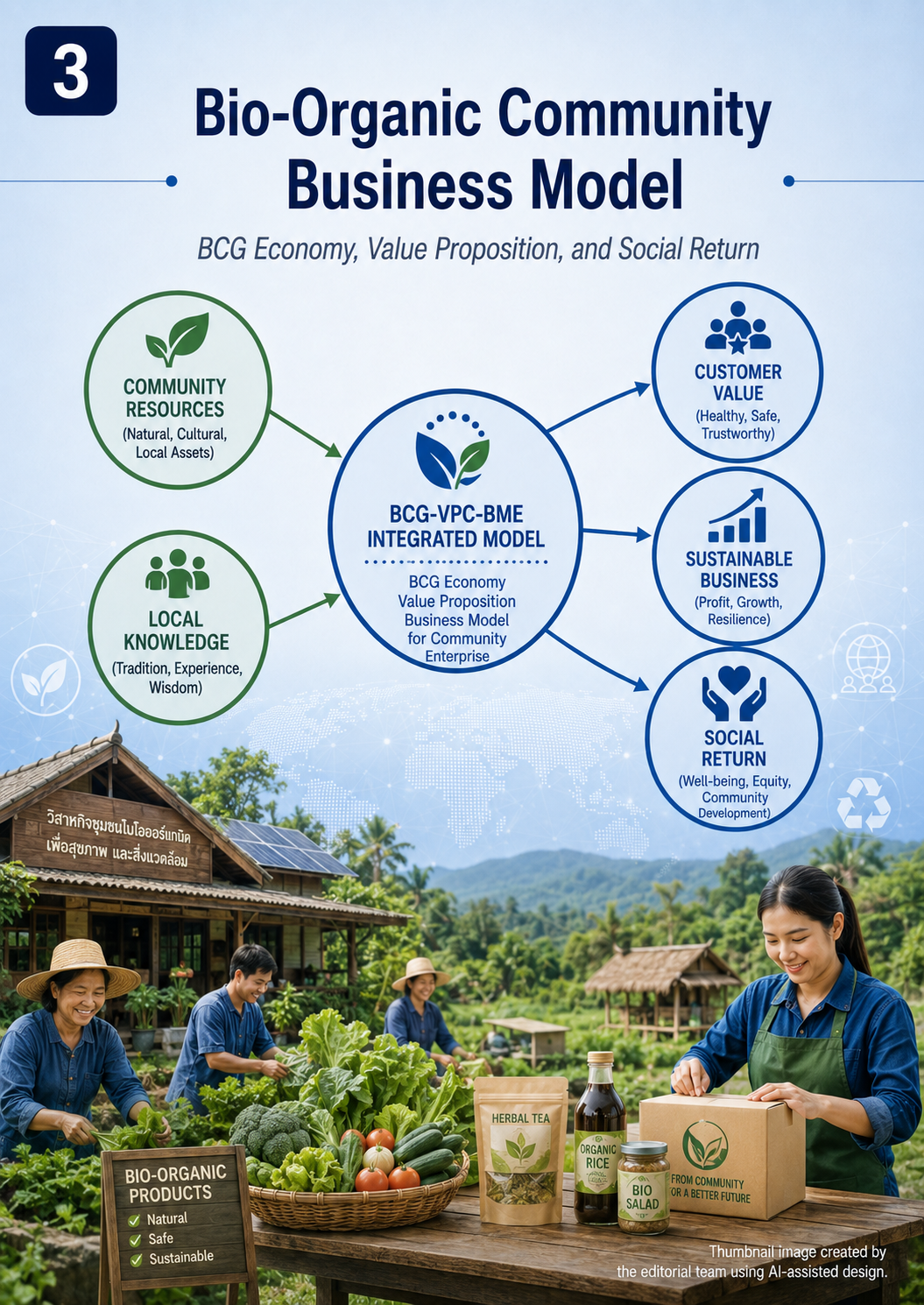
This research aimed to develop a community business model for bio-organic agricultural products by integrating the Bio-Circular-Green (BCG) Economy concept with strategic management tools (BMC, VPC). The study employed Participatory Action Research (PAR) within the Ban San Kang Pla community in Chiang Mai Province. The participants consisted of 23 informants for the qualitative study, selected through purposive sampling, including community producers, community leaders, government representatives, and business experts, and 400 consumers for the quantitative study. Qualitative data were analyzed using content analysis, while quantitative data were analyzed using descriptive statistics, the Chi-square test, and Spearman rank correlation. In addition, economic feasibility was assessed through break-even analysis and Social Return on Investment (SROI).
The findings led to the synthesis of new knowledge in the form of the BCG-VPC-BMC Integrated Model, which effectively links social capital and local resources with modern supply chains. The statistical results revealed that perceived safety and environmental impact had a strong positive correlation with price satisfaction (ρ = 0.692, p < 0.01), indicating that consumers in the green economy prioritize safety value over price factors. Furthermore, the economic analysis showed that the business model is financially viable, with a low break-even point and a high social return on investment (SROI = 6.22)
The study proposes practical guidelines for enhancing the grassroots economy, including (1) value creation from agricultural waste, (2) product positioning based on safety and environmental sustainability, and (3) the development of a community-based business model that connects local production with modern markets. These approaches support the transition toward sustainable and self-reliant social enterprises.
Downloads
Article Details

This work is licensed under a Creative Commons Attribution-NonCommercial-NoDerivatives 4.0 International License.




References
ทิพวัลย์ สีจันทร์ กฤษณันท์ มะลิทอง เกษมสันต์ สกุลรัตน์ รพี ดอกไม้เทศ และประสงค์ ตันพิชัย. (2565). รายงานการวิจัยฉบับสมบูรณ์ โครงการการพัฒนาเศรษฐกิจฐานราก กรณีศึกษา ภาคกลางตะวันตก. สำนักงานคณะกรรมการส่งเสริมวิทยาศาสตร์ วิจัยและนวัตกรรม (สกสว.). https://elibrary.tsri.or.th/fullP/paper/paper/TRP62M0415/TRP62M0415_full.pdf
ธนภูมิ เวียตตัน นคเรศ รังควัต พุฒิสรรค์ เครือคำ และสายสกุล ฟองมูล. (2564). การยอมรับเกษตรอินทรีย์ของเกษตรกรผู้ผลิตมะม่วงอำเภอสันทรายจังหวัดเชียงใหม่. วารสารผลิตกรรมการเกษตร, 3(3), 81-92. https://li01.tci-thaijo.org/index.php/japmju/article/view/253331
พิบูล ทีปะปาล. (2564). การจัดการเชิงกลยุทธ์ (Strategic Management). อมรินทร์พริ้นติ้ง.
สำนักงานคณะกรรมการส่งเสริมวิทยาศาสตร์ วิจัยและนวัตกรรม. (2566). แผนปฏิบัติการด้านการขับเคลื่อนการพัฒนาประเทศไทยด้วยโมเดลเศรษฐกิจ BCG ปี พ.ศ. 2564–2570. สำนักงานคณะกรรมการส่งเสริมวิทยาศาสตร์ วิจัยและนวัตกรรม (สกสว.). https://waa.inter.nstda.or.th/stks/pub/bcg/20211228-BCG-Action-Plan-2564-2570.pdf
สำนักงานนโยบายและแผนทรัพยากรธรรมชาติและสิ่งแวดล้อม. (2567) รายงานการติดตามประเมินผล แผนจัดการคุณภาพสิ่งแวดล้อม พ.ศ. 2566-2570 ประจำปี พ.ศ. 2567. สำนักงานนโยบายและแผนทรัพยากร ธรรมชาติและสิ่งแวดล้อม (สผ.). https://www.onep.go.th/ebook/emed/envi-report-2567.pdf
งานส่งเสริมวิสาหกิจขนาดกลางและขนาดย่อม. (2565). รายงานผลการดำเนินงานที่สำคัญของสำนักงานส่งเสริมวิสาหกิจขนาดกลางและขนาดย่อม ประจำปี 2565. สำนักงานส่งเสริมวิสาหกิจขนาดกลางและขนาดย่อม (สสว.). https://www.sme.go.th/uploads/file/download-20230424083107.pdf
สำนักงานสภาพัฒนาการเศรษฐกิจและสังคมแห่งชาติ. (2565). แผนพัฒนาเศรษฐกิจและสังคมแห่งชาติ ฉบับที่ 13 (พ.ศ. 2566 – 2570). https://www.nesdc.go.th/wordpress/wp-content/uploads/2025 /06/article_20230419104754.pdf
สำนักงานสิ่งแวดล้อมและควบคุมมลพิษที่ 1 (เชียงใหม่). (2567). รายงานสถานการณ์คุณภาพสิ่งแวดล้อมภาคเหนือตอนบน ประจำปี 2567. กรมควบคุมมลพิษ กระทรวงทรัพยากรธรรมชาติและสิ่งแวดล้อม. https://epo01.pcd.go.th/th/information/list/138
Attavanich, W. (2022). Impact of climate change on Thailand’s agriculture and adaptation strategies. Puey Ungphakorn Institute for Economic Research. https://www.pier.or.th/files/dp/pier_dp_184.pdf
Cochran, W. G. (1977). Sampling techniques (3rd ed.). John Wiley & Sons.
Cohen, J. (1988). Statistical power analysis for the behavioral sciences. Lawrence Erlbaum Associates Inc.
Creswell, J. W., & Plano Clark, V. L. (2018). Designing and conducting mixed methods research (3rd ed.). SAGE Publications.
De Angelis, R., & Vesci, M. (2024). Circular economy business models, value creation and humane entrepreneurship: A micro-sized and social enterprise perspective. Circular Economy and Sustainability, 5(1), 147–160. https://doi.org/10.1007/s43615-024-00419-w
Kemmis, S., & McTaggart, R. (2005). Participatory action research: Communicative action and the public sphere. In N. Denzin & Y. Lincoln (Eds.), The Sage handbook of qualitative research (pp. 559–603). SAGE Publications. https://www.researchgate.net/publication/ 232521456_Participatory_Action_Research_Communicative_Action_and_the_Public_Sphere
Kotler, P., & Armstrong, G. (2018). Principles of marketing (17th ed.). Pearson Education.
Kotler, P., & Keller, K. L. (2016). Marketing management (15th ed.). Pearson Education.
Osterwalder, A., & Pigneur, Y. (2010). Business model generation: A handbook for visionaries, game changers, and challengers. John Wiley & Sons. https://mymyeo.com/wp-content/uploads/2022/12/Business-model-generation-_-a-handbook-for-visionaries-game-changers-and-challengers-PDFDrive-1.pdf
Osterwalder, A., Pigneur, Y., Bernarda, G., & Smith, A. (2015). Value proposition design: How to create products and services customers want. John Wiley & Sons. https://scispace.com/pdf/value-proposition-design-how-to-create-products-and-services-3a4ofwn4rd.pdf
Porter, M. E., & Kramer, M. R. (2011). Creating shared value. Harvard Business Review, 89(1/2), 62–77. https://www.communitylivingbc.ca/wp-content/uploads/2018/05/Creating-Shared-Value.pdf
Pothikit, P. (2018). A study of an appropriate business model for organic fruits and vegetables [Master’s independent study, Burapha University]. Burapha University Intellectual Repository.
Rovinelli, R. J., & Hambleton, R. K. (1977, April 19-13). On the use of content specialists in the assessment of criterion-referenced test item validity [Paper presentation]. Annual Meeting of the American Educational Research Association, San Francisco, CA, United States. ERIC. https://files.eric.ed.gov/fulltext/ED121845.pdf
Sathish Kumar, S., Mishra, A., Kurup, S. J., Thomas, S. A., & Begum, S. (2024). Social entrepreneurship and the circular economy: A path to sustainable development. Library Progress International. 44(3), 16243-16251. DOI: https://doi.org/10.48165/bapas.2024.44.2.1
Social Value UK. (2012). A guide to Social Return on Investment. http://socialvalueselfassessmenttool.org/aguideto-socialreturnoninvestment/pdf-guide
Supriadi, I., Fatchurrohman, M., & Sari, E. P. (2025). Circular economy transformation in MSMEs: Sustainable business model innovation to enhance economic and environmental performance. Journal of Applied Economics in Developing Countries, 10(1), 27-39. https://doi.org/10.20961/jaedc.v10i1.99036
Van Opstal, W., Borms, L., Brusselaers, J., Bocken, N., Pals, E., & Dams, Y. (2024). Towards sustainable growth paths for work integration social enterprises in the circular economy. Journal of Cleaner Production. 470(10), 143296. https://doi.org/10.1016/j.jclepro.2024.143296
Weihrich, H. (1982). The TOWS matrix—A tool for situational analysis. Long Range Planning, 15(2), 54–66. https://doi.org/10.1016/0024-6301(82)90120-0
World Intellectual Property Organization. (2024). Global Innovation Index 2024: Unlocking the promise of social entrepreneurship. https://www.wipo.int/web-publications/global-innovation-index-2024/assets/67729/2000%20Global%20Innovation%20Index%202024_WEB3lite.pdf