Economic Value Analysis and Impacts of Biomass–Rice Straw Fiber Earthen Building Technology on Local Economic Development and Community-Based Tourism of Ban Phai Moo 1 Waste Bank Community Enterprise, Nong Taphan Subdistrict, Ban Khai District, Rayong Province
Article Sidebar
Main Article Content
Abstract
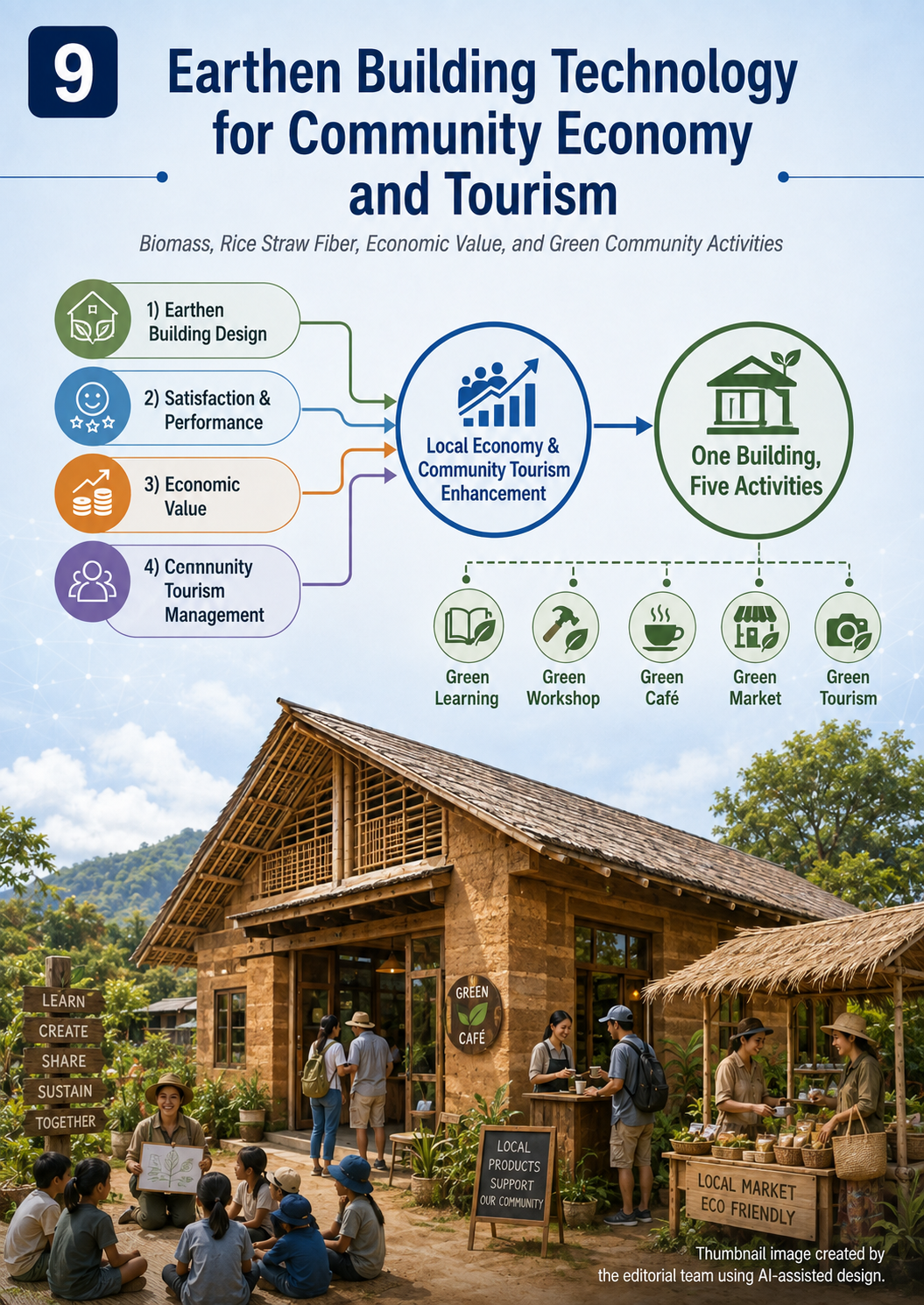
This research builds upon the development of earthen buildings constructed from biomass mixed with rice straw fibers, addressing the existing research gap concerning their economic feasibility and broader contributions to community development. The objectives were to 1) analyze the economic feasibility of earthen buildings constructed from biomass mixed with rice straw fibers 2) examine the effects of architectural technology for such earthen buildings on enhancing the local economy and community-based tourism and 3) formulate policies for strengthening the local economy and community-based tourism in Nong Taphan Subdistrict. The study employed an Explanatory Sequential Mixed Methods Design, in which quantitative research was conducted initially, followed by qualitative research. The findings from both phases were integrated, analyzed thematically, and synthesized to formulate policy recommendations. The research instruments consisted of (1) in-depth interview guidelines administered to 20 key informants comprising chairpersons and members of community enterprises (2) a focus group discussion guideline administered to 10 key stakeholders and (3) a questionnaire administered to 333 residents from six villages selected using quota sampling. The statistical methods employed included percentage mean standard deviation t-test and multiple regression analysis. The findings indicated that the Return on Investment (ROI) was 0.52 times, suggesting that the project was not economically viable during the initial investment period. However, the Social Return on Investment (SROI) was 2.33 times, indicating substantial social value generated over a five-year period. Multiple regression analysis revealed that community tourism management, together with economic value of earthen buildings constructed from biomass and rice straw, were significant factors influencing the enhancement of the local economy and community-based tourism. Accordingly, the policy direction for Nong Taphan Subdistrict should shift from treating the earthen building merely as a physical structure toward developing it as an economic and tourism platform. The proposed policy, “One Building Five Activities” aims to generate income and transform the building into a community activity hub comprising at least five functions: (1) Green Learning: a learning center for waste and biomass management (2) Green Workshop: hands-on activities for developing materials and community products (3) Green Café: serving beverages, bakery products, and local cuisine (4) Green Market: a marketplace for community products and (5) Green Tourism: a community attraction, check-in destination, and gateway to local tourism routes. These findings demonstrate that biomass-based earthen buildings can serve not only as sustainable construction innovations but also as mechanisms for creating social value, strengthening local economic activities, and promoting sustainable community-based tourism.
Downloads
Article Details

This work is licensed under a Creative Commons Attribution-NonCommercial-NoDerivatives 4.0 International License.




References
กระทรวงสาธารณสุข. (2567, 10 กุมภาพันธ์). 3 หมอ รายงานข้อมูลตำบลหนองตะพาน. https://3doctor.hss.moph.go.th/.
ดนวัต สีพุธสุข วีณา ลีลาประเสริฐศิลป์ วิลาสินี ธนพิทักษ์ และบัณฑิต ทองสงฆ์. (2567). การประเมินผลตอบแทนทางสังคม (SROI) ผ่านการท่องเที่ยวชุมชน เสริมพลังความเป็นไปได้ในการแก้ปัญหาครัวเรือนยากจน. วารสารพิพัฒนสังคม, 1(2), 51-70. https://so15.tci-thaijo.org/index.php/jsdrp/article/view/992
บริษัท คอร์เบียน จำกัด. (2564). การทำลายจุลินทรีย์ในกระบวนการผลิต [เอกสารประกอบการพิจารณาไม่ได้ตีพิมพ์].
บริษัท พูแรค (ประเทศไทย) จำกัด. (2568). รายงานการประชุมโครงการวิจัยร่วมกับมหาวิทยาลัยเทคโนโลยีราชมงคลตะวันออก [เอกสารรายงานการประชุมไม่ได้ตีพิมพ์].
พรพจน์ ศรีดัน และ ธิดาศิลป์ เปลี่ยนละออ. (2569). การประเมินผลตอบแทนทางสังคม (SROI) ของการจัดการการท่องเที่ยวเกาะสีชัง ภายใต้แนวคิดเศรษฐกิจสีน้ำเงิน. วารสารเศรษฐศาสตร์ประยุกต์และกลยุทธ์การจัดการ, 13(1), 1–19. https://doi.org/10.56825/jaems.2026.1316480 DOI: https://doi.org/10.56825/jaems.2026.1316480
พัชรี ปรีเปรมโมทย์ นรินทร์ เจริญพันธ์ ธนพล พุกเส็ง กัลยารัตน์ เชี่ยวชาญ จารึก สิงหปรีชา ปาริฉัตร เต็งสุวรรณ์ และวศิน ยุวนะเตมีย์. (2568). ผลตอบแทนทางสังคมจากการลงทุนของการท่องเที่ยวเชิงอาหารในจังหวัดจันทบุรี. วารสารเศรษฐศาสตร์ประยุกต์และกลยุทธ์การจัดการ, 12(1), 224-242. https://doi.org/10.56825/jaems.2025.1216233 DOI: https://doi.org/10.56825/jaems.2025.1216233
พู่กัน สายด้วง และณชภัทร พิชญมหุตม์. (2569). เทคโนโลยีสถาปัตยกรรมเพื่ออาคารดินจากไบโอมาสผสมเส้นใยฟางข้าว เพื่อการยกระดับเศรษฐกิจและการ ท่องเที่ยวชุมชน ของวิสาหกิจชุมชนธนาคารขยะออมทรัพย์บ้านไผ่ หมู่ 1 ตำบลหนองตะพาน อำเภอบ้านค่าย จังหวัดระยอง. (รายงานโครงการวิจัยฉบับสมบูรณ์). ชลบุรี: มหาวิทยาลัยเทคโนโลยีราชมงคลตะวันออก.
สฤณี อาชวานันทกุล และภัทราพร แย้มละออ. (2560). คู่มือการประเมินผลลัพธ์ทางสังคมและผลตอบแทนทางสังคมจากการลงทุน (ฉบับปรับปรุง). สำนักงานกองทุนสนับสนุนการวิจัย.
ALS Laboratory Group (Thailand) Co., Ltd. (2023). Analysis/test report biomass: Lot ID: 2342942 [Unpublished test report].
Boudreau, S., Hrapovic, S., Liu, Y., Leung, C. W. A., Lam E., & Kerton, M F. (2023). Isolation of hydroxyapatite from Atlantic salmon processing waste using a protease and lipase mixture. RSC Sustainability, 1(6): 1554–1564. https://doi.org/10.1039/d3su00102d DOI: https://doi.org/10.1039/D3SU00102D
Chatkaewnapanon, Y., & Lee, T. J. (2022). Planning sustainable community-based tourism in the context of Thailand: Community, development, and the foresight tools. Sustainability, 14(12), 7413. https://doi.org/10.3390/su14127413 DOI: https://doi.org/10.3390/su14127413
Leo, A., & Michael, K., (2021). Investigation of the effects of rice husk and rice straw on the properties of lightweight fibrecrete blocks. Journal of Civil, Construction and Environmental Engineering, 6(5), 135–143. https://doi.org/10.11648/j.jccee.20210605.12 DOI: https://doi.org/10.11648/j.jccee.20210605.12
Likert, R. (1932). A technique for the measurement of attitudes. Archives of psychology., 22 (140), 1-55.
Montesinos-Martínez, M., Martínez-Gabarrón, A., Barreca, F., & Flores-Yepes, J. A. (2024). A newly bio-based material for the construction industry using gypsum binder and rice straw waste (Oryza sativa). Buildings, 14(11), 3440. https://doi.org/10.3390/buildings14113440 DOI: https://doi.org/10.3390/buildings14113440
Mtapuri, O., Camilleri, M. A., & Dłużewska, A. (2022). Advancing community-based tourism approaches for the sustainable development of destinations. Sustainable Development, 30(3), 423–432. https://doi.org/10.1002/sd.2257 DOI: https://doi.org/10.1002/sd.2257
Pasanchay, K., & Schott, C. (2021). Community-based tourism homestays’ capacity to advance the Sustainable Development Goals: A holistic sustainable livelihood perspective. Tourism Management Perspectives, 38, 100784. https://doi.org/10.1016/j.tmp.2020.100784 DOI: https://doi.org/10.1016/j.tmp.2020.100784
Sharma, T., Singh, S., Sharma, S., Sharma, U., et al. (2024). Implications of agro-industrial wastes on the durability and erosion characteristics of unfired soil-blocks reinforced with paddy straw fibers: Sustainable earth construction. Journal of Reinforced Plastics and Composites. 19, 1-22. https://doi.org/10.1177/15589250241239235 DOI: https://doi.org/10.1177/15589250241239235
Siregar, M. R. A., Damayanti, N. A., Sugiana, D., & Khadijah, U. L. S. (2023). Measuring communities’ perceptions towards the socio-economic impact of community-based tourism development of tourism villages in Indonesia (Case from Bogor Regency, Indonesia). Journal of Law and Sustainable Development, 11(11), e1964. https://doi.org/10.55908/sdgs.v11i11.1964 DOI: https://doi.org/10.55908/sdgs.v11i11.1964
Thananusak, T., & Suriyankietkaew, S. (2023). Unpacking key sustainability drivers for sustainable social enterprises: A community-based tourism perspective. Sustainability, 15(4), 3401. https://doi.org/10.3390/su15043401 DOI: https://doi.org/10.3390/su15043401
Yamane, T. (1967). Statistics: An introductory analysis (2nd ed.). Harper & Row.