กลยุทธ์การตลาดดิจิทัลสำหรับผู้สูงอายุไทย: บทบาทของความไว้วางใจทางการเงินและแรงยืนยันทางสังคม
##plugins.themes.bootstrap3.article.sidebar##
##plugins.themes.bootstrap3.article.main##
บทคัดย่อ
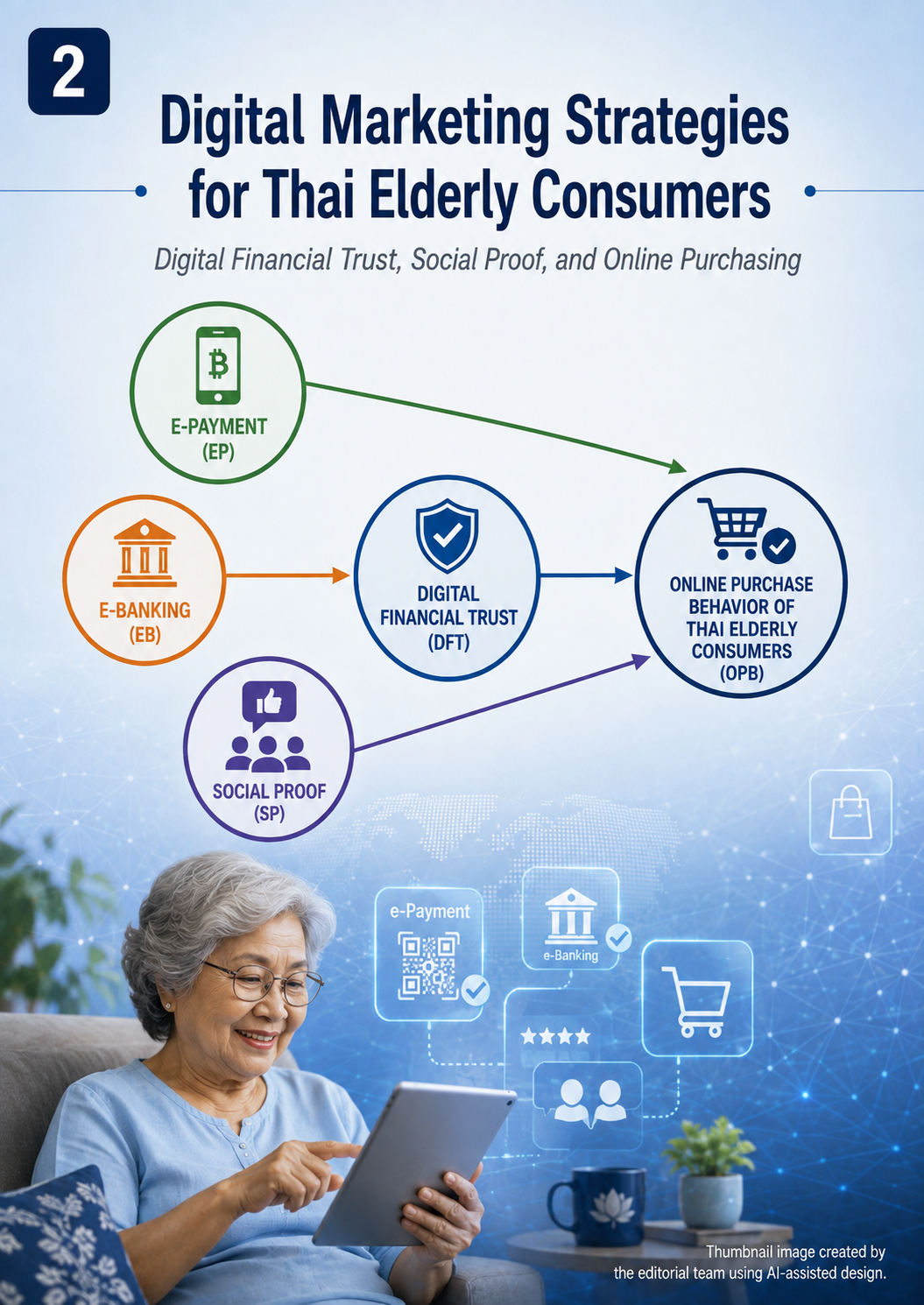
การวิจัยนี้วิเคราะห์ความสัมพันธ์ระหว่างปัจจัยทุนมนุษย์ เศรษฐกิจ การเข้าถึงเทคโนโลยี ประสบการณ์การเงินดิจิทัล และแรงยืนยันทางสังคมกับพฤติกรรมการซื้อสินค้าออนไลน์ของผู้สูงอายุไทย รวมทั้งทดสอบผลเสริมกันระหว่างประสบการณ์การเงินดิจิทัลและแรงยืนยันทางสังคม โดยใช้ข้อมูลทุติยภูมิจากการสำรวจการใช้เทคโนโลยีสารสนเทศและการสื่อสารในครัวเรือน ไตรมาส 2/2567 จำนวน 53,491 ราย แทนผู้สูงอายุ 14.0 ล้านคน วิเคราะห์ด้วยการถดถอยโลจิสติกแบบลำดับขั้นถ่วงน้ำหนัก ผลพบว่าผู้สูงอายุร้อยละ 17.9 เคยซื้อสินค้าออนไลน์ ปัจจัยที่มีความสัมพันธ์แข็งแกร่งที่สุดคือ e-Payment (OR=3.41, 95% CI: 3.05-3.81, p<0.001) รองลงมาคือ e-Banking (OR=2.18, 95% CI: 1.95-2.44, p<0.001) และสื่อสังคมออนไลน์ (OR=1.52, 95% CI: 1.38-1.68, p<0.001) พบผลเสริมกันระหว่างประสบการณ์ การเงินดิจิทัลและแรงยืนยันทางสังคม (OR=3.11, 95% CI: 2.54-3.81, p<0.001) ชี้ให้เห็นว่าการเข้าถึงเทคโนโลยีเพียงอย่างเดียวไม่เพียงพอ ผู้สูงอายุต้องมีความไว้วางใจทางดิจิทัลจากประสบการณ์ธุรกรรมที่ประสบความสำเร็จและแรงยืนยันทางสังคมงานวิจัยเสนอแบบจำลอง Trust-Finance Flywheel Model ในฐานะกรอบแนวคิดเชิงอธิบายที่พัฒนาจากหลักฐานเชิงสัมพันธ์ และเสนอกลยุทธ์ 4 ด้าน ได้แก่ (1) การสร้างประสบการณ์ธุรกรรมที่ประสบความสำเร็จ (2) การสร้างแรงยืนยันทางสังคม (3) พาณิชย์อิเล็กทรอนิกส์แบบให้ความช่วยเหลือ (Assisted Commerce Model) และ (4) การออกแบบประสบการณ์ผู้ใช้เฉพาะกลุ่มอายุ (Age-Specific User Experience)
##plugins.generic.usageStats.downloads##
##plugins.themes.bootstrap3.article.details##

This work is licensed under a Creative Commons Attribution-NonCommercial-NoDerivatives 4.0 International License.




เอกสารอ้างอิง
สำนักงานสถิติแห่งชาติ. (2567). รายงานการสำรวจการใช้เทคโนโลยีสารสนเทศและการสื่อสารในครัวเรือน พ.ศ. 2567 ไตรมาส 2 (ICTH 2567 Q2) [เอกสารที่ไม่ได้ตีพิมพ์]. สำนักงานสถิติแห่งชาติ.
อุบล ไม้พุ่ม. (2566). การยอมรับเทคโนโลยีโทรศัพท์มือถือที่ส่งผลกับความตั้งใจซื้อสินค้าอุปโภคบริโภคออนไลน์ผ่านแอปพลิเคชั่นของผู้บริโภคกลุ่มเบบี้บูมเมอร์ในกรุงเทพมหานคร. วารสารวไลยอลงกรณ์ปริทัศน์, 13(1), 33–46. https://so06.tci-thaijo.org/index.php/var/article/view/260252
Amouzadeh, E., Dianat, I., Faradmal, J., & Babamiri, M. (2025). Optimizing mobile app design for older adults: Systematic review of age-friendly design. Aging Clinical and Experimental Research, 37, 248. https://doi.org/10.1007/s40520-025-03157-7
Berg, H., & Liljedal, K. T. (2022). Elderly consumers in marketing research: A systematic literature review and directions for future research. International Journal of Consumer Studies, 46(5), 1640-1664. https://doi.org/10.1111/ijcs.12830
Chakraborty, R., Lee, J., Bagchi-Sen, S., Upadhyaya, S., & Rao, H. R. (2016). Online shopping in-tention in the context of data breach in online retail stores: An examination of older and younger adults. Decision Support Systems, 83, 47–56. https://doi.org/10.1016/ j.dss.2015.12.007
Cialdini, R. B. (2021). Influence: The psychology of persuasion (New and expanded ed.). Harper Business.
Gefen, D., Karahanna, E., & Straub, D. W. (2003). Trust and TAM in online shopping: An integrated model. MIS Quarterly, 27(1), 51-90. https://doi.org/10.2307/30036519
Hong, W., Liang, C., Ma, Y., & Zhu, J. (2025). Intergenerational digital feedback and digital social integration of older adults: An empirical study from personal initiative perspective. Humanities and Social Sciences Communications, 12, 1144. https://doi.org/10.1057/s41599-025-05518-z
Hosmer, D. W., Lemeshow, S., & Sturdivant, R. X. (2013). Applied logistic regression (3rd ed.). Wiley. https://doi.org/10.1002/9781118548387
Jantavongso, S. (2022). Toward global digital literate citizens: A case of Thailand's aging generation. The Electronic Journal of Information Systems in Developing Countries, 88(2), e12207. https://doi.org/10.1002/isd2.12207
Kebede, A. S., Ozolins, L.-L., Holst, H., & Galvin, K. (2022). Digital engagement of older adults: Scoping review. Journal of Medical Internet Research, 24(12), e40192. https://doi.org/10.2196/40192
Lian, J.-W., & Yen, D. C. (2014). Online shopping drivers and barriers for older adults: Age and gender differences. Computers in Human Behavior, 37, 133-143. https://doi.org/10.1016/j.chb.2014.04.028
Miller, L. M. S., Callegari, R. A., Abah, T., & Fann, H. (2024). Digital literacy training for low-income older adults through undergraduate community-engaged learning: Single-group pretest-posttest study. JMIR Aging, 7(1), e51675. https://doi.org/10.2196/51675
Olumekor, M., Polbitsyn, S. N., Khan, M. S., Singh, H. P., & Alhamad, I. A. (2025). Ageing and digital shopping: Measurement and validation of an innovative framework. PLOS ONE, 20(3), e0315125. https://doi.org/10.1371/journal.pone.0315125
Pavlou, P. A. (2003). Consumer acceptance of electronic commerce: Integrating trust and risk with the technology acceptance model. International Journal of Electronic Commerce, 7(3), 101–134. https://doi.org/10.1080/10864415.2003.11044275
Rajaobelina, L., Brun, I., Line, R., & Cloutier-Bilodeau, C. (2021). Not all elderly are the same: Fostering trust through mobile banking service experience. International Journal of Bank Marketing, 39(1), 85–106. https://doi.org/10.1108/IJBM-05-2020-0288
Van Dijk, J. A. G. M. (2005). The deepening divide: Inequality in the information society. SAGE Publications. https://doi.org/10.4135/9781452229812
Venkatesh, V., Morris, M. G., Davis, G. B., & Davis, F. D. (2003). User acceptance of information technology: Toward a unified view. MIS Quarterly, 27(3), 425-478. https://doi.org/10.2307/30036540
Wang, Z., & Huang, X. (2023). Understanding the role of digital finance in facilitating consumer online purchases: An empirical investigation. Finance Research Letters, 55, 103939. https://doi.org/10.1016/j.frl.2023.103939