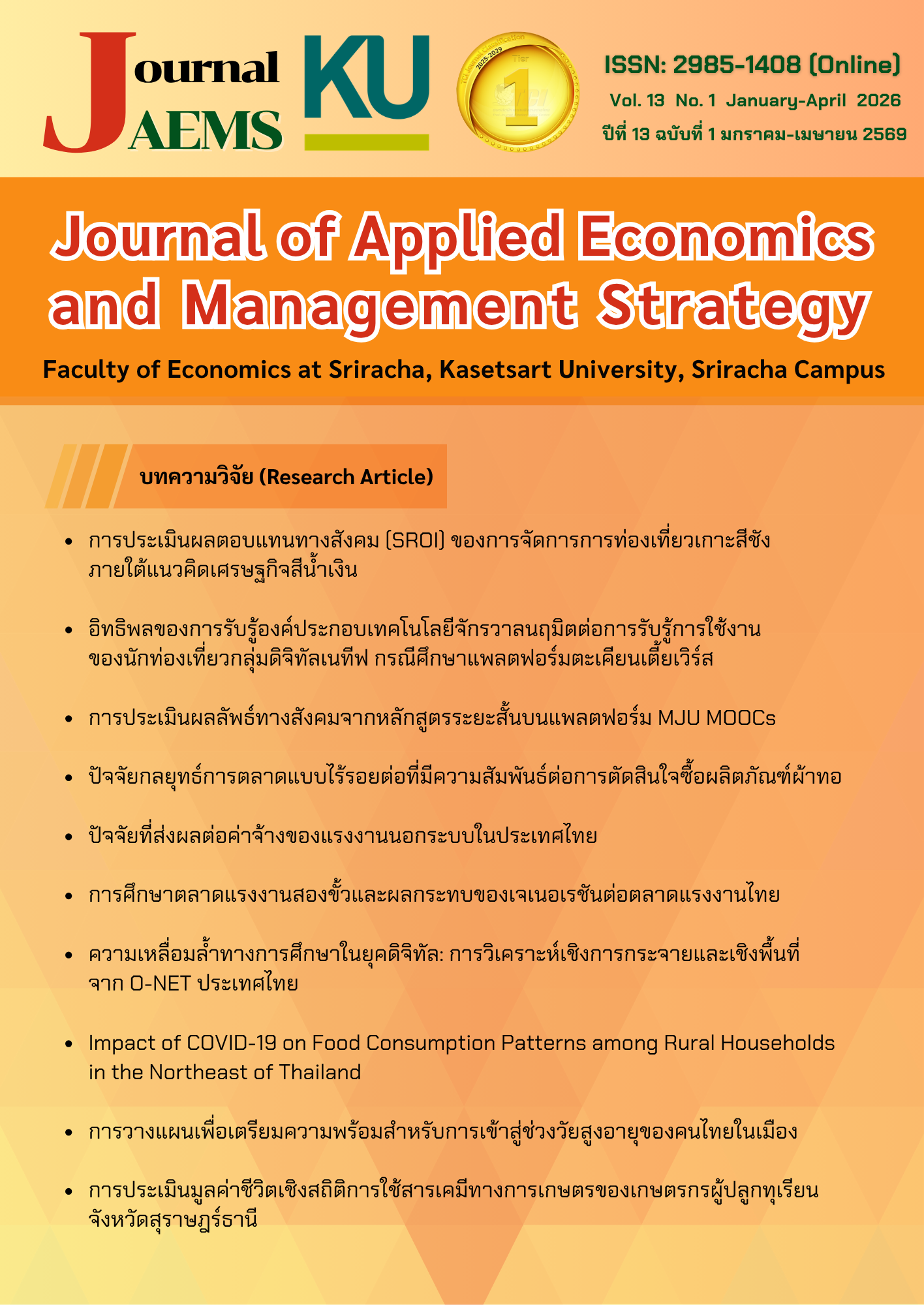
Educational Inequality in the Digital Era: Distributional and Spatial Analysis of Thailand's O-NET
Article Sidebar
Main Article Content
Abstract
Educational inequality in the digital era constitutes a critical challenge affecting human capital development and national competitiveness, particularly amid the transition to a digital economy and post-COVID-19 recovery. While prior research has examined the effects of socioeconomic factors on educational achievement, three significant gaps remain: (1) most analyses rely on mean-based approaches that fail to capture heterogeneity across the achievement distribution, (2) the role of digital access has not been systematically examined, and (3) spatial dimensions have received insufficient attention. This study employs quantile
regression and spatial analysis using O-NET data from 49,639 Grade 9 students across 77 provinces in Thailand. The analysis examines effects at the 25th, 50th, and 75th quantiles to investigate heterogeneity across achievement levels. The spatial analysis focuses on explaining contextual differences between regions (spatial heterogeneity) rather than testing direct spatial dependence. The results reveal severe inequality across three dimensions. First, the effect of the SES index increases from 3.40 points among low achievers to 15.50 points among high achievers (a 4.5-fold increase), reflecting cumulative advantage mechanisms whereby students from wealthier households have greater access to high-quality resources. Second, poverty exerts the strongest negative impact on low achievers (reducing scores by 0.30 points), indicating overlapping disadvantages among vulnerable groups. Third, the achievement gap between Bangkok and other regions reaches 33.71 points, accompanied by significant spatial interaction effects, demonstrating structural inequality across geographic areas. The findings underscore the necessity of differentiated policy interventions: (1) poverty mitigation programs for low-performing students, (2) universal support mechanisms for middle-performing groups, and (3) capability enhancement policies for high-performing students, alongside regionally targeted investment to reduce inter-regional disparities. This study provides empirical evidence supporting equitable and sustainable education policies in the era of digital transformation.
Downloads
Article Details

This work is licensed under a Creative Commons Attribution-NonCommercial-NoDerivatives 4.0 International License.




References
ดิเรก ปัทมสิริวัฒน์ พุดตาน พันธุเนร พิชิต รัชตพิบูลภพ วิทยา คามณี ดารุณี พุ่มแก้ว และ เมรดี อินอ่อน. (2566). ความเปราะบางในครัวเรือนไทยและความเหลื่อมล้ำของโอกาสการศึกษาของเด็ก: หลักฐานเชิงประจักษ์จากข้อมูลครัวเรือนและผลทดสอบสัมฤทธิ์ทางการศึกษา. วารสารเศรษฐศาสตร์และนโยบายสาธารณะ, 14(28), 33–49. https://so01.tci-thaijo.org/index.php/econswu/article/view/263344
ดิเรก ปัทมสิริวัฒน์ สุวิมล เฮงพัฒนา และพุดตาน พันธุเณร. (2555). ความเหลื่อมล้ำของโอกาสการศึกษาและมาตรฐานการคลังเพื่อขยายโอกาสการศึกษาให้เยาวชนยากจน. วารสารเศรษฐศาสตร์ปริทรรศน์ สถาบันพัฒนศาสตร์, 6(1), 1-36. https://so06.tci-thaijo.org/index.php/NER/article/view/22696
สมชัย จิตสุชน. (2558). ความเหลื่อมล้ำในสังคมไทย: แนวโน้ม นโยบาย และแนวทางการขับเคลื่อนนโยบาย. กรุงเทพฯ: สถาบันวิจัยเพื่อการพัฒนาประเทศไทย.
Anselin, L. (2001). Spatial econometrics. In B. H. Baltagi (Ed.), A companion to theoretical econ-ometrics (pp. 310–330). Blackwell. DOI: https://doi.org/10.1002/9780470996249.ch15
Becker, G. S. (1993). Human capital: A theoretical and empirical analysis, with special reference to education (3rd ed.). University of Chicago Press. DOI: https://doi.org/10.7208/chicago/9780226041223.001.0001
Buchinsky, M. (1995). Estimating the asymptotic covariance matrix for quantile regression models: A Monte Carlo study. Journal of Econometrics, 68(2), 303–338. https://doi.org/10.1016/0304-4076(94)01652-G DOI: https://doi.org/10.1016/0304-4076(94)01652-G
Chairassamee, N., Chancharoenchai, K., Saraithong, W., & Temsumrit, N. (2024). Inequality in ed-ucational opportunity in Thailand during the COVID-19 pandemic. International Journal of Educational Development, 109, Article 103083. https://doi.org/10.1016/j.ijedudev.2024.103083 DOI: https://doi.org/10.1016/j.ijedudev.2024.103083
Eide, E., & Showalter, M. H. (1998). The effect of school quality on student performance: A quantile regression approach. Economics Letters, 58(3), 345–350. https://doi.org/10.1016/S0165-1765(97)00286-3 DOI: https://doi.org/10.1016/S0165-1765(97)00286-3
Filmer, D., & Pritchett, L. H. (2001). Estimating wealth effects without expenditure data-or tears: An application to educational enrollments in states of India. Demography, 38(1), 115–132. https://doi.org/10.1353/dem.2001.0003 DOI: https://doi.org/10.1353/dem.2001.0003
Hanushek, E. A., & Woessmann, L. (2012). Education, knowledge capital, and economic growth. Cambridge University Press.
Hasamoh, A., Srivirat, S., & Wichaidit, W. (2025). Digital divide in online education during the COVID-19 pandemic and educational outcomes: Findings from a community-based survey in Thailand’s impoverished deep south. Asian Crime and Society Review, 12(1), Article 5. https://doi.org/10.14456/acsr.2025.5
KC, D., KC, P., Rado, I., & Vichit-Vadakan, N. (2025). Digital inequality and learning outcomes: Evidence from Thailand. Education and Information Technologies. https://doi.org/10.1007/s10639-025-13570-0 DOI: https://doi.org/10.1007/s10639-025-13570-0
Koenker, R., & Bassett, G. (1978). Regression quantiles. Econometrica, 46(1), 33–50. https://doi.org/10.2307/1913643 DOI: https://doi.org/10.2307/1913643
Krugman, P. (1991). Increasing returns and economic geography. Journal of Political Economy, 99(3), 483–499. https://doi.org/10.1086/261763 DOI: https://doi.org/10.1086/261763
Lounkaew, K. (2013). Explaining urban–rural differences in educational achievement in Thailand: Evidence from PISA literacy data. Economics of Education Review, 37, 213–225. https://doi.org/10.1016/j.econedurev.2013.09.003 DOI: https://doi.org/10.1016/j.econedurev.2013.09.003
Martins, P. S., & Pereira, P. T. (2004). Does education reduce wage inequality? Quantile regression evidence from 16 countries. Labour Economics, 11(3), 355–371. https://doi.org/10.1016/j.labeco.2003.05.003 DOI: https://doi.org/10.1016/j.labeco.2003.05.003
Moretti, E. (2004). Human capital externalities in cities. In Handbook of Regional and Urban Eco-nomics (Vol. 4, pp.2242-2291). Elsevier. DOI: https://doi.org/10.1016/S1574-0080(04)80008-7
OECD. (2023). PISA 2022 results (Volume I): The state of learning and equity in education. PISA, OECD Publishing. https://doi.org/10.1787/53f23881-en DOI: https://doi.org/10.1787/53f23881-en
OECD. (2025). Education at a glance 2025: OECD indicators. OECD Publishing. https://doi.org/10.1787/1c0d9c79-en DOI: https://doi.org/10.1787/1c0d9c79-en
Powell, J. L. (1984). Least absolute deviations estimation for the censored regression model. Journal of Econometrics, 25(3), 303–325. https://doi.org/10.1016/0304-4076(84)90004-6 DOI: https://doi.org/10.1016/0304-4076(84)90004-6
Reardon, S. F. (2011). The widening academic achievement gap between the rich and the poor. Community Investments, 23(2), 19–39. https://www.frbsf.org/research-and-insights/publications/2012/08/widening-academic-achievement-gap-rich-poor
Robinson, W. S. (1950). Ecological correlations and the behavior of individuals. American Sociological Review, 15(3), 351–357. https://doi.org/10.2307/2087176 DOI: https://doi.org/10.2307/2087176
Schultz, T. W. (1961). Investment in human capital. The American Economic Review, 51(1), 1–17. https://la.utexas.edu/users/hcleaver/330T/350kPEESchultzInvestmentHumanCapital.pdf
Shero, J. A., & Hart, S. A. (2022). Methodological decisions and their impacts on the perceived relations between school funding and educational achievement. Frontiers in Education, 7, Article 1043471. https://doi.org/10.3389/feduc.2022.1043471 DOI: https://doi.org/10.3389/feduc.2022.1043471
Siwareepan, N. (2020). The effects of private tutoring on academic achievement in Thailand [Master’s thesis,Thammasat University]. https://ethesisarchive.library.tu.ac.th/thesis/2020/TU_2020_6104040040_13965_14116.pdf
UNESCO. (2025). Global education monitoring report 2025: Technology, equity and learning. UNESCO Publishing.
Van Dijk, J. A. G. M. (2006). Digital divide research, achievements and shortcomings. Poetics, 34(4–5), 221–235. https://doi.org/10.1016/j.poetic.2006.05.004 DOI: https://doi.org/10.1016/j.poetic.2006.05.004
Van Dijk, J. A. G. M. (2020). The digital divide. Polity Press.
Warschauer, M. (2003). Technology and social inclusion: Rethinking the digital divide. MIT Press. DOI: https://doi.org/10.7551/mitpress/6699.001.0001
World Bank. (2023). Inequality and jobs in Thailand. World Bank Publications.