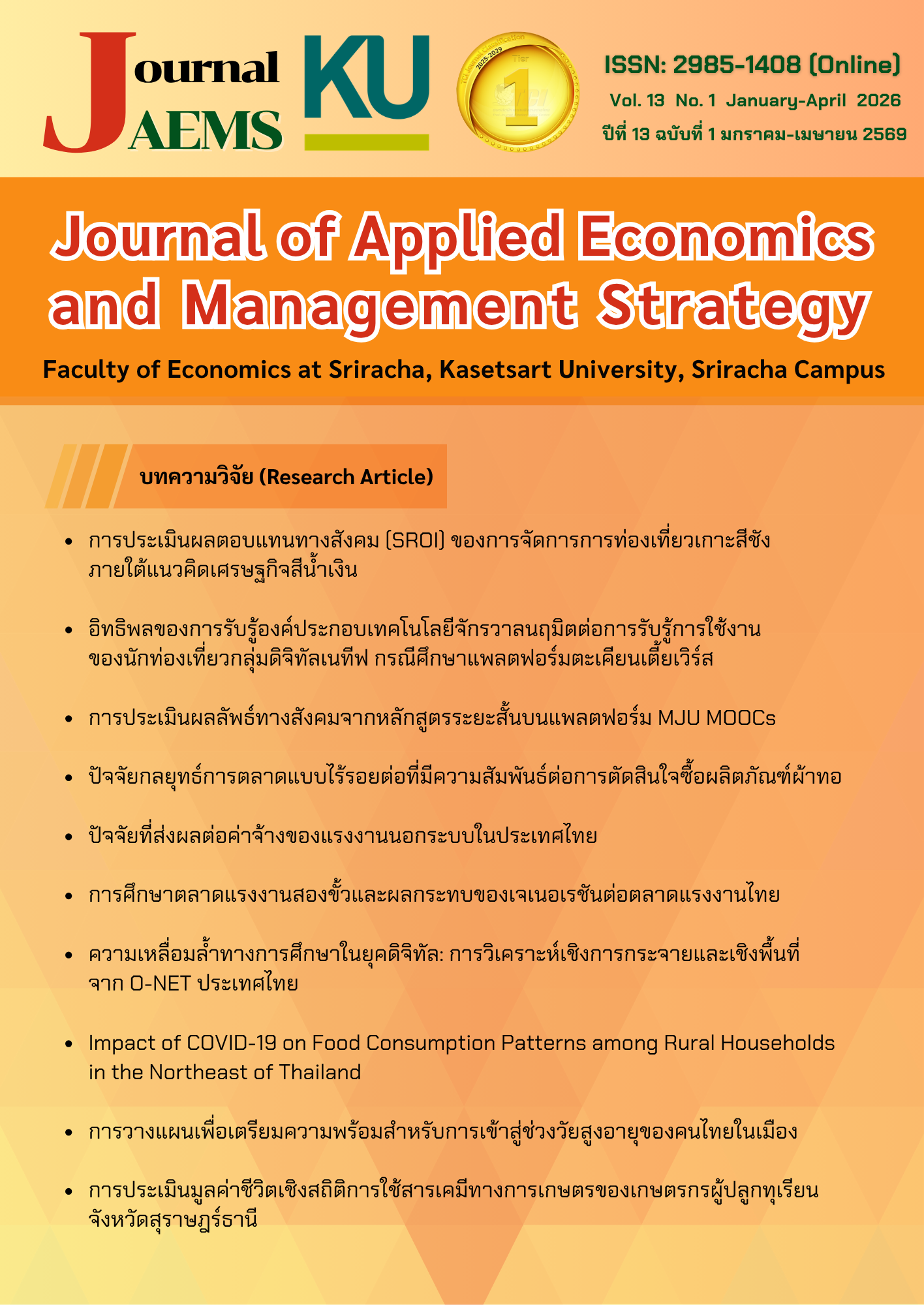
ความเหลื่อมล้ำทางการศึกษาในยุคดิจิทัล: การวิเคราะห์เชิงการกระจายและเชิงพื้นที่จาก O-NET ประเทศไทย
##plugins.themes.bootstrap3.article.sidebar##
##plugins.themes.bootstrap3.article.main##
บทคัดย่อ
ความเหลื่อมล้ำทางการศึกษาในยุคดิจิทัลเป็นปัญหาสำคัญที่ส่งผลต่อการพัฒนาทุนมนุษย์และความสามารถในการแข่งขันของประเทศ โดยเฉพาะในบริบทของการเปลี่ยนผ่านสู่เศรษฐกิจดิจิทัล และความท้าทายหลัง COVID-19 แม้งานวิจัยก่อนหน้าจะศึกษาผลกระทบของปัจจัยทางเศรษฐกิจและสังคมต่อผลสัมฤทธิ์ทางการศึกษา แต่ยังมีช่องว่างสำคัญ 3 ประการ คือ (1) การวิเคราะห์ส่วนใหญ่ใช้ค่าเฉลี่ยซึ่งไม่สามารถจับความแตกต่างตามการกระจายผลสัมฤทธิ์ (2) บทบาทของการเข้าถึงดิจิทัลยังไม่ได้รับการศึกษาอย่างเป็นระบบ และ (3) มิติเชิงพื้นที่ยังไม่ได้รับความสนใจเพียงพอ การศึกษานี้ใช้การถดถอยควอนไทล์และ การวิเคราะห์เชิงพื้นที่กับข้อมูล O-NET ชั้นมัธยมศึกษาปีที่ 3 จาก 49,639 คน ใน 77 จังหวัด โดยวิเคราะห์ที่ควอนไทล์ที่ 25 50 และ 75 เพื่อตรวจสอบความไม่เป็นเนื้อเดียวกันของผลกระทบตามระดับผลสัมฤทธิ์ การวิเคราะห์เชิงพื้นที่มุ่งอธิบายความแตกต่างเชิงบริบทระหว่างภูมิภาคมากกว่าการทดสอบการพึ่งพาระหว่างพื้นที่โดยตรง ผลการวิเคราะห์พบความเหลื่อมล้ำที่รุนแรงใน 3 มิติ (1) ดัชนี SES ส่งผลต่อคะแนนเพิ่มขึ้นจาก 3.40 คะแนนในกลุ่มผลสัมฤทธิ์ต่ำเป็น 15.50 คะแนนในกลุ่มสูง (เพิ่มขึ้น 4.5 เท่า) สะท้อนกลไกการสะสมข้อได้เปรียบที่นักเรียนในครัวเรือนฐานะดีสามารถเข้าถึงทรัพยากรคุณภาพสูงได้มากกว่า (2) ความยากจนส่งผลกระทบรุนแรงที่สุดในกลุ่มผลสัมฤทธิ์ต่ำ (ลดคะแนน 0.30 คะแนน) ชี้ให้เห็นภาระซ้อนของปัจจัยเสี่ยงในกลุ่มเปราะบาง และ (3) ช่องว่างระหว่างกรุงเทพมหานครกับภูมิภาคอื่นสูงถึง 33.71 คะแนน พร้อมผลปฏิสัมพันธ์เชิงพื้นที่ที่สำคัญ แสดงความเหลื่อมล้ำเชิงโครงสร้างระหว่างพื้นที่ ผลการวิจัยชี้ความจำเป็นของนโยบายแบบมุ่งเป้า ได้แก่ (1) โปรแกรมบรรเทาความยากจนในกลุ่มผลสัมฤทธิ์ต่ำ (2) ระบบสนับสนุนสำหรับกลุ่มกลาง และ (3) โปรแกรมส่งเสริมศักยภาพสำหรับกลุ่มสูง ควบคู่กับการลงทุนเชิงพื้นที่แบบเป้าหมาย เพื่อลดความเหลื่อมล้ำระหว่างภูมิภาค การศึกษานี้สนับสนุนหลักฐานเชิงประจักษ์สำหรับนโยบายการศึกษาที่ เป็นธรรมและยั่งยืนในยุคดิจิทัล
##plugins.generic.usageStats.downloads##
##plugins.themes.bootstrap3.article.details##

This work is licensed under a Creative Commons Attribution-NonCommercial-NoDerivatives 4.0 International License.




เอกสารอ้างอิง
ดิเรก ปัทมสิริวัฒน์ พุดตาน พันธุเนร พิชิต รัชตพิบูลภพ วิทยา คามณี ดารุณี พุ่มแก้ว และ เมรดี อินอ่อน. (2566). ความเปราะบางในครัวเรือนไทยและความเหลื่อมล้ำของโอกาสการศึกษาของเด็ก: หลักฐานเชิงประจักษ์จากข้อมูลครัวเรือนและผลทดสอบสัมฤทธิ์ทางการศึกษา. วารสารเศรษฐศาสตร์และนโยบายสาธารณะ, 14(28), 33–49. https://so01.tci-thaijo.org/index.php/econswu/article/view/263344
ดิเรก ปัทมสิริวัฒน์ สุวิมล เฮงพัฒนา และพุดตาน พันธุเณร. (2555). ความเหลื่อมล้ำของโอกาสการศึกษาและมาตรฐานการคลังเพื่อขยายโอกาสการศึกษาให้เยาวชนยากจน. วารสารเศรษฐศาสตร์ปริทรรศน์ สถาบันพัฒนศาสตร์, 6(1), 1-36. https://so06.tci-thaijo.org/index.php/NER/article/view/22696
สมชัย จิตสุชน. (2558). ความเหลื่อมล้ำในสังคมไทย: แนวโน้ม นโยบาย และแนวทางการขับเคลื่อนนโยบาย. กรุงเทพฯ: สถาบันวิจัยเพื่อการพัฒนาประเทศไทย.
Anselin, L. (2001). Spatial econometrics. In B. H. Baltagi (Ed.), A companion to theoretical econ-ometrics (pp. 310–330). Blackwell. DOI: https://doi.org/10.1002/9780470996249.ch15
Becker, G. S. (1993). Human capital: A theoretical and empirical analysis, with special reference to education (3rd ed.). University of Chicago Press. DOI: https://doi.org/10.7208/chicago/9780226041223.001.0001
Buchinsky, M. (1995). Estimating the asymptotic covariance matrix for quantile regression models: A Monte Carlo study. Journal of Econometrics, 68(2), 303–338. https://doi.org/10.1016/0304-4076(94)01652-G DOI: https://doi.org/10.1016/0304-4076(94)01652-G
Chairassamee, N., Chancharoenchai, K., Saraithong, W., & Temsumrit, N. (2024). Inequality in ed-ucational opportunity in Thailand during the COVID-19 pandemic. International Journal of Educational Development, 109, Article 103083. https://doi.org/10.1016/j.ijedudev.2024.103083 DOI: https://doi.org/10.1016/j.ijedudev.2024.103083
Eide, E., & Showalter, M. H. (1998). The effect of school quality on student performance: A quantile regression approach. Economics Letters, 58(3), 345–350. https://doi.org/10.1016/S0165-1765(97)00286-3 DOI: https://doi.org/10.1016/S0165-1765(97)00286-3
Filmer, D., & Pritchett, L. H. (2001). Estimating wealth effects without expenditure data-or tears: An application to educational enrollments in states of India. Demography, 38(1), 115–132. https://doi.org/10.1353/dem.2001.0003 DOI: https://doi.org/10.1353/dem.2001.0003
Hanushek, E. A., & Woessmann, L. (2012). Education, knowledge capital, and economic growth. Cambridge University Press.
Hasamoh, A., Srivirat, S., & Wichaidit, W. (2025). Digital divide in online education during the COVID-19 pandemic and educational outcomes: Findings from a community-based survey in Thailand’s impoverished deep south. Asian Crime and Society Review, 12(1), Article 5. https://doi.org/10.14456/acsr.2025.5
KC, D., KC, P., Rado, I., & Vichit-Vadakan, N. (2025). Digital inequality and learning outcomes: Evidence from Thailand. Education and Information Technologies. https://doi.org/10.1007/s10639-025-13570-0 DOI: https://doi.org/10.1007/s10639-025-13570-0
Koenker, R., & Bassett, G. (1978). Regression quantiles. Econometrica, 46(1), 33–50. https://doi.org/10.2307/1913643 DOI: https://doi.org/10.2307/1913643
Krugman, P. (1991). Increasing returns and economic geography. Journal of Political Economy, 99(3), 483–499. https://doi.org/10.1086/261763 DOI: https://doi.org/10.1086/261763
Lounkaew, K. (2013). Explaining urban–rural differences in educational achievement in Thailand: Evidence from PISA literacy data. Economics of Education Review, 37, 213–225. https://doi.org/10.1016/j.econedurev.2013.09.003 DOI: https://doi.org/10.1016/j.econedurev.2013.09.003
Martins, P. S., & Pereira, P. T. (2004). Does education reduce wage inequality? Quantile regression evidence from 16 countries. Labour Economics, 11(3), 355–371. https://doi.org/10.1016/j.labeco.2003.05.003 DOI: https://doi.org/10.1016/j.labeco.2003.05.003
Moretti, E. (2004). Human capital externalities in cities. In Handbook of Regional and Urban Eco-nomics (Vol. 4, pp.2242-2291). Elsevier. DOI: https://doi.org/10.1016/S1574-0080(04)80008-7
OECD. (2023). PISA 2022 results (Volume I): The state of learning and equity in education. PISA, OECD Publishing. https://doi.org/10.1787/53f23881-en DOI: https://doi.org/10.1787/53f23881-en
OECD. (2025). Education at a glance 2025: OECD indicators. OECD Publishing. https://doi.org/10.1787/1c0d9c79-en DOI: https://doi.org/10.1787/1c0d9c79-en
Powell, J. L. (1984). Least absolute deviations estimation for the censored regression model. Journal of Econometrics, 25(3), 303–325. https://doi.org/10.1016/0304-4076(84)90004-6 DOI: https://doi.org/10.1016/0304-4076(84)90004-6
Reardon, S. F. (2011). The widening academic achievement gap between the rich and the poor. Community Investments, 23(2), 19–39. https://www.frbsf.org/research-and-insights/publications/2012/08/widening-academic-achievement-gap-rich-poor
Robinson, W. S. (1950). Ecological correlations and the behavior of individuals. American Sociological Review, 15(3), 351–357. https://doi.org/10.2307/2087176 DOI: https://doi.org/10.2307/2087176
Schultz, T. W. (1961). Investment in human capital. The American Economic Review, 51(1), 1–17. https://la.utexas.edu/users/hcleaver/330T/350kPEESchultzInvestmentHumanCapital.pdf
Shero, J. A., & Hart, S. A. (2022). Methodological decisions and their impacts on the perceived relations between school funding and educational achievement. Frontiers in Education, 7, Article 1043471. https://doi.org/10.3389/feduc.2022.1043471 DOI: https://doi.org/10.3389/feduc.2022.1043471
Siwareepan, N. (2020). The effects of private tutoring on academic achievement in Thailand [Master’s thesis,Thammasat University]. https://ethesisarchive.library.tu.ac.th/thesis/2020/TU_2020_6104040040_13965_14116.pdf
UNESCO. (2025). Global education monitoring report 2025: Technology, equity and learning. UNESCO Publishing.
Van Dijk, J. A. G. M. (2006). Digital divide research, achievements and shortcomings. Poetics, 34(4–5), 221–235. https://doi.org/10.1016/j.poetic.2006.05.004 DOI: https://doi.org/10.1016/j.poetic.2006.05.004
Van Dijk, J. A. G. M. (2020). The digital divide. Polity Press.
Warschauer, M. (2003). Technology and social inclusion: Rethinking the digital divide. MIT Press. DOI: https://doi.org/10.7551/mitpress/6699.001.0001
World Bank. (2023). Inequality and jobs in Thailand. World Bank Publications.