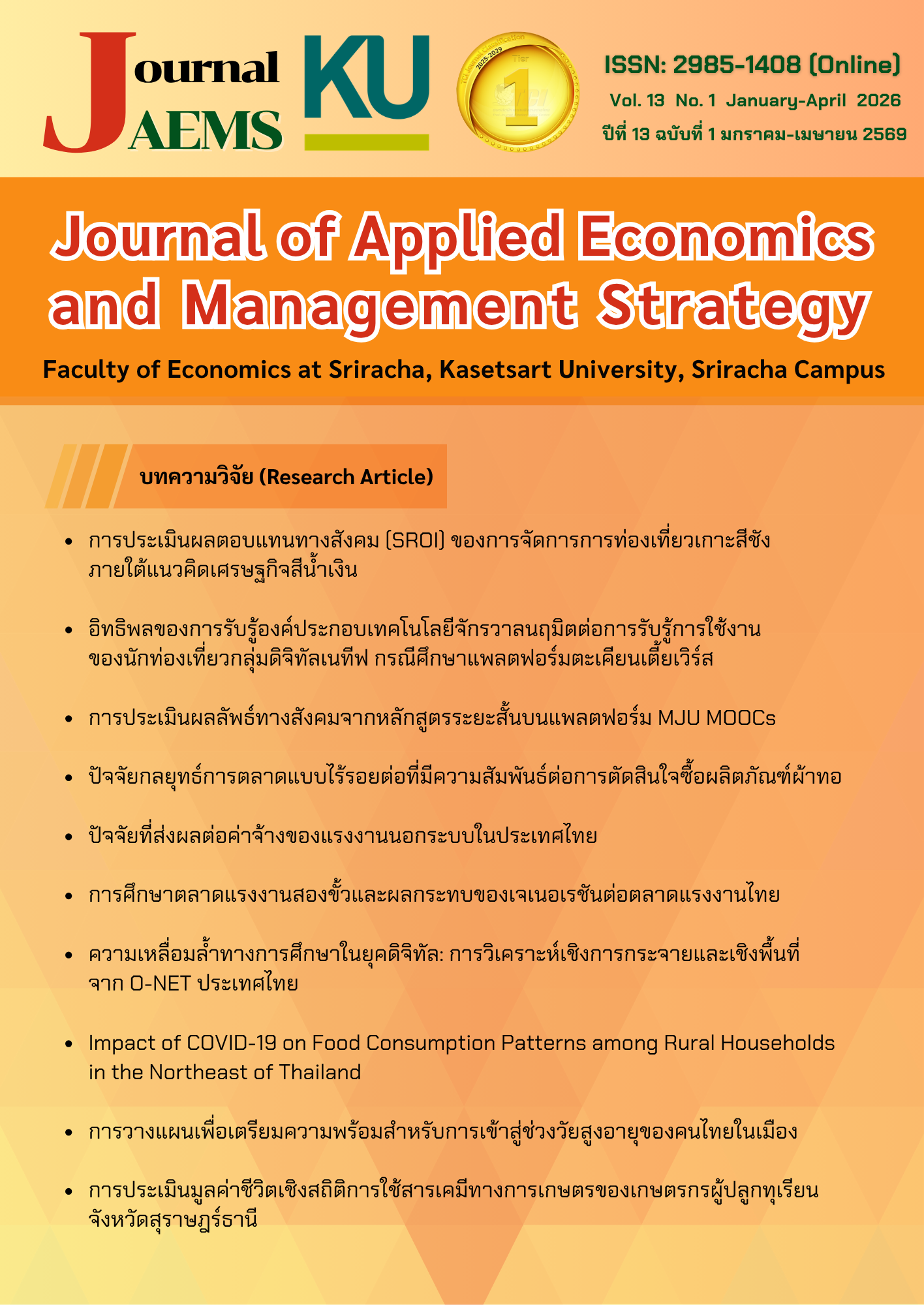
Social Return on Investment (SROI) of Tourism Management on Koh Sichang: Insights from the Blue Economy Framework
Article Sidebar
Main Article Content
Abstract
This study aims to evaluate the Social Return on Investment (SROI) of tourism management on Koh Sichang Island under the Blue Economy framework during the period 2020–2023, and to formulate policy recommendations for strategic development that enables economic growth to proceed in parallel with the sustainable conservation of natural resources and local livelihoods. The research employs a participatory action research approach and adopts a mixed-methods design, integrating quantitative and qualitative data collected through in-depth interviews, focus group discussions, and questionnaires with a wide range of stakeholders. These stakeholders include public transport service providers, accommodation operators and community-based tourism enterprises, local retailers and producers, fishing communities and marine resource management groups, local authorities and government agencies, as well as community leaders and local residents. The findings indicate that tourism management on Koh Sichang Island under the Blue Economy approach generates a Social Return on Investment (SROI) ratio of 2.21, meaning that every 1 Thai baht invested in tourism management generates a total social value of 2.21 baht. The analysis also reveals a net present value (NPV) of 444,557,549 baht and a benefit–cost ratio of 147.63. The primary beneficiaries of these outcomes are small-scale entrepreneurs, local communities and artisanal fishers, and public-sector agencies. These results demonstrate that the Blue Economy–based tourism management approach has strong potential to generate income, promote equitable benefit distribution, and simultaneously support the sustainable conservation of natural resources. In addition, the study proposes policy recommendations structured around four strategic pillars: (1) economic and marketing development, (2) social and community development, (3) environmental sustainability, and (4) governance and monitoring and evaluation mechanisms. Together, these strategies provide a concrete policy framework for advancing tourism-led economic, social, and environmental development under the Blue Economy paradigm.
Downloads
Article Details

This work is licensed under a Creative Commons Attribution-NonCommercial-NoDerivatives 4.0 International License.




References
ดนวัต สีพุธสุข วีณา ลีลาประเสริฐศิลป์ วิลาสินี ธนพิทักษ์ และบัณฑิต ทองสงฆ์. (2567). การประเมินผลตอบแทนทางสังคม (SROI) ผ่านการท่องเที่ยวชุมชน เสริมพลังความเป็นไปได้ในการแก้ปัญหาครัวเรือนยากจน. วารสารพิพัฒนสังคม, 1(2), 51-70. https://so15.tci-thaijo.org/index.php/jsdrp/article/view/992
เทศบาลตำบลเกาะสีชัง จังหวัดชลบุรี. (2565). สถิติข้อมูลการท่องเที่ยวอำเภอเกาะสีชัง พ.ศ. 2563–2565. เทศบาลตำบลเกาะสีชัง จังหวัดชลบุรี.
พัชรี ปรีเปรมโมทย์ นรินทร์ เจริญพันธ์ ธนพล พุกเส็ง กัลยารัตน์ เชี่ยวชาญ จารึก สิงหปรีชา ปาริฉัตร เต็งสุวรรณ์ และวศิน ยุวนะเตมีย์. (2568). ผลตอบแทนทางสังคมจากการลงทุนของการท่องเที่ยวเชิงอาหารในจังหวัดจันทบุรี. วารสารเศรษฐศาสตร์ประยุกต์และกลยุทธ์การจัดการ, 12(1), 224-242. https://doi.org/10.56825/jaems.2025.1216233
รชฏ จันทร์น้อย. (2560). การพัฒนาตราสินค้าการท่องเที่ยวเกาะสีชังตามแนวทางการส่งเสริมการท่องเที่ยววิถีไทย [รายงานวิจัย]. มหาวิทยาลัยบูรพา. https://digital_collect.lib.buu.ac.th/research/2563_291.pdf
วรภัทร เมฆขจร, ธีระพงษ์ ทศวัฒน์ และ พรรณรัตน์ กานต์ไกรศรี. (2567). การประเมินผลตอบแทนทางสังคมจากการลงทุน (SROI) กิจกรรมการพัฒนาผู้ประกอบการเชิงวัฒนธรรมอำเภอบ้านโพธิ์ จังหวัดฉะเชิงเทรา. วารสารวิชาการเครือข่ายบัณฑิตศึกษามหาวิทยาลัยราชภัฏภาคเหนือ, 14(1), 21-38. https://so02.tci-thaijo.org/index.php/JGNRU/article/view/266877
Corvo, L., Pastore, L., Mastrodascio, M., & Cepiku, D. (2022). The social return on investment model: a systematic literature review. Meditari Accountancy Research, 30(7), 49-86. https://doi.org/10.1108/MEDAR-05-2021-1307
Giorbelidze, M. (2025). The SROI puzzle: exploring barriers and strategies for effective social value measurement. Social Enterprise Journal, 21(2), 210-227. https://doi.org/10.1108/SEJ-03-2024-0053
Gourvenec, S., Dbouk, W., Sturt, F., & Teagle, D. A. H. (2025). Pathways to a blue economy. Current Opinion in Environmental Sustainability, 77, Article 101570. https://doi.org/10.1016/j.cosust.2025.101570
Jones, P., & Comfort, D. (2020). The COVID-19 crisis, tourism and sustainable development. Athens Journal of Tourism, 7(2), 75-86. DOI:10.30958/ajt.7-2-1
Molina, A., & Rajagopal, R. (2023). People, Planet, and Profit: Crossing the Triple Bottom Line. In Challenge-Based Learning, Research, and Innovation: Leveraging Industry, Government, and Society. Springer International Publishing.
Munthe, A. A., Nazaruddin, & Sembiring, M. T. (2024). Applying of Social Return on Investment (SROI): A Practical Review to Financial Social Value and Benefits. Jurnal Sistem Teknik Industri, 26(1), 1-10. https://doi.org/10.32734/jsti.v26i1.11250
Narwal, S., Kaur, M., Yadav, D. S., & Bast, F. (2024). Sustainable blue economy: Opportunities and challenges. Journal of Biosciences, 49(1), DOI:10.1007/s12038-023-00375-x
Nicholls, J., Lawlor, E., Neitzert, E., & Goodspeed, T. (2012). A guide to social return on investment. The Cabinet Office.
Pakkan, S., Sudhakar, C., Tripathi, S., & Rao, M. (2023). A correlation study of sustainable development goal (SDG) interactions. Quality & quantity, 57, 1937-1956. https://link.springer.com/article/10.1007/s11135-022-01443-4
Smith-Godfrey, S. (2016). Defining the Blue Economy. Maritime Affairs: Journal of the National Maritime Foundation of India, 12(1), 58–64. https://doi.org/10.1080/09733159.2016.1175131
UNWTO. (2023, May). UNWTO World Tourism Barometer and Statistical Annex. World Tourism Barometer, 21(2). https://www.e-unwto.org/doi/abs/10.18111/wtobarometereng.2023.21.1.2