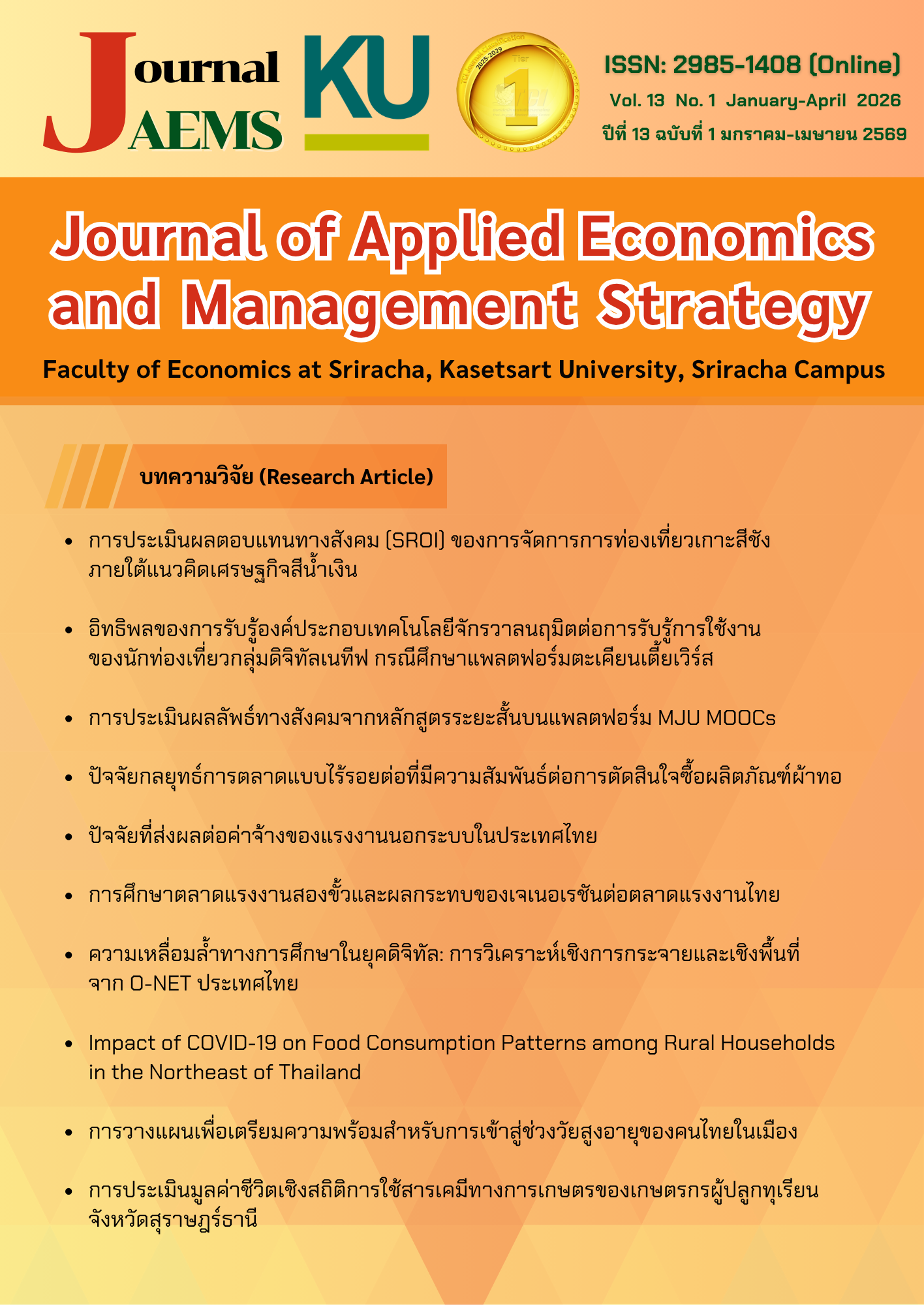
Factors Affecting Informal Worker’s Wage in Thailand
Article Sidebar
Main Article Content
Abstract
This study aims to (1) analyze factors affecting informal workers' wages in Thailand,(2) analyze the differential impacts of various factors on informal workers' wages at different wage levels using alternative econometric approaches, namely Ordinary Least Squares (OLS) and Quantile Regression, and (3) propose guidelines for improving wages and welfare of informal workers. The analysis uses data drawn from the Labor Force Survey for the third quarter of 2022 by the National Statistical Office, with a sample of 31,338 individuals.
The study found that education level is the factor with the highest impact on informal workers' wages. Those with a bachelor's degree or higher earn 79.80% more than those with less than primary education according to the OLS model. Quantile Regression results reveal that returns to education differ significantly across wage levels. The low-wage group (Q25) shows a 65.20% return to bachelor's degree education, while the high-wage group (Q75) shows returns as high as 91.20%, demonstrating that education is creating increasing education premium inequality. Males earn 16.0% more than females (OLS), and this gap increases to 17.2% in the high-wage group (Q75), reflecting a worsening gender wage gap at higher wage levels. Regional inequality remains a significant problem, with the Northern region earning 33.10% less than Bangkok (OLS), and this gap widening to 37.20% in the high-wage group. Private sector employees earn 31.10% less than government employees, and this difference increases to 34.80% in the high-wage group.
The comparison between OLS and Quantile Regression demonstrates that OLS estimates represent only averages that may obscure important differences between low and high wage groups. Using Quantile Regression helps reveal that the impacts of various factors are not equal across all levels of wage distribution, particularly returns to education and skills that increase with wage levels. This study highlights the necessity of designing policies that account for differences across wage groups, rather than adopting a uniform “one-size-fits-all” approach.
Downloads
Article Details

This work is licensed under a Creative Commons Attribution-NonCommercial-NoDerivatives 4.0 International License.




References
ฐิตาวรรณ อินสะอาด ชมพูนุท โกสลากร เพิ่มพูนวิวัฒน์ และกิริยา กุลกลการ. (2565). การวิเคราะห์ปัจจัยที่มีผลต่อค่าจ้างแรงงานหญิงในภาคอุตสาหกรรมการผลิต. วารสารสถาบันพระปกเกล้า, 20(2), 95–120. https://so06.tci-thaijo.org/index.php/kpi_journal/article/view/257342
ธีรธร ยูงทอง. (2557). แรงงานนอกระบบในประเทศไทย: ประเด็นงานวิจัยที่ยังขาดหาย [รายงานฉบับสมบูรณ์]. สถาบันวิจัยประชากรและสังคม มหาวิทยาลัยมหิดล.
เพียงทิพย์ ศรีบุญเรือง และรัชพันธุ์ เชยจิตร (2564). การศึกษาผลกระทบแรงงานข้ามชาติต่ออัตราค่าจ้างเฉลี่ยและชั่วโมงการทำงานของแรงงานนอกระบบ. วารสารรัชต์ภาคย์, 16(48), 496-511. https://so05.tci-thaijo.org/index.php/RJPJ/article/view/259202
ศศิวิมล วรุณศิริ ปวีณวัฒน์. (2565, 29 พฤศจิกายน). สมอง vs กำลัง-แรงงานสองขั้ว อัตราผลตอบแทนของทักษะ และความไม่เท่าเทียมของค่าจ้าง. https://www.pier.or.th/briefs/2022/06/
สำนักงานสถิติแห่งชาติ. (2566). การสำรวจแรงงานนอกระบบ พ.ศ. 2566. สำนักงานสถิติแห่งชาติ.
สำนักงานสถิติแห่งชาติ. (2567). การสำรวจแรงงานนอกระบบ พ.ศ. 2567. สำนักงานสถิติแห่งชาติ.
องอาจ รุกขวัฒนกุล (2558). ปัจจัยที่มีอิทธิพลต่อการเปลี่ยนแปลงรายได้ของประชาชนในพื้นที่การพัฒนาเขตเศรษฐกิจพิเศษ หนองคาย มุกดาหาร แม่สอด. มหาวิทยาลัยธรรมศาสตร์.
Arabsheibani, G. R., & Staneva, A. (2012). Is there an informal employment wage premium? Evidence from Tajikistan (IZA Discussion Paper No. 6727). Institute for the Study of Labor (IZA). DOI: https://doi.org/10.2139/ssrn.2114907
Bago, J. L., Souratié, W. D. M., Ouédraogo, E., & Zahonogo, P. (2022). Human capital and women’s informal work: Theory and evidence. Journal of Economic Development, 47(3), 1–28. https://jed.cau.ac.kr/archives/47-3/47-3-1.pdf
Becker, G. S. (1964). Human capital: A theoretical and empirical analysis, with special reference to education. University of Chicago Press.
Blau, F. D., & Kahn, L. M. (2017). The gender wage gap: Extent, trends, and explanations. Journal of Economic Literature, 55(3), 789–865. https://doi.org/10.1257/jel.20160995 DOI: https://doi.org/10.1257/jel.20160995
Bobba, M., Flabbi, L., & Levy, S. (2019). Labor market search, informality, and on-the-job human capital accumulation (CEPR Discussion Paper No. 13814). Centre for Economic Policy Research. DOI: https://doi.org/10.2139/ssrn.3323206
Chenphuengpawn, J., Partihuttakorn, R., Fakthong, N., & Udomkiattikul, N. (2023). Labour market structure and wage dynamics in Thailand. BIS Papers, 142, 287-296.
Chiswick, B. R. (1978). The effect of Americanization on the earnings of foreign-born men. Journal of Political Economy, 86(5), 897–921. https://is.muni.cz/el/1456/jaro2016/BPE_EKPR/um/55633306/55809248/Chiswick__1978_.pdf DOI: https://doi.org/10.1086/260717
Dasgupta, S., Bhula-or, R., & Fakthong, T. (2015). Earnings differentials between formal and informal employment in Thailand. ILO Asia-Pacific Working Paper Series. International Labour Organization.
De Vreyer, P., & Roubaud, F. (Eds.). (2013). Urban labor markets in Sub-Saharan Africa. The World Bank. DOI: https://doi.org/10.1596/978-0-8213-9781-7
Doeringer, P. B., & Piore, M. J. (1971). Internal labor markets and manpower analysis. D.C. Heath.
García, G. A. (2017). Labor informality: Choice or sign of segmentation? A quantile regression approach at the regional level for Colombia. Review of Development Economics, 21(4), 985-1017. https://doi.org/10.1111/rode.12317 DOI: https://doi.org/10.1111/rode.12317
Harris, J. R., & Todaro, M. P. (1970). Migration, unemployment and development: A two-sector analysis. American Economic Review, 60(1), 126–142. https://www.jstor.org/stable/1807860?seq=1
International Labour Organization. (2020). COVID-19 employment and labour market impact in Thailand. ILO Country Office for Thailand, Cambodia and Lao People's Democratic Republic.
Koenker, R., & Bassett Jr, G. (1978). Regression quantiles. Econometrica: journal of the Econometric Society, 46(1), 33-50. https://doi.org/10.2307/1913643 DOI: https://doi.org/10.2307/1913643
Korenman, S., & Neumark, D. (1991). Does marriage really make men more productive?. Journal of Human Resources, 26(2), 282–307. https://www.jstor.org/stable/pdf/145924.pdf DOI: https://doi.org/10.2307/145924
Korwatanasakul, U. (2021) Determinants, wage inequality, and occupational risk exposure of informal workers: A comprehensive analysis with the case study of Thailand (PIER Discussion Paper, No. 160). Puey Ungphakorn Institute for Economic Research.
Marcouiller, D., Ruiz de Castilla, V., & Woodruff, C. (1997). Formal measures of the informal-sector wage gap in Mexico, El Salvador, and Peru. Economic Development and Cultural Change, 45(2), 367-392. https://chriswoodruff.qeh.ox.ac.uk/wp-content/uploads/2019/10/EDCC-1997-MRW.pdf DOI: https://doi.org/10.1086/452278
Meghir, C., Narita, R., & Robin, J. M. (2015). Wages and informality in developing countries. American Economic Review, 105(4), 1509-1546. https://www.aeaweb.org/articles?id=10.1257/aer.20121110 DOI: https://doi.org/10.1257/aer.20121110
Mincer, J. A. (1974). Schooling, Experience and Earnings. National Bureau of Economic Research. https://www.nber.org/system/files/chapters/c1765/c1765.pdf
Phijaisanit, E., & Komin, W. (2022). Understanding barriers to social insurance enrollment in Thailand (PIER Discussion Paper No. 223). Puey Ungphakorn Institute for Economic Research.
Psacharopoulos, G. (1994). Returns to investment in education: A global update. World Development, 22(9), 1325–1343. https://doi.org/10.1016/0305-750X(94)90007-8 DOI: https://doi.org/10.1016/0305-750X(94)90007-8
Smith, A. (1776). An inquiry into the nature and causes of the wealth of nations. W. Strahan and T. Cadell. DOI: https://doi.org/10.1093/oseo/instance.00043218
Taniguchi, H., & Yamada, K. (2025). The race between technology and woman: Changes in relative wages and labor shares in OECD countries (Working paper). https://arxiv.org/pdf/2005.12600
Tansel, A., & Kan, E. O. (2012). The formal/informal employment earnings gap: Evidence from Turkey (IZA Discussion Paper No. 6556). IZA Institute of Labor Economics. https://docs.iza.org/dp6556.pdf DOI: https://doi.org/10.2139/ssrn.2066979
Ulyssea, G. (2020). Minimum wages, inequality, and the informal sector (IMF Working Paper No. 2020/159). International Monetary Fund.
Vivatsurakit, T. (2019). The roles of informality and labor mismatch on returns to education in Thailand [Doctoral dissertation, Chulalongkorn University]. https://digital.car.chula.ac.th/cgi/viewcontent.cgi?article=9556&context=chulaetd
World Bank. (2024). Gender and informal work in Thailand. World Bank Thailand Office.