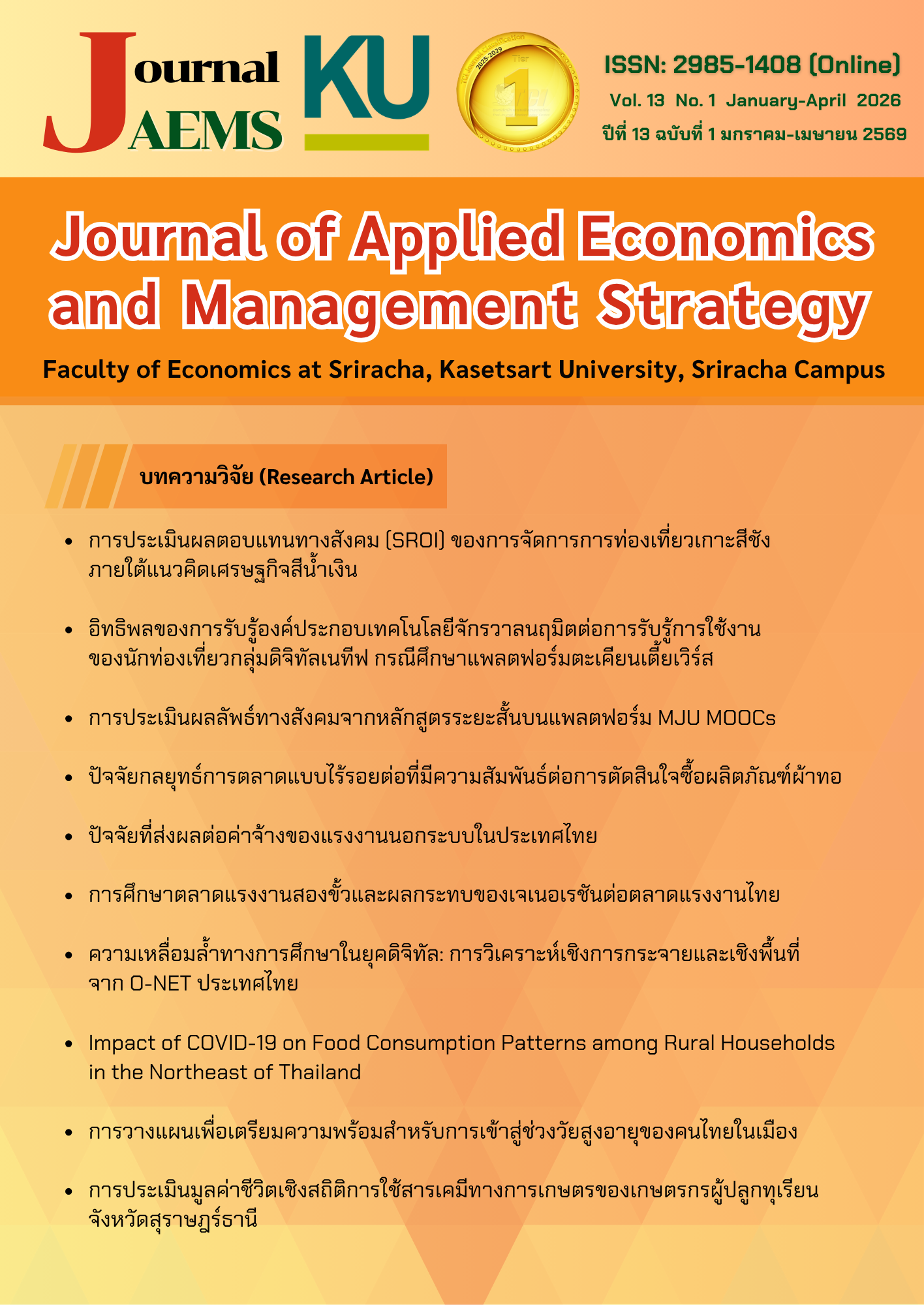
Omni-channel Marketing Strategy Factors Influencing the Purchasing Decisions of Woven Fabric Products
Article Sidebar
Main Article Content
Abstract
This study aimed to (1) compare demographic characteristics of consumers influencing purchasing decisions for woven fabric products, (2) examine consumer behaviors related to purchasing decisions, and (3) investigate omni-channel marketing strategies associated with purchasing decisions for woven fabric products. This quantitative research employed a survey method, collecting data through questionnaires from 400 consumers who had previously purchased woven fabric products via online or offline channels. The data were analyzed using frequency, percentage, mean, standard deviation, one-way analysis of variance (ANOVA), chi-square test, and multiple regression analysis. The findings revealed that 1) demographic factors, including age, education level, income, and occupation, significantly influenced consumers’ purchasing decisions for woven fabric products 2) five dimensions of consumer behavior namely media exposure, perception, attitude, purchasing behavior, and consumer satisfaction were significantly associated with purchasing decisions; and 3) all four dimensions of omni-channel marketing strategy customer reach and connectivity, understanding consumer behavior, delivering consistent and seamless customer experiences, and building customer engagement had a positive relationship with purchasing decisions. Among these factors, delivering a consistent and seamless customer experience was identified as the most influential factor. The results of this study provide practical implications for woven fabric producers and retailers operating in both online and offline channels. The findings can be applied to enhance business operations in alignment with consumer behavior in the digital era, particularly through the development of integrated and seamless omni-channel marketing strategies.
Downloads
Article Details

This work is licensed under a Creative Commons Attribution-NonCommercial-NoDerivatives 4.0 International License.




References
วิศาล ภุชฌงค์ อรณิชชา ทศตา และศิรินธร เอี๊ยบศิริเมธี. (2565). อิทธิพลของกลยุทธ์การตลาดออนไลน์ที่มีต่อพฤติกรรมการตัดสินใจซื้อของผู้บริโภค. วารสารวิชาการมนุษยศาสตร์และสังคมศาสตร์ มหาวิทยาลัยนครราชสีมา, 19(2), 63–81. https://so03.tci-thaijo.org/index.php/hsjournalnmc/article/view/288908
ศูนย์วิเคราะห์เศรษฐกิจ ทีทีบี. (2567, 30 สิงหาคม). ห่วงอุตสาหกรรมสิ่งทอและเครื่องนุ่งห่มไทยเข้าสู่ขาลงในอัตราเร่ง. https://www.ttbbank.com/th/newsroom/detail/ttba-textile-industry-aug-2024
Cochran, W. G. (1977). Sampling techniques (3rd ed.). John Wiley & Sons.
Hair, J. F., Black, W. C., Babin, B. J., & Anderson, R. E. (2019). Multivariate data analysis (8th ed.). Cengage Learning.
Hair, J. F., Hult, G. T. M., Ringle, C. M., & Sarstedt, M. (2022). A primer on partial least squares structural equation modeling (PLS-SEM) (3rd ed.). Sage. DOI: https://doi.org/10.1007/978-3-030-80519-7
Herhausen, D., Binder, J., Schoegel, M., & Herrmann, A. (2015). Integrating bricks with clicks: Retailer-level and channel-level outcomes of online–offline channel integration. Journal of Retailing, 91(2), 309–325. https://doi.org/10.1016/j.jretai.2014.12.009 DOI: https://doi.org/10.1016/j.jretai.2014.12.009
Juaneda-Ayensa, E., Mosquera, A., & Sierra Murillo, Y. (2016). Omnichannel customer behavior: Key drivers of technology acceptance and use and their effects on purchase intention. Frontiers in Psychology, 7, Article 117. https://doi.org/10.3389/fpsyg.2016.01117 DOI: https://doi.org/10.3389/fpsyg.2016.01117
Kotler, P., & Armstrong, G. (2018). Principles of marketing (17th ed.). Pearson Education.
Kotler, P., & Keller, K. L. (2016). Marketing management (15th ed.). Pearson Education.
Lemon, K. N., & Verhoef, P. C. (2016). Understanding customer experience throughout the customer journey. Journal of Marketing, 80(6), 69–96. https://doi.org/10.1509/jm.15.0420 DOI: https://doi.org/10.1509/jm.15.0420
Piotrowicz, W., & Cuthbertson, R. (2014). Introduction to the special issue information technology in retail: Toward omnichannel retailing. International Journal of Electronic Commerce, 18(4), 5–16. https://doi.org/10.2753/JEC1086-4415180400 DOI: https://doi.org/10.2753/JEC1086-4415180400
Potjanajaruwit, P. (2023). Influence of digital marketing on purchasing decisions of internet users in Thailand. Journal of Southwest Jiaotong University, 58(1), 298-308. DOI:10.35741/issn.0258-2724.58.1.23 DOI: https://doi.org/10.35741/issn.0258-2724.58.1.23
Solomon, M. R. (2018). Consumer behavior: Buying, having, and being (12th ed.). Pearson.
Verhoef, P. C., Kannan, P. K., & Inman, J. J. (2015). From multi-channel retailing to omni-channel retailing: Introduction to the special issue on omni-channel retailing. Journal of Retailing, 91(2), 174–181. https://doi.org/10.1016/j.jretai.2015.02.005 DOI: https://doi.org/10.1016/j.jretai.2015.02.005
Yanpitak, P. (2023). The influence of online marketing on online purchasing decisions. Interdisciplinary Academic and Research Journal, 3(6), 1005–1020. https://doi.org/10.60027/iarj.2023.272786 DOI: https://doi.org/10.60027/iarj.2023.272786