A Structural Model of Perceived Value, Perceived Risk, and Trust in Online Technology on Online Motor Insurance Purchase Decisions
Article Sidebar
Main Article Content
Abstract
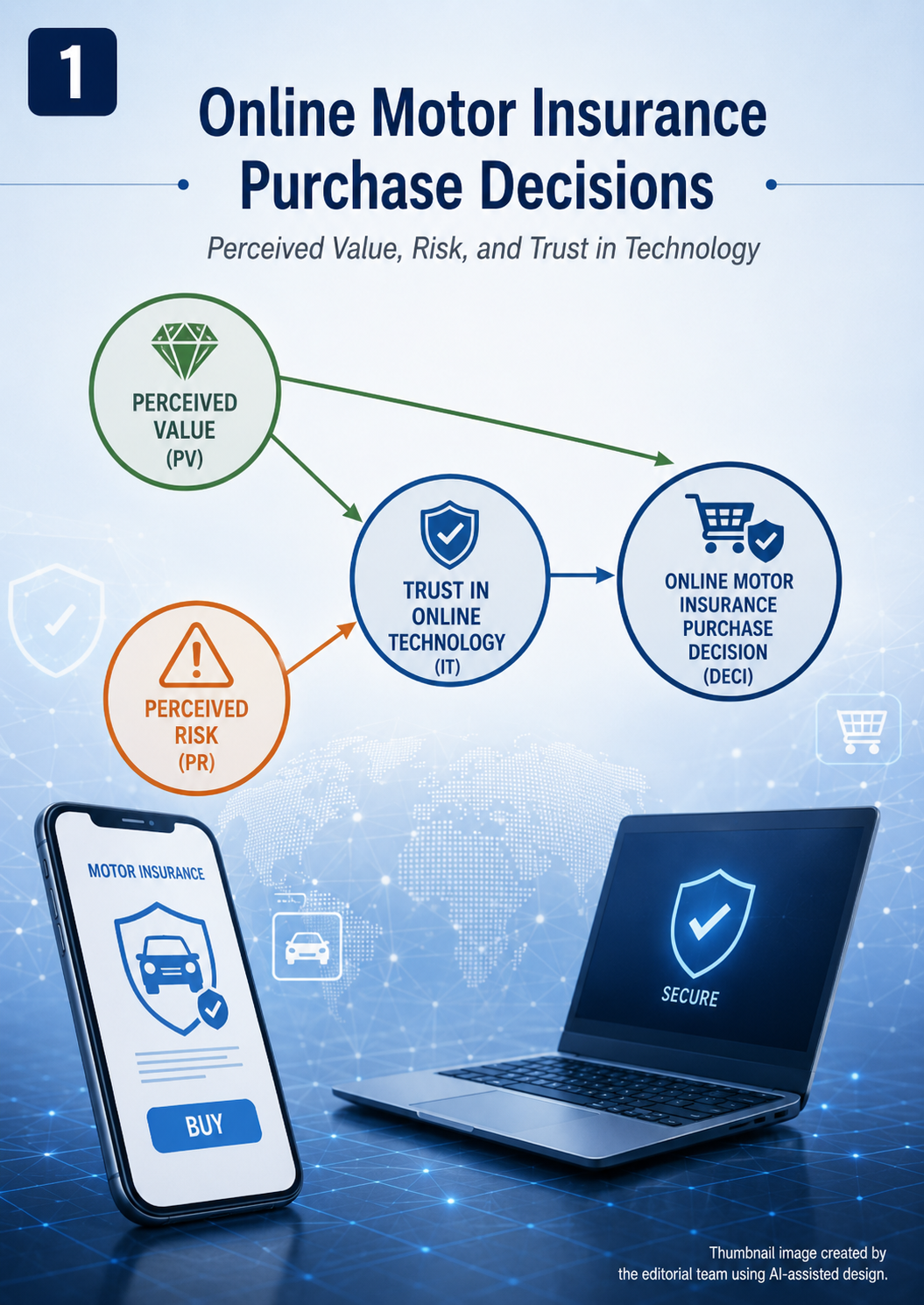
This study examines the factors influencing consumers’ decisions to purchase motor insurance through online channels in Bangkok and its metropolitan area, focusing on perceived value, perceived risk, and trust in online technology. A quantitative approach was employed using a questionnaire survey of 386 policyholders with experience in purchasing motor insurance online, and the data were analyzed using Structural Equation Modeling (SEM). The results indicate that the proposed model demonstrates an acceptable fit with the empirical data (χ2/df = 1.852, CFI = 0.942, GFI = 0.953, AGFI = 0.903, RMSEA = 0.043). Perceived value has a positive direct effect on trust in online technology and online purchase decision, whereas perceived risk has a negative direct effect on trust in online technology. Trust in online technology also positively influences online purchase decision and mediates the effects of perceived value and perceived risk on online purchase decision. The findings provide strategic implications for the development of online insurance platforms by emphasizing system security, transparency, user-friendly design, and clear communication to enhance perceived value, reduce perceived risk, and strengthen trust in online technology.
Downloads
Article Details

This work is licensed under a Creative Commons Attribution-NonCommercial-NoDerivatives 4.0 International License.




References
ธนาคารแห่งประเทศไทย. (2568). ทิศทางการพัฒนาระบบการชำระเงินภายใต้ภูมิทัศน์ภาคการเงินไทย. ธนาคารแห่งประเทศไทย. https://www.bot.or.th/content/dam/bot/documents/th/our-roles/payment-systems/payment-systems-policy/payment-directional-paper-2568-th.pdf
ทริสเรทติ้ง. (2568). Industry analysis and outlook: แนวโน้มธุรกิจกลุ่มบริษัทประกันภัย. บริษัท ทริสเรทติ้ง จำกัด. https://media.setgroup.or.th/setlink/Documents/2025/Apr/แนวโน้มธุรกิจกลุ่มบริษัทประกันภัย.pdf
อรรถเดช สรสุชาติ. (2563). สถิติประยุกต์และระเบียบวิธีวิจัย. กรีนเนสไวด์ จำกัด.
Abdullah, S., Diposumarto, N. S., & Muharam, H. (2025). The role of exploration e-WOM to improve purchasing decision for online retail insurance products in Indonesia. Research Horizon, 5(3), 607–620. https://doi.org/10.54518/rh.5.3.2025.607
Aina, J. (2025). Digital transformation in life insurance marketing: Examining new age advertisement strategies adoption in Nigeria’s insurance sector. JABU International Journal of Social and Management Sciences, 9(2), 53–66. https://jabu.edu.ng/wp-content/uploads/2025/06/4.-Digital-Transformation-in-Life-Insurance-Marketing-Examining-New-Age-Advertisement-Strategies-Adoption-in-Nigerias-Insurance-Sector.pdf
Baidoun, S. D., & Salem, M. Z. (2024). The moderating role of perceived trust and perceived value on online shopping behavioral intention of Palestinian millennials during COVID-19. Competitiveness Review, 34(1), 125–143. https://doi.org/10.1108/CR-10-2022-0161
Baranauskas, G., & Raišiene, A. G. (2021). Reflections on the customer decision-making process in the digital insurance platforms: An empirical study of the Baltic market. Applied Sciences, 11(18), 8524. https://doi.org/10.3390/app11188524
Bauer, R. A. (1967). Consumer behavior as risk taking. In D. F. Cox (Ed.), Risk Taking and Information Handling in Consumer Behavior. Cambridge, Harvard University Press.
Bollen, K. A. (1989). Structural equations with latent variables. John Wiley & Sons.
Blackwell, R. D., Miniard, P. W., & Engel, J. F. (2006). Consumer behavior (10th ed.). Mason, OH: Thomson South-Western.
Braun, A., & Jia, R. (2025). InsurTech: Digital technologies in insurance. The Geneva Papers on Risk and Insurance – Issues and Practice, 50(1), 1–7. https://doi.org/10.1057/s41288-024-00344-x
Byrne, B. M. (2010). Structural equation modeling with AMOS: Basic concepts, applications, and programming (2nd ed.). Routledge.
Cooper, D. R., Schindler, P. S., & Sun, J. (2006). Business research methods (9th ed.). McGraw-Hill.
Cronbach, L. J. (1960). Essentials of psychological testing (2nd ed.). Harper & Row.
Davis, F. D. (1989). Perceived usefulness, perceived ease of use, and user acceptance of information technology. MIS Quarterly, 13(3), 319–340. https://doi.org/10.2307/249008
Gefen, D., Karahanna, E., & Straub, D. W. (2003). Trust and TAM in online shopping: An integrated model. MIS Quarterly, 27(1), 51–90. https://doi.org/10.2307/30036519
Goel, A., Soti, N., Taneja, U., & Kumar, A. (2025). Decoding consumer perspective for tech-based health insurance products. Innovation & Management Review, 22(4), 251–265. https://doi.org/10.1108/inmr-10-2023-0191
Hair, J. F., Black, W. C., Babin, B. J., & Anderson, R. E. (2019). Multivariate data analysis (8th ed.). Cengage Learning.
Hanaysha, J. R., Chen, C. L., Rahim, N. F. A., Salamzadeh, Y., & Hasouneh, L. O. (2023). Determinants of online purchase intention toward life insurance in Malaysia: Moderating role of trust. Jindal Journal of Business Research, 12(2), 233–250. https://doi.org/10.1177/22786821231189377
Jiang, S., Liu, X., Liu, N., & Xiang, F. (2019). Online life insurance purchasing intention: Applying the unified theory of acceptance and use of technology. Social Behavior and Personality: An International Journal, 47(7), 1–13. https://doi.org/10.2224/sbp.8141
Kim, E., & Kim, Y. (2025). Determinants of user acceptance of digital insurance platform service on InsurTech: An empirical study in South Korea. Asian Journal of Technology Innovation, 33(1), 45–75. https://doi.org/10.1080/19761597.2024.2337629
Kline, R. B. (2016). Principles and practice of structural equation modeling (4th ed.). The Guilford Press.
Kwasniok, S. (2025). Planned behavior, insurance knowledge and the demand for private disability insurance – Evidence from Germany. ZBW – Leibniz Information Centre for Economics, Kiel & Hamburg. https://hdl.handle.net/10419/321819
Likert, R. (1961). New patterns of management. McGraw-Hill.
Lin, C. H., Shih, K. H., Wang, W. C., Chuang, L. F., Tsai, W. C., & Huang, C. (2020). Factors influencing the purchase of travel insurance over mobile banking. International Journal of Mobile Communications, 18(2), 158-174. https://doi.org/10.1504/ijmc.2020.105843
Lu, H., Hsu, C., & Hsu, H. (2005). An empirical study of the effect of perceived risk upon intention to use online applications. Information Management and Computer Security, 13(2), 106–120. https://doi.org/10.1108/09685220510589299
Luo, C., Chen, Q., Zhang, Y., & Xu, Y. (2021). The effects of trust on policyholders’ purchase intentions in an online insurance platform. Emerging Markets Finance and Trade, 57(15), 4167–4184. https://doi.org/10.1080/1540496X.2019.1695122
Pavlou, P. A. (2003). Consumer acceptance of electronic commerce: Integrating trust and risk with the technology acceptance model. International Journal of Electronic Commerce, 7(3), 101–134. https://doi.org/10.1080/10864415.2003.11044275
Pentz, C. D., Preez, R. D., & Swiegers, L. (2020). To bu(y) or not to bu(y): Perceived risk barriers to online shopping among South African generation Y consumers. Cogent Business & Management, 7(1), 1827813. https://doi.org/10.1080/23311975.2020.1827813
Schiffman, L. G., & Wisenblit, J. (2019). Consumer behavior (12th ed.). Pearson.
Schumacker, R. E., & Lomax, R. G. (2010). A beginner's guide to structural equation modeling (3rd ed.). Routledge.
Singh, S. & Ahmad, I. (2025). Innovating insurance services: Enhancing perceived value and customer satisfaction through service innovation. Acta Universitatis Bohemiae Meridionalis 28(1), 55-71. DOI:10.32725/acta.2025.004
Sirdeshmukh, D., Singh, J., & Sabol, B. (2002). Consumer trust, value, and loyalty in relational exchanges. Journal of Marketing, 66(1), 15–37. DOI:10.1509/jmkg.66.1.15.18449
Solomon, M., & Russell, C. A. (2024). Consumer behavior: Buying, having, and being (Global ed.). Pearson Education Limited.
Suvittawat, A., & Suvittawat, N. (2026). Modeling electric vehicle adoption in Thailand: The impact of ecosystem and policy support via perceived value and charging anxiety. World Electric Vehicle Journal, 17(4), 166. https://doi.org/10.3390/wevj17040166
Umran, M. F., Maupa, H., Irawan, A. P., & Sadat, A. M. (2025). Factors influencing the intention to use insurance technology (Insurtech) among generation Z using the extended D-M model. Journal of Applied Data Sciences, 6(2), 1301–1318. https://doi.org/10.47738/jads.v6i2.726
Yin, J., & Qiu, X. (2021). AI technology and online purchase intention: Structural equation model based on perceived value. Sustainability, 13(10), 5671. https://doi.org/10.3390/su13105671
Zeithaml, V. A. (1988). Consumer perceptions of price, quality, and value: A means–end model and synthesis of evidence. Journal of Marketing, 52(3), 2–22. https://www.jstor.org/stable/1251446