The Economic Value of Coral Reefs: The Case Study of Mu Ko Chang National Park, Trat Province, Thailand
Article Sidebar
Main Article Content
Abstract
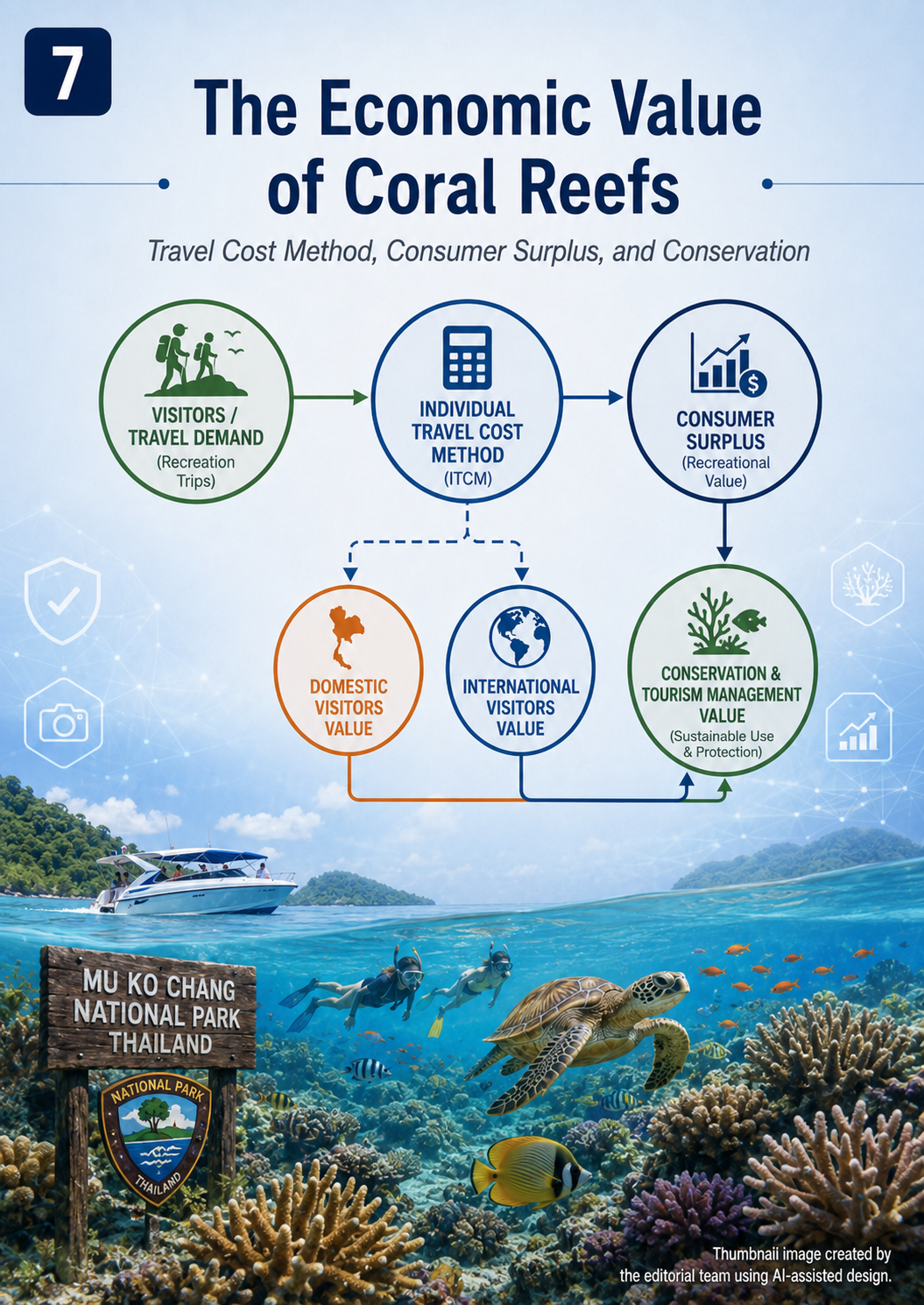
The past decade has witnessed a substantial rise in ecotourism, providing a major economic boost to many developing countries, including Thailand's second-largest island, Ko Chang in Trat Province. Protected areas like Mu Ko Chang National Park face critical challenges in reconciling economic development with conservation. This paper contributes to understanding the role of economic analysis in protected area management by estimating the recreational benefit (consumer surplus) of the coral reefs in Mu Ko Chang, Trat province, using the Individual Travel Cost Method (ITCM). Data were collected via direct interviews with 592 visitors. The results indicate that the recreational services of the park generate an estimated annual consumer surplus of 2,025.92 million Baht (USD 61.73 million), of which international visitors account for the largest share (1,298.13 million Baht). The present recreational value over 30 years is calculated to be 25,139.48 million Baht (USD 794.75 million) (using a 7% discount rate). Crucially, demand analysis revealed distinct market behaviors: Domestic demand aligns with a normal good and is inelastic to price, while international demand is negatively income elastic (indicating substitution as wealth rises) but strongly and positively driven by educational attainment. The findings demonstrate the substantial economic importance of coral reef ecosystems and support the implementation of a tiered entrance fee system and conservation funding mechanisms to enhance sustainable tourism management and long-term marine ecosystem conservation.
Downloads
Article Details

This work is licensed under a Creative Commons Attribution-NonCommercial-NoDerivatives 4.0 International License.




References
Al Ismaili, S., Al Abri, I., Gulseven, O., Al-Masroori, H., & Dutta, S. (2024). Recreational value of different coral reefs richness levels in Oman. Journal of Outdoor Recreation and Tourism, 46, Article 100775. https://doi.org/https://doi.org/10.1016/j.jort.2024.100775
Bateman, I., Carson, R., Day, B., Hanemann, M., Hanley, N., Hett, T., Jones-Lee, M., & Loomes, G. (2002). Economic Valuation with Stated Preference Techniques. Edward Elgar Publishing. https://EconPapers.repec.org/RePEc:elg:eebook:2639
Bateman, I. J., Carson, R. T., Day, B., Hanemann, W. M., Hanley, N., Hett, T., & Ozdemiroglu, E. (2002). Economic valuation with stated preference techniques: A manual. Edward Elgar.
Bateman, I. J., Willis, K. G., Bateman, I. J., & Willis, K. G. (2011). Valuing environmental preferences: Theory and practice of the contingent valuation method. Oxford University Press.
Bradford, J. F., & Herrmann, W. A. (2021). Thailand’s Maritime Strategy. Journal of Indo-Pacific Affairs, 4(9), 29-46. https://media.defense.gov/2026/Jan/14/2003856279/-1/-1/0/JIPA%20WINTER%202021.PDF
Chamchoy, C., Yeemin, T., Klinthong, W., Aunkhongthong, W., Phoaduang, S., Ruangthong, C., Damphupha, P., & Sutthacheep, M. (2018). Coral recovery trends in Mu Ko Chang National Park, the Eastern Gulf of Thailand. Ramkhamhaeng International Journal of Science and Technology, 1(2), 15-24. https://ph02.tci-thaijo.org/index.php/RIST/article /view/245862
Chariyaphan, R. (2012). Thailand’s country profile 2012. Department of Disaster Prevention and Mitigation, Ministry of Interior, Thailand. https://web.adrc.asia/countryreport/THA/2012/THA_CR2012B.pdf
Clawson, M., & Knetsch, J. L. (1966). Economics of outdoor recreation. Johns Hopkins Press. Department of Marine and Coastal Resources, (2022). Knowledge management: coral reef. https://km.dmcr.go.th/c_3
Department of National Parks Wildlife and Plant Conservation. (2025). Mu Ko Chang National Park. https://portal.dnp.go.th/Content/nationalpark?contentId=971
Englong, A., Punwong, P., Selby, K., Marchant, R., Traiperm, P., & Pumijumnong, N. (2019). Mangrove dynamics and environmental changes on Koh Chang, Thailand during the last millennium. Quaternary International, 500, 128-138. https://doi.org/https://doi.org/10.1016/j.quaint.2019.05.011
Fezzi, C., Ford, D. J., & Oleson, K. L. L. (2023). The economic value of coral reefs: Climate change impacts and spatial targeting of restoration measures. Ecological Economics, 203, Article 107628. https://doi.org/https://doi.org/10.1016/j.ecolecon.2022.107628
Fonner, R., Bellanger, M., & Warlick, A. (2020). Economic analysis for marine protected resources management: challenges, tools, and opportunities. Ocean & Coastal Management, 194, Article 105222. DOI: 10.1016/j.ocecoaman.2020.105222
Freeman, A. M., Herriges, J. A., & Kling, C. L. (2014). The measurement of environmental and resource values: theory and methods. Routledge.
Gibbons, S., Mourato, S., & Resende, G. M. (2014). The amenity value of english nature: A hedonic price approach. Environmental and Resource Economics, 57(2), 175-196. https://doi.org/10.1007/s10640-013-9664-9
Google. (2024). Mu Ko Chang National Park, Trat, Thailand [Map]. Google Maps. https://maps.app.goo.gl/uA9ceRwXNikbSf988
Halaburka, B. J., Lawrence, J. E., Bischel, H. N., Hsiao, J., Plumlee, M. H., Resh, V. H., & Luthy, R. G. (2013). Economic and ecological costs and benefits of streamflow augmentation using recycled water in a California coastal stream. Environmental science & technology, 47(19), 10735-10743. DOI: 10.1021/es305011z.
Hoegh-Guldberg, O., Poloczanska, E. S., Skirving, W., & Dove, S. (2017). Coral Reef Ecosystems under Climate Change and Ocean Acidification [Review]. Frontiers in Marine Science, 4, Article 158. https://doi.org/10.3389/fmars.2017.00158
IPBES, W. (2019). Intergovernmental science-policy platform on biodiversity and ecosystem services (Summary for policy makers of the global assessment report on biodiversity and ecosystem services of the intergovernmental science-policy platform on biodiversity and ecosystem services). IPBES Secretariat, Bonn, Germany, Issue.
Menegaki, A. N., Tiwari, A. K., & Agiomirgianakis, G. M. (2020). Asymmetries in European inbound and outbound tourism: Normal, luxury or inferior good? Fresh evidence from a quantile regression. European journal of tourism research, 25, Article 2508. https://doi.org/10.54055/ejtr.v25i.423
Millennium Ecosystem Assessment. (2005). Ecosystems and human well-being (Vol. 5). Island Press.
Office of the National Economic and Social Development Council. (2024). Manual of guidelines and criteria for project analysis (Revised Edition B.E.2567). Bangkok, Thailand: Office of the National Economic and Social Development Council (NESDC)
Owuor, M. A., Mulwa, R., Otieno, P., Icely, J., & Newton, A. (2019). Valuing mangrove biodiversity and ecosystem services: A deliberative choice experiment in Mida Creek, Kenya. Ecosystem Services, 40, Article 101040. https://doi.org/https://doi.org/10.1016/j.ecoser.2019.101040
Piriyapada, S., & Wang, E. (2015). Modeling Willingness to Pay for Coastal Tourism Resource Protection in Ko Chang Marine National Park, Thailand. Asia Pacific Journal of Tourism Research, 20(5), 515-540. https://doi.org/10.1080/10941665.2014.904806
Roman, G., Dearden, P., & Rollins, R. (2004). Zoning to manage recreation at coral reefs: a case study of Koh Chang National Marine Park, Thailand. Marine Protected Area Research Group.
Seenprachawong, U. (2016). An Economic Analysis of Coral Reefs in the Andaman Sea of Thailand. In N. Olewiler, H. A. Francisco, & A. J. G. Ferrer (Eds.), Marine and Coastal Ecosystem Valuation, Institutions, and Policy in Southeast Asia (pp. 31-45). Springer Singapore. https://doi.org/10.1007/978-981-10-0141-3_3
Tamayo, N. C. A., Anticamara, J. A., & Acosta-Michlik, L. (2018). National Estimates of Values of Philippine Reefs' Ecosystem Services. Ecological Economics, 146, 633-644. https://doi.org/https://doi.org/10.1016/j.ecolecon.2017.12.005
Thai National Parks. (2024). About Ko Chang. Thai National Parks. www.thainationalparks.com/mu-ko-chang-national-park
Van Beukering, P., & Cesar, H. (2010). Economic valuation of the coral reefs of Hawai ‘i. In: Geneva: The Economics of Ecosystems and Biodiversity.
Wooldridge, J. M. (2016). Introductory econometrics a modern approach. South-Western cengage learning.
Zambrano-Monserrate, M. A., Silva-Zambrano, C. A., & Ruano, M. A. (2018). The economic value of natural protected areas in Ecuador: A case of Villamil Beach National Recreation Area. Ocean & Coastal Management, 157, 193-202. https://doi.org/https://doi.org/10.1016/j.ocecoaman.2018.02.020