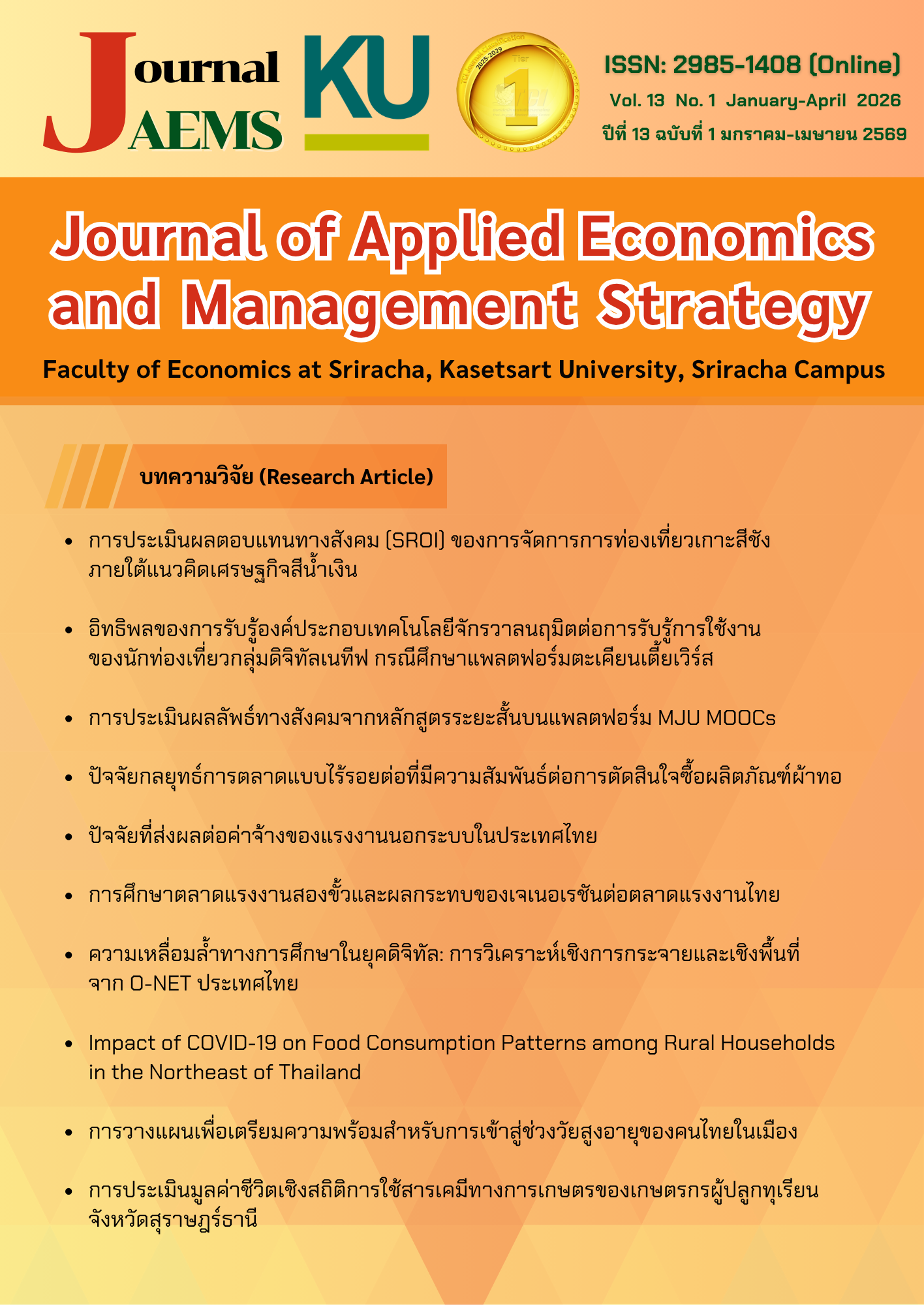
อิทธิพลของการรับรู้องค์ประกอบเทคโนโลยีจักรวาลนฤมิตต่อการรับรู้การใช้งาน ของนักท่องเที่ยวกลุ่มดิจิทัลเนทีฟ กรณีศึกษาแพลตฟอร์มตะเคียนเตี้ยเวิร์ส
##plugins.themes.bootstrap3.article.sidebar##
##plugins.themes.bootstrap3.article.main##
บทคัดย่อ
การเปลี่ยนแปลงบทบาทของเทคโนโลยีต่อการท่องเที่ยว นำมาสู่วัตถุประสงค์การวิจัยเพื่อศึกษาระดับการรับรู้องค์ประกอบของเทคโนโลยีจักรวาลนฤมิตหรือเมตาเวิร์ส (Metaverse) และระดับการรับรู้การใช้งานของนักท่องเที่ยวกลุ่มดิจิทัลเนทีฟ ในแพลตฟอร์มตะเคียนเตี้ยเวิร์ส และเพื่อตรวจสอบอิทธิพลของการรับรู้องค์ประกอบของเทคโนโลยี Metaverse กับการรับรู้การใช้งานของนักท่องเที่ยวกลุ่มดิจิทัลเนทีฟ เลือกตัวอย่างจากนักท่องเที่ยวกลุ่มดิจิทัลเนทีฟที่เคยมีประสบการณ์การใช้แพลตฟอร์มตะเคียนเตี้ยเวิร์ส อย่างน้อย 1 ครั้ง จำนวน 353 คน เก็บข้อมูลโดยใช้แบบสอบถาม วิเคราะห์ข้อมูลด้วยสถิติเชิงพรรณนาในการหาค่าเฉลี่ย ค่าส่วนเบี่ยงเบนมาตรฐาน และสถิติเชิงอนุมานในแบบจำลองสมการโครงสร้างเพื่อเปรียบเทียบเกณฑ์ที่ยอมรับได้
ผลการวิจัยพบว่า นักท่องเที่ยวกลุ่มดิจิทัลเนทีฟมีระดับการรับรู้องค์ประกอบของเทคโนโลยี Metaverse ด้านผู้ใช้งานเป็นผู้กำหนดมีค่าเฉลี่ยสูงที่สุด ( M = 3.90) และระดับการรับรู้การใช้งานด้านการใช้สัญลักษณ์เดียวกันตลอดการใช้งานมีค่าเฉลี่ยสูงสุด ( M =4.03) โดยข้อมูลทั้ง 2 ตัวแปร มีการแจกแจงแบบปกติอยู่ในเกณฑ์ที่ยอมรับได้ สามารถนําไปพัฒนาโมเดลได้ ซึ่งโมเดลที่พัฒนาขึ้นมีความสอดคล้องกลมกลืนกับข้อมูลเชิงประจักษ์ (Chi-quare=1,449.405, df=610, χ²/df = 2.45, CFI = 0.928, TLI = 0.921, RMSEA = 0.063, RMR = 0.037) นอกจากนี้การรับรู้องค์ประกอบของเทคโนโลยี Metaverse มีอิทธิพลทางตรงเชิงบวกต่อการรับรู้การใช้งานของนักท่องเที่ยวกลุ่มดิจิทัลเนทีฟ (β = 0.770) อย่างมีนัยสำคัญทางสถิติที่ระดับ 0.001 โดยการรับรู้องค์ประกอบของเทคโนโลยี Metaverse อธิบายการรับรู้การใช้งานของนักท่องเที่ยวกลุ่มดิจิทัลเนทีฟได้ ร้อยละ 59.3 ดังนั้นผลการวิจัยนี้สามารถนำไปใช้เป็นแนวทางในการพัฒนาการท่องเที่ยวดิจิทัลควรให้ความสำคัญกับ การออกแบบและสื่อสารคุณลักษณะของแพลตฟอร์ม Metaverse ให้ผู้ใช้งานรับรู้ได้อย่างชัดเจน ซึ่งจะช่วยเพิ่มการรับรู้คุณค่าของแพลตฟอร์มและส่งเสริมการยอมรับการใช้งานในระยะยาว
##plugins.generic.usageStats.downloads##
##plugins.themes.bootstrap3.article.details##

This work is licensed under a Creative Commons Attribution-NonCommercial-NoDerivatives 4.0 International License.




เอกสารอ้างอิง
Baker, J., Nam, K., & Dutt, C. S. (2023). A user experience perspective on heritage tourism in the metaverse: Empirical evidence and design dilemmas for VR. Information Technology & Tourism, 25, 265–306. https://doi.org/10.1007/s40558-023-00256-x
Bollen, K.A. (1989) Structural equations with latent variables. John Wiley and Sons.
Boone, H., & Boone, D. (2012). Analyzing likert data. Journal of Extension, 50(2), Article 48. https://doi.org/10.34068/joe.50.02.48
Browne, M. W., & Cudeck, R. (1993). Alternative ways of assessing model fit. In K. A. Bollen & J. S. Long (Eds.), Testing structural equation models (pp. 136–162). Sage.
Cohen, J. (1988). Statistical Power Analysis for the Behavioral Sciences (2nd ed.). Lawrence Erlbaum Associates.
Davis, F. D. (1989). Perceived usefulness, perceived ease of use, and user acceptance of information technology. MIS Quarterly, 13(3), 319–340. https://doi.org/10.2307/249008
Debnath, C., & Srivastava, A. (2025). Metaverse in tourism and hospitality: A framework-based systematic review. Human Behavior and Emerging Technologies, 2025, Article 6662141. https://doi.org/10.1155/hbe2/6662141
Ezzatian, S., Toghraee, M. T., & Farsani, N. T. (2025). Branding tourism destinations in the metaverse: Insights from professionals and researchers. Journal of Tourism Future, 2025, 1-25. https://doi.org/10.1108/JTF-08-2024-0176
George, D., & Mallery, M. (2010). SPSS for Windows step by step: A simple guide and reference (10th ed.). Pearson.
Hair, J. F., Black, W. C., Babin, B. J., & Anderson, R. E. (2014). Multivariate data analysis (7th ed.). Pearson Education.
Hair, J. F., Black, W. C., Babin, B. J., & Anderson, R. E. (2019). Multivariate data analysis (8th ed.). Cengage Learning.
Jatturat, P., & Na-Talang, C. (2022). Behavior of Thai tourists visiting cultural attractions in community-based Bangkok. Dusit Thani College Journal, 16(2), 50–64. https://so01.tci-thaijo.org/index.php/journaldtc/article/view/262397
Jiang, C., Phoong, S. W., & Moghavvemi, S. (2025). Cultural odyssey in the metaverse: Investigating the impact of virtual technologies on tourist reuse behavior and social sustainability. Humanities and Social Sciences Communications, 12, Article 866. https://doi.org/10.1057/s41599-025-05132-z
Joshi, A., Kale, S., Chandel, S., & Pal, D. K. (2015). Likert scale: Explored and explained. British Journal of Applied Science & Technology, 7(4), 396-403. https://doi.org/10.9734/BJAST/2015/14975
Kendrick, A. (2021). 10 usability heuristics applied to virtual reality. Nielsen Norman Group.
Kline, R. B. (2023). Principles and practice of structural equation modeling. Guilford Press.
Lee, L. H., Braud, T., Zhou, P. Y., Wang, L., Xu, D., Lin, Z., Kumar, A., Bermejo, C., & Hui, P. (2021). All one needs to know about metaverse: A complete survey on technological singularity, virtual ecosystem, and research agenda. Journal of Latex Class Files, 14(8). DOI:10.13140/RG.2.2.11200.05124/8
Liu, H., & Park, K. S. (2024). Exploring the impact of metaverse tourism experiences on actual visit intentions: An integrated model of presence, the technology acceptance model, and the theory of planned behavior. International Journal of Tourism Research, 26(1), Article e2616. https://doi.org/10.1002/jtr.2616
Mehmood, K., Rehman, M. A., Rafi, A., & Mogaji, E. (2024). Amplifying personalized experiences in the metaverse: A tourism and hospitality perspective. In H. Ramkissoon, R. Singh, & J. Iqbal (Eds.), A research agenda for tourism, hospitality and the metaverse (pp. 9–24). Edward Elgar Publishing. https://doi.org/10.4337/9781035328222.00006
Nielsen, J. (1994). Usability engineering. Morgan Kaufmann.
Norman, D. A. (2013). The design of everyday things (Revised and expanded ed.). Basic Books.
Nunnally, J., & Bernstein, I. (1994). Psychometric theory (3rd ed.). McGraw-Hill.
Omar, K., Fakhouri, H., Zraqou, J., & Marx Gómez, J. (2024). Usability heuristics for metaverse. Computers, 13(9), Article 222. https://doi.org/10.3390/computers13090222
Polit, D. F., & Beck, C. T. (2012). Nursing research: Generating and assessing evidence for nursing practice (9th ed.). Wolters Kluwer.
Pyae, A., Ravyse, W., Luimula, M., Pizarro-Lucas, E., Sanchez, P. L., Dorado-Diaz, I. P., & Thaw, A. K. (2023). Exploring user experience and usability in a metaverse learning environment for students: A usability study of the artificial intelligence, innovation, and society (AIIS). Electronics, 12(20), Article 4283. https://doi.org/10.3390/electronics12204283
Reis, I. W., Romeiro, A. E., Berg, C. H., & Ulbricht, V. R. (2024). Sociodigital experiences and creativity in the metaverse: An integrative review. Heliyon, 10(7). Article e29047. https://doi.org/10.1016/j.heliyon.2024.e29047
Schreiber, J. B., Nora, A., Stage, F. K., Barlow, E. A., & King, J. (2006). Reporting structural equation modeling and confirmatory factor analysis results. Journal of Educational Research, 99(6), 323–338. https://doi.org/10.3200/JOER.99.6.323-338
Schumacher, R. E., & Lomax, R. G. (2004). A beginner’s guide to structural equation modeling (2nd ed.). Lawrence Erlbaum Associates.
She, S., Li, X., & Li, Y. (2025). Exploring the metaverse tourism experience and its driving forces. Current Issues in Tourism. 1–24. https://doi.org/10.1080/13683500.2025.2530588
Shin, D. (2022). The actualization of meta affordances: conceptualizing affordance actualiztion in the metaverse games 1. Computers in Human Behavior, 133, 107292. https://doi.org/10.1016/j.chb.2022.107292
Sriharun, P., & Kampetch, P. (2020). Community tourism: A new alternative to sustainability. Dusit Thani College Journal, 12(3), 118–132. https://so01.tci-thaijo.org/index.php/journaldtc/article/view/240952
Wu, Q., Li, M. Q., & Wang, J. H. (2024). Behavioral intentions in metaverse tourism : an extended technology acceptance model with flow theory. Information, 15(10), Article 632. https://doi.org/10.3390/info15100632
Wunderman Thompson. (2022). Into the metaverse: A consumer guide to the future of the internet. https://geraldferreira.com/wp-content/uploads/2022/07/wunderman-thompson-into-the-metaverse.pdf